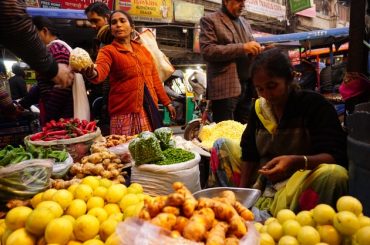

Ask any Indian who grew up in a mid-sized city or a metro before the 2010s, and they will tell you the same story, word for word.
Saturday mornings meant the market (the real “mandi” market). The one that smelled of wet mud and marigolds, where vendors sat behind mountains of cauliflower. You went with your grandfather, or your grandmother, or with both if you were lucky. The vegetable vendor knew your family by name. You could inspect everything before you bought anything. You could press the tomatoes to check for firmness. You could hold the bitter gourd up to the light to spot blemishes. You peeled back a layer of the onion just to see what was underneath. The vendor watched you do all of this and said nothing, because this was simply how things worked. You walked home with a cloth bag, a pocket lighter by fifty rupees, and the quiet, unspoken satisfaction of someone who had done the weekly grocery shopping the right way.
That experience was never really about vegetables and fruits. It was about the texture of how Indian households operated, slow, tactile, deeply relational, and built on a rhythm that repeated itself every single week without much question. And now, for a very large and growing number of Indian families, it has evolved.
Consider what has happened to the Indian family itself. In 2019, India had approximately 183 million nuclear families, by 2030 – that number is projected to reach 263 million. That is 80 million additional nuclear households in just over a decade. To understand what that means in practice: when the joint family breaks into smaller units, the informal labour that once sustained it, the grandmother who had time to go to the market every morning, the aunt who could watch the children while someone else cooked, disappears. Each smaller household must do everything on its own, with fewer people and less time.
Meanwhile, the economic profile of these households is rising. The middle class (households with the income to make discretionary consumption choices) grew from 50 million households in 2019 to 68 million in 2024 and is expected to reach 98 million by 2030. These are households that are not just surviving but actively spending, on better food, better appliances, better experiences. They have money in a way that earlier generations simply did not. Also, both partners are increasingly working. Commutes in Indian cities are punishing. The mental load of running a modern household, managing children’s schooling, and maintaining a career simultaneously leaves very little room for rituals that require physical presence and unstructured time.
And then there is the women’s workforce participation story, which tends to get underreported in conversations about consumer behaviour. Over the past five years, women’s participation in India’s formal workforce has grown at approximately 17% per year. The woman who was once, by social default, the manager of the household’s food procurement, the one who knew which vendor had the best spinach on a Wednesday, who could tell a good batch of beans from a mediocre one just by looking, is no longer available to do that job at 9 AM on a weekday morning, or even on Saturday. That role does not simply disappear. It must be replaced. And increasingly, it is being replaced by an app.
When you put all of this together, smaller families, rising incomes, two working adults, compressed time, what you get is not a preference for convenience. You get a structural necessity for it. The shift away from the “sabziwala” is not a statement about modernity or aspiration. It is a straightforward arithmetic problem: there are not enough hours in the week to do it the old way anymore.
This is the gap that two entirely new ways of buying food have stepped into.
The first is quick commerce. Platforms like Blinkit, Zepto, Swiggy Instamart, and Flipkart Minutes have built a delivery model that would have seemed like science fiction to anyone shopping at a sabzi mandi in 2005. You open an app, pick your vegetables, pay, and a delivery executive is at your door in ten minutes. What makes this possible is an entirely new physical infrastructure, thousands of small, strategically located dark stores, stocked with fast-moving inventory.
The second is food services, a category that has exploded in the last decade and continues to grow at a pace that most traditional food businesses find disorienting. This is the world of cloud kitchens, delivery-first restaurant brands, and organised dine-in chains. Companies like Rebel Foods, which operates over a dozen brands out of a single kitchen, or Cure Foods, or Jubilant Foodworks. When you order biryani or a burger through Swiggy or Zomato, the kitchen that made it is almost certainly a professionally run operation that sources its ingredients not from a local mandi but from a supplier who can guarantee that every ingredient meets the same specification, every time, across every city. These businesses cannot afford the variability of traditional produce sourcing.
Together, these two channels, quick commerce and food services, are not a generational trend that will peak and correct. They are the new architecture of how urban India feeds itself. And they are growing at a rate that makes the question of what powers them, what sits behind them, what ensures their supply chains can deliver on their promises, increasingly urgent.
This is where the story gets interesting.
During every gold rush, it is the prospectors who get the headlines. In India’s quick commerce and food services boom, the press belongs to the apps, the funding announcements, the promise of delivery in ten minutes flat. Every new city launch gets a press release.
India’s quick commerce and food services revolution has its own “shovel-sellers”. Without them, the 10-minute promise is not operationally possible. Without a supply chain that delivers pre-graded, pre-sorted, cold-chain-maintained fresh produce to a dark store every single morning at 4 AM, there is nothing to put in that delivery bag. The shovel seller is invisible. The shovel seller is also indispensable.
Mulyam Agronomics is one such company, one that has quietly built this invisible infrastructure, city by city, customer by customer, without a single consumer-facing rupee spent. A company that is not chasing the gold rush. It is supplying the shovels.
The market Mulyam Agronomics is built for
India’s fresh fruit and vegetable market is currently valued at $126 billion, approximately ₹10.5 lakh crore. It is larger than the GDP of many mid-sized countries. And it is growing. At a compounded annual rate of 7%, it is projected to reach $177 billion by 2030. We are the second largest producer in the world, behind only China. This is not a niche opportunity. This is one of the largest, most structurally important consumer markets in the country.
Quick commerce currently represents $1.86 billion of the F&V market. By 2030, that number is projected to reach $11 billion, a CAGR of 43% per year. To understand what that means in practice: the segment doubles every twenty months. Quick commerce is the fastest-growing formal channel for fresh produce India has ever seen, and it is still in the early innings.
Food services are the larger and more stable of the two. At $10.6 billion today, growing to $17.8 billion by 2030 at 11% per year, this is the aggregate fresh produce demand from every cloud kitchen, every delivery-first brand, every organised restaurant chain in the country. These businesses do not have the option of making do with inconsistent supply. For them, one bad batch of onions on a Tuesday is not an inconvenience. It is a direct hit to the day’s unit economics.
Quick commerce and food services are two largest channels Mulyam Agronomics currently serves, representing a combined F&V opportunity of $12.5 billion today, growing to $29 billion by 2030.
Every supply chain problem described previously has a mirror image on the customer side. Quick commerce platforms and food service businesses do not experience these as abstract inefficiencies. They experience them as daily operational crises, each with a direct rupee cost attached. Mulyam Agronomics was built to navigate exactly this landscape, with three interlocking solutions that together cover the entire journey from farm to customer.
- Quality as a Service (QaaS)
At its warehouses, Mulyam standardises and grades every batch before it moves forward. What this produces, on the other side, is something buyers have historically never been able to get from a single supplier: a guarantee that what was ordered is exactly what will arrive, at the same standard, every time. Farmers benefit too, they are paid at a price that reflects the actual grade of their produce, not just volume, creating a quality incentive the mandi system has never provided.
2. Lean Supply chain
Mulyam removes middlemen from the traditional journey. In a conventional chain, produce passes through a local aggregator, district/state level traders, wholesaler, [NN2] and then Quick commerce players before reaching the buyer. With every change of hand, the freshness decreases and also shrinkage in volume happens.
3. Demand-led procurement.
Because Mulyam sits simultaneously on the supply side, over 100+ Farmer Producer Organisation partnerships, and the demand side, serving quick commerce, modern trade, and food service businesses, it has visibility that neither side has independently. It plans procurement in advance based on what its customers will need, rather than reacting to whatever arrives at the mandi on a given morning. This is what separates a sophisticated supply chain intermediary from other traditional players.
The results are visible in the financial operations. Over 1,00,000+ metric tonnes of fresh produce handled and ₹300+ crore revenue in just three years of operations.
The people behind Mulyam Agronomics
The story of Mulyam begins, quite literally, in a field. Yogesh Kedari grew up in an agricultural family, which means he did not learn about the problems of India’s fresh produce supply chain from a consulting report or a market study. He learned it watching it happen, season after season, harvest after harvest.
Between him and the founding team, there is a depth of institutional experience that is rare in a company of Mulyam’s age. Yogesh spent 19 years in agri supply chains and finance, including stints at NCDEX eMarkets, where he worked at the intersection of agricultural commodities and structured markets, and at DeHaat, one of India’s most serious agri-tech platforms.
The rest of the founding team adds layers that matter enormously in a business that operates at the intersection of farming, logistics, and institutional sales. Together, the core leadership team carries over 120 years of cumulative experience, with more than 50 of those years spent specifically in the fresh produce sector in India. This is not a team that discovered agriculture as an investment theme. This is a team that has spent their careers inside it.
What comes next
Quick commerce and food services are not just growing categories; they are locked in one of the most capital-intensive races Indian consumer internets has ever seen. Three platforms already account for more than 90% of Quick commerce segment, and everyone one of them is simultaneously utilising capital to expand dark stores, and fight for the same urban consumer. The race is far from over. Tier 2 cities remain largely untapped. New categories are still being added. The pressure to grow is structural. And as these platforms scale, their dependency on a dependable, standardised, city-agnostic supply chain does not grow linearly, it compounds. One bad batch of produce does not just affect one dark store. It affects every dark store in that city, on that day, in a market where the margin for error is already thin.
The fresh produce backend that serves these platforms today is still largely fragmented with many regional players and just a handful who can service a quick commerce platform from one end of the country to another. As the market matures, consolidation will come into play and players like Mulyam Agronomics are going to have the first mover advantage because of the deeper relationships with customers, robust infrastructure, trust, and the mere scale of the business. As a natural progression to the current fresh produce supply chain, it will be interesting to see how Mulyam Agronomics shapes the future of fresh produce supply chain in the next few years.
Co-Authored by Sahil Yadav