
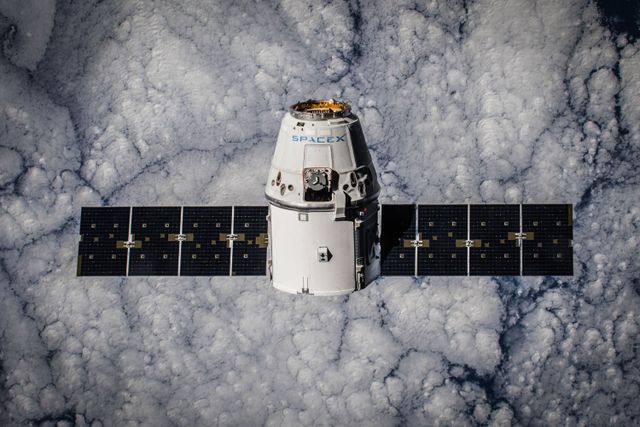
Founded in 2002 by Elon Musk, SpaceX has evolved from a private aerospace manufacturer into one of the world’s most ambitious infrastructure companies, operating at the intersection of space transportation, satellite connectivity, and artificial intelligence. The company’s mission is to make humanity multiplanetary by dramatically reducing the cost of accessing space while developing the technologies required for long-term human presence beyond Earth. Today, SpaceX designs, manufactures, launches, and operates a fully integrated ecosystem of rockets, spacecraft, satellites, communications networks, and AI infrastructure, positioning itself as a unique player across multiple high-growth industries.

SpaceX’s core business is built around its launch services division, led by the Falcon family of rockets and the next-generation Starship platform. Through pioneering reusable rocket technology, the company has fundamentally transformed the economics of spaceflight, reducing launch costs by more than 90% compared to historical industry averages. Since 2023, SpaceX has been responsible for launching more than 80% of the world’s mass to orbit annually while maintaining a mission success rate exceeding 99%, making it the dominant provider of commercial and government launch services.
Beyond launch operations, SpaceX has established a global communications business through Starlink, the world’s largest satellite broadband constellation. With approximately 9,600 satellites in low-Earth orbit, Starlink delivers high-speed internet and communication services to millions of consumer, enterprise, and government customers across more than 160 countries and territories. The network also supports direct-to-mobile connectivity services designed to reduce mobile dead zones and extend communications coverage in underserved regions.

In 2026, SpaceX expanded its strategic scope through the integration of xAI, the artificial intelligence company founded by Elon Musk in 2023. This move transformed SpaceX into a vertically integrated technology platform spanning physical and digital infrastructure. The company now develops large-scale AI compute capabilities, advanced frontier AI models such as Grok, and the supporting data center infrastructure required to power next-generation artificial intelligence systems. By combining launch capabilities, space-based connectivity, and AI infrastructure under a single organization, SpaceX aims to create a foundation for future economic activity both on Earth and in space.
Through its emphasis on first-principles thinking, rapid innovation, and extreme vertical integration, SpaceX continues to challenge traditional industry boundaries. The company envisions a future where affordable space access, global connectivity, and advanced artificial intelligence converge to unlock new industries, expand economic opportunities, and enable humanity’s long-term expansion into the solar system.
Competitive Advantages of SpaceX
SpaceX has built a unique competitive position by combining leadership across three strategic pillars: space transportation, global connectivity, and artificial intelligence. Together, these capabilities create a vertically integrated ecosystem that is difficult for competitors to replicate.

The company’s first and most significant advantage is its leadership in space transportation. SpaceX pioneered several industry milestones, including the first privately developed liquid-fuel rocket to reach orbit, the first private spacecraft to dock with the International Space Station, and the first successful reuse of an orbital-class rocket booster. Through its Falcon rocket family, the company has completed hundreds of orbital launches while dramatically reducing the cost of access to space through reusability. As the only private company certified by NASA to transport astronauts to orbit and with the development of the fully reusable Starship launch system, SpaceX possesses unmatched launch capabilities that serve as the foundation for all its businesses.
Its second competitive advantage lies in connectivity through the Starlink satellite network. With thousands of satellites in low-Earth orbit serving millions of customers across more than 160 countries, Starlink has become the world’s largest satellite broadband constellation. Unlike traditional telecommunications providers that depend on expensive terrestrial infrastructure, Starlink can deliver high-speed internet virtually anywhere on Earth. The addition of satellite-to-mobile services further strengthens its position by addressing connectivity gaps and reducing mobile dead zones globally.
The third pillar is artificial intelligence. Through the integration of xAI, SpaceX has established one of the world’s largest AI computing infrastructures. The company controls critical components of the AI value chain, including power generation, data centers, compute infrastructure, model development, and distribution. This vertical integration enables faster deployment, lower operating costs, and rapid model improvement. Furthermore, the combination of Grok’s AI capabilities with real-time data from X creates a powerful competitive advantage in delivering timely and contextually relevant intelligence.
Together, these three pillars reinforce one another, positioning SpaceX as a company uniquely equipped to build the integrated infrastructure of the future on Earth and beyond.
SpaceX business model
SpaceX operates a repeatable, engineering-driven business model built around launch leadership, vertical integration, rapid innovation, and continuous reinvestment. The model enables the company to identify, create, and scale large market opportunities while maintaining long-term competitive advantages.
At its foundation are SpaceX’s launch capabilities. Through industry-leading launch frequency, reliability, and low-cost access to orbit, the company can deploy assets at a scale that competitors cannot economically match. These capabilities serve as the backbone for expanding businesses across space transportation, global connectivity, and artificial intelligence.
SpaceX focuses on large, transformative markets with trillion-dollar potential, including satellite broadband, mobile connectivity, AI infrastructure, and future space-based industries. The company targets sectors where traditional technologies have created supply constraints or high costs, allowing it to unlock new demand through innovation.
A core element of the business model is first-principles thinking. Rather than relying on industry conventions, SpaceX designs products and systems from the ground up based on fundamental engineering principles. This approach drives significant improvements in performance, scalability, and cost efficiency.
The company executes through a disciplined framework known as “The Algorithm”: simplify requirements, eliminate unnecessary components, optimize what remains, accelerate development cycles, and automate proven processes. Combined with extensive vertical integration, this enables rapid iteration, tighter quality control, and lower costs. SpaceX designs and manufactures many critical components in-house, ranging from engines and structures to software and production systems.
Continuous cost reduction and throughput expansion are central to the model. Reusable rockets, large-scale manufacturing, and operational excellence allow SpaceX to lower unit costs while increasing launch cadence, satellite deployment, and computing capacity.
Finally, the company reinvests cash flows from mature businesses into future growth opportunities. This self-reinforcing cycle funds ambitious projects such as Starship, lunar infrastructure, and next-generation AI systems. By combining launch leadership, engineering expertise, and disciplined capital allocation, SpaceX seeks to create and scale entirely new industries on Earth, the Moon, Mars, and beyond.
How does SpaceX make money?
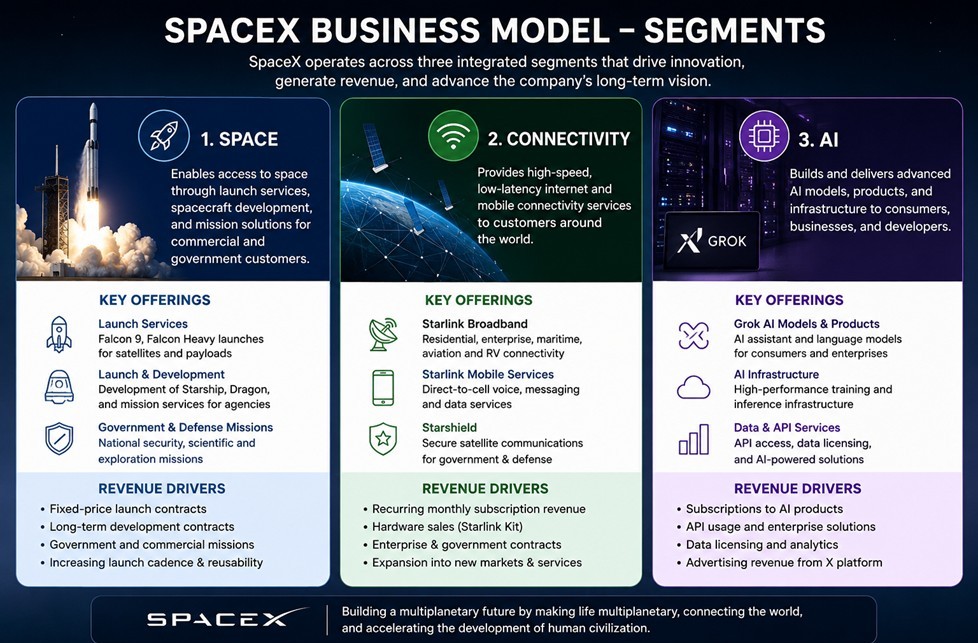
SpaceX generates revenue through three primary business segments: Space, Connectivity, and Artificial Intelligence. Together, these businesses create multiple recurring and long-term revenue streams while leveraging the company’s shared technology, engineering, and infrastructure capabilities.
The largest and most established revenue source is the Space segment. SpaceX earns revenue by providing launch services to commercial customers, satellite operators, governments, and space agencies. These services primarily utilize the Falcon 9 and Falcon Heavy launch vehicles to transport satellites and other payloads into orbit. The company also generates revenue through long-term development and mission contracts with government agencies, including spacecraft development, human spaceflight missions, and specialized space programs involving Dragon and Starship. Revenue is recognized either upon successful mission completion or progressively over the duration of development contracts.
The Connectivity segment is powered by Starlink, SpaceX’s satellite-based broadband network. Starlink generates recurring subscription revenue from millions of residential, enterprise, maritime, aviation, and government customers worldwide. Customers typically purchase a Starlink Kit, which includes the satellite terminal and associated hardware, creating an upfront equipment revenue stream. In addition, users pay recurring monthly service fees for broadband connectivity. SpaceX has also expanded into direct-to-mobile services through its Starlink Mobile constellation, generating revenue from satellite-enabled voice, messaging, and data services that complement traditional telecommunications networks. The company further serves government and defense customers through Starshield, a specialized satellite communications and security platform.
The AI segment represents SpaceX’s newest growth engine following the integration of xAI. Revenue is generated through several channels, including subscriptions to AI products and services, API access to Grok models, data licensing arrangements, and AI infrastructure services. Businesses and developers pay for access to Grok through usage-based or subscription-based pricing models, while enterprises purchase data access and analytics capabilities derived from the X platform. Additionally, the company generates advertising revenue through X, where advertisers pay to reach users across the platform’s large global audience.
A key characteristic of SpaceX’s business model is the combination of recurring revenue streams, such as Starlink subscriptions and AI services, with large-scale contract-based revenues from launch and government programs. This diversified revenue structure allows the company to generate significant cash flow, which can be reinvested into future growth initiatives such as Starship, advanced AI infrastructure, and long-term space exploration projects.
In 2025, SpaceX reported total revenues of $18.7 billion, a significant increase from $14.0 billion in 2024. The Connectivity segment (primarily Starlink) contributed $11.4 billion, driven by consumer and enterprise subscribers. Space revenue, including launch services and development contracts, accounted for $4.1 billion. The AI segment—comprising advertising, AI solutions, and infrastructure—generated $3.2 billion. As SpaceX scales Starship and AI services, profitability is poised to grow in parallel with recurring subscription and contract-based revenue.
Future of SpaceX
SpaceX’s future hinges on its fully reusable Starship platform, which aims to redefine space access at scale. With Starship, the company envisions drastically lower costs for lunar missions, Mars colonization, and orbital industries. Future ambitions include permanent lunar infrastructure, enabling scientific research and space manufacturing. As Starship achieves scale, SpaceX aims to unlock entirely new space-based economies, from orbital AI compute clusters to interplanetary supply chains.
In parallel, the AI segment is poised to grow. SpaceX’s vertically integrated AI infrastructure, through Grok and its orbital ambitions, could handle massive computational workloads off-planet. By leveraging solar power in space, SpaceX anticipates that AI development could transcend Earth’s physical limitations. Ultimately, the company’s future lies in fusing space, connectivity, and AI to drive unprecedented innovation.