
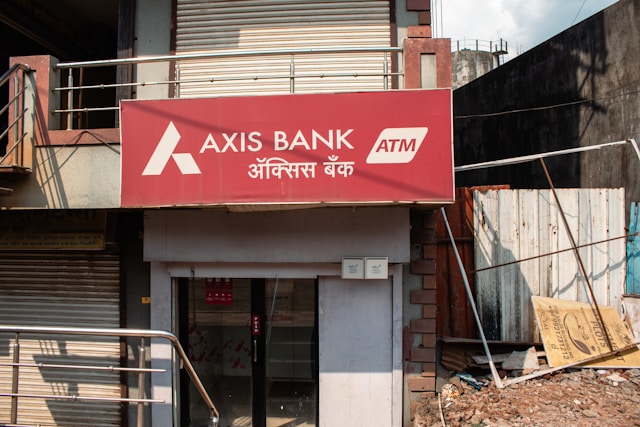
Axis Bank is India’s third-largest private sector bank by market capitalization and one of the country’s most diversified financial services institutions. Since commencing operations in 1994, the Bank has evolved beyond traditional banking into an integrated financial services ecosystem serving retail customers, MSMEs, corporates, institutions, government bodies, and international clients. Through its philosophy of “Har raah dil se open”, Axis Bank aims to provide inclusive, customer-centric, and technology-enabled financial solutions while creating long-term value for all stakeholders.
The Bank’s strategy combines a strong physical presence with an increasingly digital operating model. As of FY2024-25, Axis Bank operated 5,879 domestic branches, 13,941 ATMs and cash deposit/withdrawal machines, served customers across 3,194 cities and 692 districts, and covered nearly 89% of India’s districts through its branch and correspondent banking network. Complementing this physical reach are robust digital platforms, including mobile banking, WhatsApp Banking, and AI-powered customer engagement, enabling the Bank to deliver seamless banking experiences across multiple channels.
Unlike traditional banks that primarily depend on lending, Axis Bank has developed a diversified business model built around Retail Banking, Wholesale & Commercial Banking, and the “One Axis” ecosystem. Through wholly owned subsidiaries and strategic associates, the Bank offers investment banking, broking, mutual funds, insurance, asset management, trustee services, fintech solutions, and invoice discounting. This integrated approach allows Axis Bank to deepen customer relationships while generating multiple sources of interest and fee-based income.

The Bank’s long-term strategy is supported by six strategic pillars, including ‘One Axis’ in Action, Digital-first Banking, Bharat Banking, Nation-building Partnerships, Stakeholder Value Creation, and Sustainability. Together, these pillars position Axis Bank to benefit from India’s rising financial inclusion, increasing digital adoption, expanding credit demand, and growing wealth creation.
Axis Bank Business Strategy in 2026
Industry Problems Axis Bank Solves
India’s financial services industry faces several structural challenges, including limited access to formal banking in rural areas, fragmented financial products, increasing digital expectations, financing gaps for MSMEs, and the growing need for integrated financial solutions. Axis Bank has designed its business model to address these challenges through an extensive physical network, digital innovation, and diversified financial services.
One of the biggest challenges is financial inclusion. Millions of individuals and businesses across rural and semi-urban India still have limited access to formal financial services. Axis Bank addresses this through its Bharat Banking strategy, expanding branches into underserved regions while leveraging digital platforms to make banking accessible, affordable, and inclusive. The Bank combines physical infrastructure with digital channels to reach customers across urban, semi-urban, and rural India.
Another challenge is the increasing demand for digital-first banking experiences. Customers now expect instant account opening, seamless payments, mobile banking, digital lending, and personalised financial services. Axis Bank addresses this through its digital ecosystem, including the Axis Mobile App, Axis Pay, WhatsApp Banking, Axis Aha! AI chatbot, and multiple end-to-end digital customer journeys. These platforms enable customers to complete banking transactions anytime and anywhere while reducing operational costs for the Bank.
Businesses, particularly MSMEs and corporates, often require integrated banking, trade finance, treasury, payments, foreign exchange, and capital market services from a single institution. Through its Wholesale & Commercial Banking division and the ‘One Axis’ ecosystem, the Bank provides comprehensive financial solutions covering lending, cash management, trade finance, commercial cards, investment banking, insurance, and advisory services under one platform.
Customers also increasingly seek a single trusted institution to manage their savings, investments, insurance, loans, and wealth creation. Instead of operating as separate businesses, Axis Bank integrates these services through its subsidiaries, allowing customers to access multiple financial products within one ecosystem. This simplifies financial management while increasing customer convenience and engagement.
Axis Bank SWOT Analysis in 2026
How Axis Bank Solves These Problems
Axis Bank addresses India’s evolving financial needs through an integrated business model that combines Retail Banking, Wholesale & Commercial Banking, and the ‘One Axis’ ecosystem. Instead of operating as a traditional lender, the Bank has built a diversified financial services platform where banking, investments, insurance, payments, lending, wealth management, and digital services work together to serve customers across every stage of their financial journey. This integrated approach enables the Bank to deliver personalised solutions while strengthening customer relationships and creating multiple revenue streams.
At the core of Axis Bank’s model is Retail Banking, which serves individuals, families, small businesses, and Bharat Banking customers through a broad portfolio of products including savings accounts, deposits, retail loans, credit and debit cards, wealth management, insurance distribution, mutual funds, government bonds, bill payments, and foreign exchange services. The Bank combines personalised relationship management with digital banking to improve customer convenience while increasing product penetration across its large retail customer base.
For businesses, the Wholesale & Commercial Banking franchise provides customised financial solutions to corporates, MSMEs, and institutional customers. Its offerings include corporate loans, SME financing, cash management, trade finance, foreign exchange, derivatives, commercial cards, payment solutions, and treasury services. By leveraging sector expertise and relationship-led banking, Axis Bank supports businesses throughout their growth lifecycle while generating long-term customer relationships.
A major differentiator is the Bank’s ‘One Axis’ ecosystem, which integrates the capabilities of the Bank with its subsidiaries to deliver comprehensive financial solutions through a single platform. Customers can seamlessly access investment banking, stock broking, mutual funds, insurance, trustee services, invoice discounting, fintech solutions, and asset management alongside traditional banking products. This ecosystem enables customers to fulfil multiple financial needs within one institution while allowing Axis Bank to deepen engagement through cross-selling and integrated customer journeys.
Technology plays an equally important role in solving customer challenges. Axis Bank follows a digital-first strategy, investing heavily in AI, automation, mobile banking, WhatsApp Banking, API integration, and omnichannel customer experiences. During FY2024-25, the Bank had over 30 million registered WhatsApp Banking users, approximately 3 crore registered mobile banking customers, more than 250 self-service features on its mobile application, and 40 fully digitised product journeys. AI-powered services such as Axis Aha! improve customer support while enabling faster, more personalised banking experiences.
The Bank also places strong emphasis on financial inclusion and Bharat Banking by expanding its presence across rural and semi-urban India. Through calibrated branch expansion, correspondent banking, digital channels, and specialised rural banking models, Axis Bank aims to make formal financial services accessible to underserved communities while supporting agriculture, MSMEs, entrepreneurs, and local businesses. This approach aligns commercial growth with broader socio-economic development.
Axis Bank PESTEL Analysis in 2026
Business Model
Axis Bank operates a universal banking business model that combines traditional banking with a diversified financial services ecosystem. Rather than depending solely on interest income from lending, the Bank generates value through three interconnected business lines—Retail Banking, Wholesale & Commercial Banking, and Offerings through ‘One Axis’. Together, these businesses create a comprehensive platform capable of serving individuals, businesses, institutions, governments, and investors while generating both interest and fee-based income.
The Retail Banking business serves as the Bank’s largest customer franchise. It offers savings and current accounts, fixed deposits, retail loans, credit cards, debit cards, personal finance, wealth management, insurance distribution, mutual funds, forex services, and payment solutions. Retail Banking is supported by one of India’s largest physical banking networks and an increasingly digital customer experience, allowing Axis Bank to serve customers across urban, semi-urban, and rural markets.
The Wholesale & Commercial Banking business focuses on large corporates, MSMEs, institutions, and government clients. The Bank provides working capital, project finance, trade finance, transaction banking, treasury solutions, cash management, foreign exchange, guarantees, commercial cards, and advisory services. Its relationship-led approach enables long-term partnerships with businesses while supporting India’s expanding manufacturing, infrastructure, trade, and services sectors.
The third pillar is the ‘One Axis’ ecosystem, which differentiates Axis Bank from many traditional banks. Through subsidiaries such as Axis Securities, Axis Capital, Axis Finance, Axis Asset Management, Axis Trustee Services, Freecharge, A.TReDS, and its strategic association with Axis Max Life Insurance, the Bank provides an integrated portfolio of investment, insurance, lending, brokerage, fintech, trustee, and asset management services. These businesses are connected through common customer journeys, API integrations, CRM platforms, and cross-selling initiatives, allowing customers to access multiple financial products through a unified relationship with Axis Bank.
Supporting this model is the Bank’s extensive phygital infrastructure, combining physical branches with digital engagement channels. During FY2024-25, Axis Bank operated 5,879 branches, 13,941 ATMs and cash deposit/withdrawal machines, 8 Axis Virtual Centres, and served customers through mobile banking, internet banking, WhatsApp Banking, and AI-enabled customer support. With 96%+ digital transaction penetration, the Bank continues to improve operational efficiency while enhancing customer convenience and accessibility.
Axis Bank’s business model is further strengthened by six strategic pillars—‘One Axis’ in Action, Digital-first Banking, Bharat Banking, Nation-building Partnerships, Stakeholder Value Creation, and Sustainability. Together, these pillars enable the Bank to balance profitable growth with financial inclusion, technological innovation, responsible governance, and long-term value creation for customers, shareholders, employees, and society.
How Axis Bank Makes Money
Axis Bank generates revenue through a diversified universal banking model that combines interest income from lending with recurring fee-based income from investments, payments, wealth management, insurance, capital markets, and digital financial services. Rather than depending solely on traditional banking, the Bank has built multiple revenue engines across Retail Banking, Wholesale & Commercial Banking, and the ‘One Axis’ ecosystem, allowing it to maintain balanced and sustainable earnings across different economic cycles.
The Bank’s largest source of revenue is Retail Banking. Axis Bank earns interest income by mobilising customer deposits and deploying these funds across home loans, personal loans, vehicle finance, credit cards, loans against property, and other retail lending products. Alongside lending, the Bank generates fee income from savings and current accounts, payment services, debit and credit cards, forex services, bill payments, wealth management, and third-party distribution of insurance, mutual funds, and government bonds. During FY2024-25, the retail franchise continued to expand, with retail term deposits growing 8%, retail loan book increasing 7%, and Burgundy Private Assets Under Management (AUM) growing 16%, demonstrating healthy customer engagement across lending and wealth businesses.
The second major revenue engine is Wholesale & Commercial Banking. Axis Bank provides financing and transaction banking services to corporates, MSMEs, and institutional clients through products such as corporate loans, SME lending, trade finance, letters of credit, guarantees, foreign exchange, derivatives, cash management, treasury services, and commercial cards. These businesses generate both interest income and fee-based revenues while creating long-term banking relationships. During FY2024-25, corporate loans grew 8%, mid-corporate loan book expanded 10%, and the SME loan book increased 14%, reflecting continued growth across business banking segments.
A significant differentiator of Axis Bank’s earnings model is the ‘One Axis’ ecosystem, which enables the Bank to generate substantial non-interest income through its subsidiaries. Businesses such as Axis Securities, Axis Capital, Axis Asset Management, Axis Finance, Axis Trustee Services, Freecharge, A.TReDS, and Axis Max Life Insurance contribute revenues from investment banking, stock broking, mutual funds, insurance, fintech, trustee services, invoice discounting, and asset management. During FY2024-25, the Bank had invested Rs. 3,812 crore in its subsidiaries, whose combined domestic net worth reached Rs. 10,650 crore, while operating subsidiaries generated a combined Profit After Tax (PAT) of Rs. 1,768 crore, highlighting the growing contribution of fee-based businesses.
Digital banking has also become an important revenue and efficiency driver. Axis Bank earns income through digital payments, transaction banking, merchant services, digital lending, and customer engagement across its mobile banking platform, WhatsApp Banking, and API-enabled ecosystems. During FY2024-25, the Bank processed 8.7 billion mobile banking transactions, recorded Rs. 25.7 trillion in mobile banking spends, served over 30 million WhatsApp Banking users, and achieved 96%+ digital transaction penetration. These digital channels not only generate transaction-related revenues but also reduce servicing costs while improving customer retention and cross-selling opportunities.
By integrating lending, payments, investments, insurance, wealth management, capital markets, and digital financial services into one ecosystem, Axis Bank has developed a balanced revenue model that combines stable interest income with growing fee-based businesses. This diversification enhances profitability, strengthens customer lifetime value, and reduces dependence on any single line of business.
Future Outlook
Axis Bank’s long-term outlook is built around its vision of becoming a customer-first, future-ready financial services institution. Management believes India’s banking industry will continue to benefit from rising financial inclusion, expanding formal credit, increasing household wealth, rapid digital adoption, infrastructure-led economic growth, and greater financialisation of savings. These structural trends are expected to create significant opportunities across retail banking, corporate banking, wealth management, insurance, payments, and capital markets.
To capture these opportunities, the Bank has developed six long-term strategic pillars—‘One Axis’ in Action, Digital-first Banking, Bharat Banking, Partnering in Nation-building, Making a Difference to the Life of Every Stakeholder, and Embracing the Green Way. These pillars aim to strengthen customer relationships, accelerate digital transformation, expand rural banking, deepen government partnerships, create sustainable stakeholder value, and integrate ESG principles into the Bank’s long-term growth strategy.
Technology will remain a key competitive advantage. Axis Bank continues investing in artificial intelligence, automation, cybersecurity, API-based banking, cloud infrastructure, data analytics, and digital customer journeys to improve operational efficiency while delivering faster, more personalised financial services. At the same time, the Bank is expanding its ‘One Axis’ ecosystem, enabling customers to seamlessly access banking, lending, investments, insurance, wealth management, and fintech solutions through an integrated platform.
With a diversified business model, strong capital base, expanding digital ecosystem, extensive physical network, disciplined risk management, and customer-centric strategy, Axis Bank believes it is well positioned to deliver sustainable long-term growth while strengthening its leadership in India’s rapidly evolving financial services industry.
Source: Axis Bank Annual Report 2024-25