
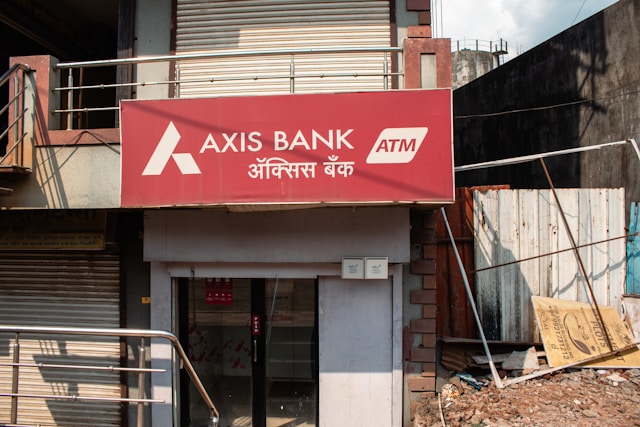
Axis Bank has evolved into one of India’s leading private-sector financial services institutions, operating through an integrated ecosystem spanning retail banking, wholesale banking, capital markets, wealth management, insurance, asset management, fintech, and digital financial services. Guided by its philosophy of “Har raah dil se open” and supported by the ‘One Axis’ strategy, the Bank combines physical reach with digital innovation to serve individuals, businesses, governments, and institutions across India.

As of FY2024-25, Axis Bank operated 5,879 domestic branches, 13,941 ATMs and cash deposit/withdrawal machines, served customers across 3,194 cities, and maintained one of India’s largest digital banking ecosystems. The Bank’s strategy is built around customer-centricity, technology leadership, financial inclusion, sustainability, and integrated financial services, positioning it for long-term growth in India’s rapidly evolving banking sector.
The following SWOT analysis is based on Axis Bank’s FY2024-25 Integrated Annual Report.

Axis Bank Business Model in 2026: How Axis Bank Makes Money
Strengths
1. Integrated ‘One Axis’ Financial Ecosystem
Axis Bank differentiates itself through the ‘One Axis’ strategy, integrating banking, lending, investments, insurance, asset management, broking, fintech, and trustee services into a unified customer ecosystem. This enables seamless cross-selling, improves customer retention, and diversifies revenue beyond traditional lending.
2. Extensive Physical and Digital Reach
The Bank operates 5,879 branches, 13,941 ATMs, covers 3,194 cities and 89% of India’s districts, while simultaneously maintaining one of India’s strongest digital banking platforms with mobile banking, WhatsApp Banking, and AI-enabled customer services.

3. Strong Digital Banking Capabilities
Axis Bank has positioned digital transformation at the centre of its strategy through open, neo, Axis Aha!, WhatsApp Banking, AI-powered services, and more than 96% digital transaction penetration. These capabilities improve customer experience while increasing operational efficiency.
4. Diversified Revenue Streams
Beyond traditional banking, Axis Bank generates earnings through investment banking, securities, asset management, insurance, NBFC operations, fintech, payments, trustee services, and invoice discounting. This diversified business model reduces dependence on interest income and strengthens profitability across business cycles.
5. Strong Focus on ESG and Governance
Axis Bank was the first Indian bank to establish a standalone Board-level ESG Committee and has embedded sustainability into governance, lending, climate finance, diversity, and community development. This strengthens long-term resilience while aligning the Bank with evolving stakeholder and regulatory expectations.
Axis Bank Business Strategy in 2026
Weaknesses
1. High Dependence on the Indian Market
Although Axis Bank maintains international offices and overseas operations, its core business remains concentrated within India, making performance highly dependent on domestic economic growth, credit demand, and regulatory developments.
2. Significant Technology Investment Requirements
The Bank’s digital-first strategy requires continuous investments in artificial intelligence, cybersecurity, cloud infrastructure, digital platforms, data analytics, and technology upgrades, increasing operating expenditure and execution complexity.
3. Exposure to Credit Risk
Axis Bank’s diversified lending portfolio across retail, MSMEs, corporates, agriculture, and commercial banking exposes it to potential deterioration in asset quality during economic slowdowns despite its disciplined risk management framework.
4. Complex Universal Banking Structure
Managing multiple subsidiaries across banking, NBFCs, investment banking, broking, insurance, fintech, asset management, and trustee services requires significant coordination, governance, technology integration, and capital allocation.
5. Increasing Regulatory Compliance Burden
As a diversified financial services institution, Axis Bank must comply with evolving RBI, SEBI, DPDP, ESG, cybersecurity, and financial reporting regulations, increasing compliance costs and operational complexity.
Axis Bank PESTEL Analysis in 2026
Opportunities
1. Rising Financial Inclusion
India’s expanding formal banking ecosystem creates significant opportunities for Axis Bank to grow deposits, lending, digital payments, and financial services through its Bharat Banking strategy across rural and semi-urban markets.
2. Expansion of Digital Banking
Increasing adoption of AI, mobile banking, embedded finance, API banking, and digital payments provides opportunities to improve customer acquisition, lower servicing costs, and expand transaction-based revenue.
3. Growth of the ‘One Axis’ Ecosystem
The integrated ecosystem enables greater cross-selling across banking, insurance, investments, wealth management, fintech, and lending, increasing customer lifetime value while generating higher fee-based income.
4. Expanding MSME and Corporate Banking
India’s manufacturing growth, infrastructure investments, startup ecosystem, and increasing formalisation of businesses create opportunities across SME lending, trade finance, treasury, investment banking, and transaction banking.
5. Sustainable Finance and ESG
Growing demand for green financing, climate-related investments, renewable energy projects, and ESG-linked financial products creates new opportunities for Axis Bank to expand sustainable lending while strengthening its leadership in responsible banking.
Threats
1. Intensifying Industry Competition
Axis Bank faces increasing competition from private-sector banks, public-sector banks, fintech companies, NBFCs, payment platforms, digital banks, and wealth management firms, putting pressure on pricing, innovation, and customer acquisition.
2. Rapid Technological Disruption
Artificial intelligence, embedded finance, digital-native competitors, and rapidly evolving customer expectations require continuous investments in technology to maintain competitiveness.
3. Cybersecurity and Data Privacy Risks
As digital banking expands, the Bank faces increasing risks related to cyberattacks, fraud, operational resilience, and customer data protection, making cybersecurity a strategic priority.
4. Regulatory Changes
Frequent changes in banking regulations, digital governance, climate disclosures, capital adequacy requirements, consumer protection norms, and data privacy laws may increase compliance costs while affecting business operations.
5. Global Economic and Credit Uncertainty
Macroeconomic slowdowns, geopolitical tensions, inflation, interest rate volatility, and global financial market disruptions could affect credit demand, asset quality, customer repayment capacity, and overall banking profitability.
Source: Axis Bank Annual Report 2024-25