
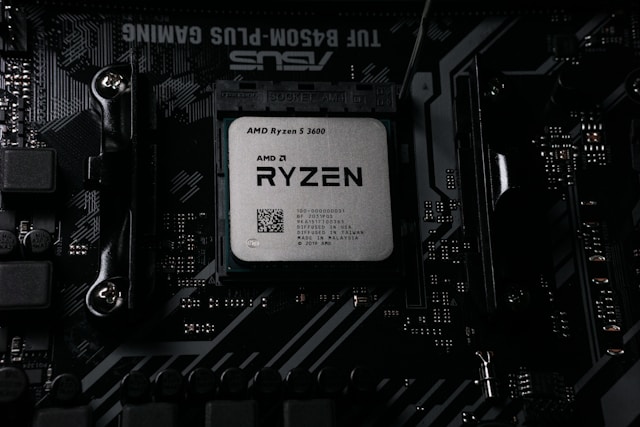
Advanced Micro Devices (AMD) has evolved from a processor company into a broad high-performance and AI computing platform business spanning data centers, AI accelerators, PCs, gaming, embedded systems, networking and software. Its business model is predominantly product-led: AMD designs advanced semiconductors and related software, outsources most manufacturing to third-party foundries and assembly partners, and sells its products through hyperscale customers, OEMs, ODMs, distributors and system integrators.

AMD’s 2025 Annual Report describes the company as a global semiconductor business focused on AI accelerators, CPUs, GPUs, APUs, DPUs, FPGAs, AI NICs, adaptive SoCs and related technologies. Substantially all of AMD’s revenue comes from product sales, although it also earns revenue from development services and IP licensing.
In 2025, AMD generated $34.6 billion in revenue, up 34% from $25.8 billion in 2024. The growth was driven mainly by its Data Center and Client and Gaming businesses.

Industry Background: What Problem Does AMD Solve?
Modern computing increasingly requires different types of processing for different workloads.
Traditional CPUs remain critical for general-purpose computing, but AI training and inference require highly parallel GPU processing. Data centers increasingly need networking and data-processing infrastructure. PCs are incorporating dedicated AI engines. Automotive, industrial and communications applications require programmable and adaptable computing.

AMD addresses these needs through a broad portfolio instead of relying on a single processor architecture or end market.
Its product set spans CPUs, GPUs, AI accelerators, DPUs, AI NICs, FPGAs, adaptive SoCs and software, allowing AMD to address computing from cloud data centers to PCs and embedded systems.
The strategic shift is especially important in AI. AMD believes AI will become pervasive across the cloud, edge and endpoint devices, and is positioning itself as an end-to-end AI computing provider rather than only a chip supplier.
AMD Business Model
AMD organizes its operations into three reportable segments:
- Data Center
- Client and Gaming
- Embedded
AMD may also periodically sell or license portions of its intellectual-property portfolio.
1. Data Center
Data Center has become AMD’s largest segment.
The business includes:
- AMD Instinct AI accelerators
- AMD EPYC server CPUs
- data center GPUs
- DPUs
- AI network interface cards
- FPGAs
- adaptive SoCs
These products are sold to hyperscale cloud providers, OEMs, ODMs, system integrators and enterprise customers for AI, cloud computing, high-performance computing and other data-center workloads.
In 2025, Data Center revenue reached $16.6 billion, up 32% from $12.6 billion in 2024. The increase was driven primarily by strong demand for AMD EPYC processors and AMD Instinct GPU accelerators. Segment operating income was $3.6 billion.
Data Center therefore contributed roughly 48% of AMD’s total 2025 revenue, making it the company’s largest economic engine.
2. Client and Gaming
AMD combined Client and Gaming into a single reporting segment beginning in fiscal 2025.
The Client business sells processors and related products for desktops and notebooks, mainly under brands including:
Ryzen, Ryzen AI, Ryzen PRO and Threadripper.
AMD is increasingly embedding AI directly into client devices. It says it was the first company to integrate a dedicated neural processing unit into the same SoC as an x86 CPU for AI PCs.
Gaming includes Radeon GPUs and semi-custom SoCs used in platforms such as PlayStation and Xbox. AMD works with customers to create customized processors combining CPU, GPU and multimedia technologies.
In 2025:
- Client revenue reached $10.64 billion
- Gaming revenue reached $3.91 billion
- Total Client and Gaming revenue reached $14.55 billion
- Segment operating income reached $2.86 billion
Total Client and Gaming revenue increased 51% year over year.
3. Embedded
AMD’s Embedded business primarily includes:
- embedded CPUs and APUs,
- FPGAs,
- adaptive SoCs,
- System-on-Modules.
Its products serve markets including automotive, aerospace and defense, healthcare, industrial automation, communications infrastructure, storage and networking.
Embedded revenue was $3.45 billion in 2025, down slightly from $3.56 billion in 2024, while operating income was $1.24 billion.
Although smaller than Data Center or Client and Gaming, Embedded provides AMD with exposure to longer product cycles and a wider variety of industrial applications.
How Does AMD Make Money?
AMD generated $34.64 billion of net revenue in 2025. Its revenue mix was approximately:
| Segment | 2025 Revenue | Approx. Share |
|---|---|---|
| Data Center | $16.64B | 48% |
| Client and Gaming | $14.55B | 42% |
| Embedded | $3.45B | 10% |
| Total | $34.64B | 100% |
The numbers reveal an important transformation: nearly half of AMD’s revenue now comes from Data Center, while Client and Gaming remains another large growth engine.
1. AI Accelerator and Data Center GPU Sales
One of AMD’s most important revenue opportunities is selling AI accelerators.
Its AMD Instinct GPU family is designed for:
- AI training,
- AI inference,
- generative AI,
- scientific computing,
- large-scale cloud deployments.
Demand accelerated in 2025 as hyperscalers, OEMs and ODMs deployed the Instinct MI350X Series.
AMD is also moving toward a more predictable annual AI GPU product cadence, which can help it remain competitive as AI computing requirements evolve rapidly.
The scale of the opportunity is illustrated by AMD’s October 2025 agreement with OpenAI to deploy 6 gigawatts of AMD GPUs, beginning with one gigawatt powered by AMD Instinct MI450-series products.
2. Server CPU Sales
AMD earns significant revenue by selling EPYC processors used in servers.
These CPUs are designed for:
- cloud computing,
- enterprise workloads,
- high-performance computing,
- supercomputers,
- AI-related data-center workloads.
AMD’s fifth-generation EPYC processors helped drive the 32% increase in Data Center revenue during 2025.
This allows AMD to participate in AI infrastructure beyond GPUs because large AI systems still require CPUs for orchestration, data processing and general workloads.
3. PC Processor Sales
AMD sells Ryzen processors to OEMs, distributors and other PC ecosystem customers.
Client revenue rose 51% to $10.6 billion in 2025, driven by a 31% increase in processor unit shipments and a 15% increase in average selling prices.
That is an especially strong business-model signal because AMD grew through both volume and pricing.
AMD is also expanding the product proposition through Ryzen AI processors containing dedicated NPUs.
The strategic objective is to participate in the shift from conventional PCs toward AI PCs, potentially creating another processor upgrade cycle.
4. Gaming GPU Sales
AMD earns revenue from Radeon discrete graphics cards used in gaming and creator PCs.
Its Radeon RX 9000 Series, introduced in 2025, uses the RDNA 4 architecture and incorporates enhanced AI and ray-tracing capabilities.
Gaming revenue increased 51% to $3.9 billion in 2025, supported by Radeon GPU demand and higher semi-custom revenue.
5. Semi-Custom Chips
AMD also develops customer-specific processors.
Its semi-custom SoCs power platforms including:
- Sony PlayStation 5,
- Microsoft Xbox Series S and X,
- Valve Steam Machine PC.
The economics differ from standard chips.
AMD can receive non-recurring engineering fees for designing the processor and then revenue from selling the resulting semi-custom SoCs.
This produces a model of:
customer design engagement → engineering revenue → chip production → unit sales over the platform lifecycle.
6. Embedded Processor, FPGA and Adaptive SoC Sales
AMD sells embedded products into markets where computing is integrated into other equipment rather than sold as a conventional PC or server.
Applications include automotive, industrial automation, communications, healthcare and aerospace.
FPGA and adaptive SoC technologies are particularly valuable where customers require programmable hardware, low latency, specialized interfaces or long product lifecycles.
The Embedded segment generated $3.45 billion of revenue and $1.24 billion of operating income in 2025.
7. Development Services and IP Licensing
Although substantially all AMD revenue comes from product sales, there are smaller additional streams.
AMD sometimes receives fees from customers for design and development work, particularly in semi-custom solutions.
It can also sell or license parts of its intellectual-property portfolio.
Revenue recognized over time from custom products and development services accounted for approximately 9% of AMD’s 2025 revenue.
This is meaningful because AMD is not purely selling standardized chips; part of the business involves co-development and long-term customer relationships.
AMD’s Fabless Manufacturing Model
A crucial part of AMD’s business model is what it generally does not do: manufacture leading-edge wafers itself.
AMD focuses heavily on:
architecture → chip design → IP → software → system integration → customer solutions
while relying on specialist semiconductor manufacturing companies.
AMD uses TSMC for production of wafers for its high-performance computing, FPGA and adaptive SoC products, while GlobalFoundries supplies certain older-node products. TSMC, UMC and Samsung also manufacture certain programmable-logic devices.
Assembly, testing, marking and packaging are also largely conducted by third-party partners in the Asia-Pacific region.
This allows AMD to avoid the huge fixed cost of owning leading-edge semiconductor fabs.
The trade-off is dependence on outside manufacturers, particularly TSMC. AMD acknowledges that insufficient leading-edge capacity or manufacturing yields could materially affect supply, unit costs and gross margins.
Software Is Becoming More Important to AMD’s Business Model
Modern AI competition is not determined only by chip performance.
Software determines whether developers can efficiently use the hardware.
AMD therefore develops software stacks including:
- ROCm,
- compilers,
- drivers,
- development libraries,
- Vitis,
- Vitis AI,
- Vivado.
ROCm is particularly important to AMD’s AI strategy.
The company continues to expand its open AI ecosystem and improve performance for training, inference and generative-AI workloads.
The economic role of software is therefore primarily to increase adoption of AMD hardware, improve switching economics and make the entire AMD platform more competitive.
AMD Is Moving From Chips to Full-Stack AI Infrastructure
This may be the most important evolution of AMD’s business model.
Historically, AMD competed mainly at the component level:
CPU vs CPU or GPU vs GPU.
AI infrastructure increasingly requires a complete system:
CPU + GPU + networking + software + rack architecture + systems integration.
AMD states that AI systems will require full-stack innovation across compute, networking, systems architecture and software.
Its proposed Helios rack-scale platform combines CPUs, GPUs and networking into an integrated AI infrastructure solution.
The acquisition of ZT Systems’ design capabilities further supports this strategy by giving AMD additional expertise in designing and deploying large-scale AI infrastructure.
This shifts AMD’s value proposition from:
“buy our processor”
toward:
“deploy AI infrastructure built around AMD technology.”
Customer and Distribution Model
AMD reaches the market through several channels.
It sells through:
- direct sales,
- OEMs,
- ODMs,
- hyperscale cloud companies,
- distributors,
- add-in-board manufacturers,
- system integrators,
- sales representatives.
Large hyperscale cloud operators directly and indirectly purchase significant quantities of AMD’s Data Center products, which may then be incorporated into OEM servers or custom systems built by ODMs.
AMD also works closely with customers during product development. Application engineers help customers design, test and qualify systems containing AMD products, strengthening customer relationships and increasing the likelihood that future generations of AMD chips remain within those platforms.
Research and Development as the Core Investment Engine
AMD’s business depends heavily on continuously designing better processors.
Its R&D activities focus on:
- CPUs,
- GPUs,
- FPGAs,
- adaptive SoCs,
- accelerators,
- AI NICs,
- advanced packaging,
- chiplets,
- software,
- AI development stacks.
The company specifically emphasizes improved performance and performance-per-watt, advanced semiconductor processes, heterogeneous integration and software tools.
This creates the central economic cycle of AMD:
R&D → new architectures → higher-performance products → customer adoption → higher revenue → reinvestment into the next generation of products.
In semiconductors, maintaining this cadence is critical because technological leadership can change rapidly.
Financial Economics of AMD’s Business Model
AMD’s 2025 financial results show the benefit of its increasing exposure to Data Center and higher-value computing products.
Revenue increased 34% to $34.6 billion.
Gross margin increased to 50%, from 49% in 2024.
Data Center revenue increased 32%.
Client and Gaming revenue increased 51%.
Segment operating income demonstrates the profitability of AMD’s core businesses:
| Segment | Revenue | Operating Income | Approx. Segment Margin |
|---|---|---|---|
| Data Center | $16.64B | $3.60B | ~22% |
| Client & Gaming | $14.55B | $2.86B | ~20% |
| Embedded | $3.45B | $1.24B | ~36% |
Embedded remains particularly profitable relative to revenue, while Data Center has become the largest revenue pool.
AMD also ended 2025 with $10.6 billion in cash, cash equivalents and short-term investments, versus $5.1 billion a year earlier.
Competitive Advantage of AMD’s Business Model
AMD’s competitive advantage increasingly comes from combining several capabilities rather than relying on a single processor.
Its portfolio spans CPUs, GPUs, adaptive computing, networking and software.
Its chiplet approach and Infinity Fabric allow differentiated system integration.
Its fabless model gives access to advanced foundry technology without owning leading-edge fabs.
Its relationships with hyperscalers, OEMs and embedded customers create broad distribution.
Its semi-custom capabilities allow deep co-design with customers.
And its open software approach, including ROCm, aims to make AMD hardware easier to adopt across diverse AI workloads.
The challenge is equally clear: AMD competes in markets where technological change is extremely fast and where rivals include Intel and Nvidia as well as customers developing their own chips.
Future of AMD’s Business Model
AMD’s future business model is increasingly centered on AI as a platform opportunity spanning cloud, edge and endpoints.
The company is simultaneously building:
Data Center AI: Instinct accelerators, EPYC CPUs, AI networking and rack-scale systems.
AI PCs: Ryzen AI processors with NPUs.
Embedded AI: adaptive SoCs and FPGAs used in industrial, automotive and communications environments.
AI software: ROCm and other development platforms.
Custom AI infrastructure: chiplets, system design and full-stack integration.
The OpenAI agreement, annual Instinct GPU roadmap and ZT Systems design acquisition reinforce this direction.
AMD is therefore moving from being primarily a semiconductor component supplier toward becoming an end-to-end high-performance and AI computing platform company.
Conclusion
AMD’s business model in 2026 can be summarized as:
invest heavily in processor architecture, software and IP → design high-performance CPUs, GPUs and adaptive computing products → outsource manufacturing to advanced foundries → sell through hyperscalers, OEMs, distributors and embedded customers → deepen relationships through customized designs and software → reinvest revenue into the next generation of computing platforms.
Its revenue engine is now highly diversified across three major businesses, but Data Center has emerged as the largest:
48% Data Center + 42% Client and Gaming + 10% Embedded.
The more important transformation, however, is qualitative.
AMD is moving from:
CPU and GPU products
to:
CPU + GPU + networking + software + system architecture + custom silicon.
If AMD can execute that full-stack transition, its business model increasingly positions the company to capture value not only from individual processors but from the broader computing infrastructure required for the AI era.
Source: AMD annual report