
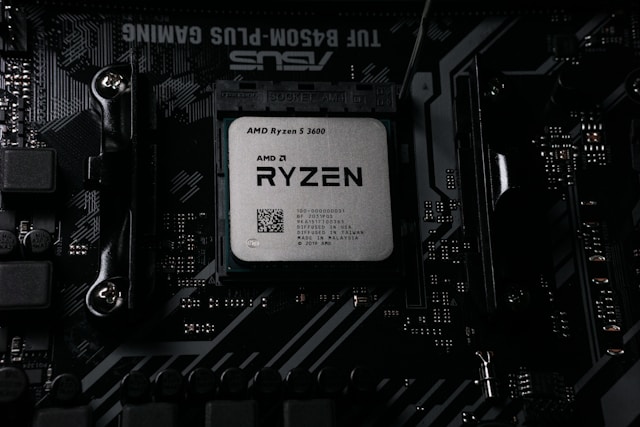
AMD enters 2026 with strong momentum in AI and high-performance computing. In 2025, revenue increased 34% to $34.6 billion, driven primarily by Data Center and Client and Gaming, while gross margin improved to 50%. At the same time, AMD faces intense competition, export restrictions, manufacturing dependence and the inherent cyclicality of the semiconductor industry.

The following AMD SWOT Analysis 2026 is based strictly on AMD’s 2025 Annual Report.
AMD Business Model 2026: How Does AMD Make Money?

Strengths
1. Rapid Growth in Data Center and AI
AMD’s Data Center revenue increased 32% to $16.6 billion in 2025, driven by strong demand for EPYC server CPUs and Instinct AI accelerators. Data Center now represents almost half of company revenue, giving AMD significant exposure to growing AI infrastructure spending.
2. Broad Computing Portfolio
AMD has developed a diversified technology portfolio spanning CPUs, GPUs, AI accelerators, DPUs, AI NICs, FPGAs, adaptive SoCs and software. This allows the company to address Data Center, PCs, gaming and embedded markets rather than depending on one computing category.
3. Growing Full-Stack AI Capabilities
AMD is moving beyond individual chips toward integrated AI infrastructure incorporating compute, networking, systems architecture and software. The company is developing the Helios rack-scale platform and expanding ROCm to improve AI training and inference capabilities.

4. Strong Client and Gaming Momentum
Client and Gaming revenue increased 51% to $14.6 billion in 2025. Client growth reflected both a 31% increase in processor shipments and a 15% increase in average selling prices, demonstrating strong demand for Ryzen processors.
5. Stronger Financial Position
AMD ended 2025 with $10.6 billion in cash, cash equivalents and short-term investments, more than double the $5.1 billion held at the end of 2024. This provides flexibility for R&D, acquisitions, strategic investments and shareholder returns.
Weaknesses
1. Dependence on Third-Party Manufacturing
AMD relies heavily on external foundries rather than manufacturing leading-edge semiconductors itself. This creates dependence on suppliers for advanced capacity, manufacturing yields and delivery schedules, making supply disruptions capable of affecting costs and customer relationships.
2. High Exposure to a Few Large AI Customers
Although no customer represented at least 10% of consolidated revenue in 2025, AMD acknowledges that a relatively small number of customers can account for a substantial portion of revenue and receivables. Large hyperscalers therefore carry meaningful strategic importance.
3. Embedded Business Has Contracted
Embedded revenue decreased 3% to $3.45 billion in 2025, compared with $3.56 billion in 2024, as demand across certain end markets remained mixed. This contrasts with the strong growth in Data Center and Client and Gaming.
4. Significant Acquisition-Related Intangible Assets
AMD carried approximately $25.1 billion of goodwill and $16.7 billion of acquisition-related intangible assets at the end of 2025. While no impairment was recorded, these balances create exposure should acquired businesses fail to deliver expected long-term performance.
5. Heavy Dependence on Continuous Product Execution
AMD operates in markets where product cycles are short and technology changes rapidly. Maintaining leadership requires frequent launches across CPUs, GPUs, networking, embedded products and software, increasing execution complexity and R&D demands.
Opportunities
1. Expansion of AI Infrastructure
AMD believes AI will require full-stack innovation across compute, networking, system architecture and software. Its Instinct GPUs, EPYC CPUs, Pensando networking and ROCm platform give it an opportunity to capture a larger share of AI infrastructure spending.
2. OpenAI Partnership Could Drive Major GPU Demand
AMD entered a multiyear agreement with OpenAI covering deployment of 6 gigawatts of AMD GPUs, beginning with the Instinct MI450 series. Large deployments could strengthen AMD’s credibility with other hyperscale AI customers and accelerate ecosystem adoption.
3. AI PCs Create a New Client Upgrade Cycle
AMD is increasingly integrating dedicated AI capabilities into Ryzen processors. As AI functionality expands from the cloud to endpoint devices, AMD can benefit from demand for processors capable of running AI workloads locally across consumer and enterprise PCs.
4. Custom Silicon and Rack-Scale Systems Expand AMD’s Addressable Market
The ZT Systems acquisition added system-design capabilities aimed at accelerating deployment of AMD-powered AI infrastructure. AMD retained ZT’s design IP and employees while selling the manufacturing operation, supporting a more asset-light move into complete systems.
5. Embedded AI Can Extend AMD Into New Industries
AMD’s embedded portfolio spans automotive, industrial, healthcare, aerospace and communications applications. Its adaptive computing products create opportunities as AI processing increasingly moves to edge devices and specialized systems.
Threats
1. Intense Competition From Nvidia, Intel and Others
AMD faces Nvidia and Intel in Data Center, Intel and Arm-based alternatives in PCs, and numerous FPGA and embedded competitors. AMD also notes that some of its own customers are developing internal processors and accelerators, potentially reducing its addressable market.
2. U.S. Export Controls Can Directly Reduce Revenue
New U.S. export restrictions on the Instinct MI308 resulted in approximately $800 million of inventory and related charges in 2025, although about $360 million was subsequently reversed after some licenses were granted. Future restrictions could affect additional products and markets.
3. Semiconductor Industry Cyclicality
AMD explicitly identifies the semiconductor industry as highly cyclical and historically subject to severe downturns. Demand changes across PCs, gaming, data centers and embedded markets can therefore result in significant swings in revenue, inventory and profitability.
4. Geopolitical Risk Around Taiwan
AMD relies heavily on Asian manufacturing, including Taiwan-based foundries and subcontractors. The company warns that worsening China-Taiwan geopolitical tensions could disrupt manufacturing and materially affect product deliveries and financial performance.
5. Rapid Technological Change Can Erode Competitive Position
AMD competes in markets characterized by frequent product launches, evolving technical standards and rapid obsolescence. Falling behind in GPU performance, CPU architecture, AI software or networking could quickly reduce customer adoption and market position.
Source: AMD annual report