
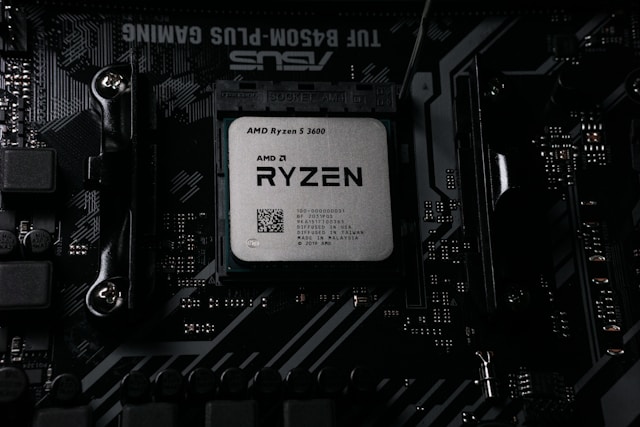
AMD operates in a highly global, technology-intensive semiconductor industry where government policy, economic cycles, AI adoption, manufacturing technology, environmental regulation and intellectual-property law can materially affect growth. In 2025, AMD generated $34.6 billion in revenue, with Data Center revenue reaching $16.6 billion and Client and Gaming revenue reaching $14.6 billion.

The following AMD PESTEL Analysis 2026 is based strictly on AMD’s 2025 Annual Report.
AMD Business Model 2026: How Does AMD Make Money?

Political Factors Affecting AMD
1. U.S. Export Controls Can Restrict Key AI Products
Government restrictions on advanced semiconductor exports have a direct financial impact on AMD. New U.S. licensing requirements affecting Instinct MI308 products resulted in approximately $800 million of inventory and related charges in 2025, although roughly $360 million was later reversed after some licenses were obtained.
2. U.S.–China Relations Are Strategically Important
China, including Hong Kong, accounted for approximately $7.75 billion of AMD’s 2025 sales based on customer billing location. Deteriorating U.S.–China trade relations, licensing restrictions or Chinese import controls can therefore materially affect AMD’s addressable market.
3. Tariffs and Trade Protection Can Increase Costs
AMD identifies tariffs, trade-protection measures and retaliatory government actions as risks that can reduce sales and disrupt international business. Changes in U.S. trade policy can also affect supply chains and customer relationships.

4. Taiwan Geopolitics Create Supply-Chain Risk
AMD relies significantly on manufacturing activity in Taiwan. The company warns that geopolitical developments between China and Taiwan could disrupt wafer foundries, manufacturing facilities and subcontractors, potentially affecting product deliveries and financial performance.
5. Global Political Instability Can Affect Operations
AMD identifies geopolitical conflicts and changing political conditions as risks to its worldwide operations. International sales represented 67% of revenue in 2025, making the company materially exposed to political, trade and sanctions developments across multiple regions.
Economic Factors Affecting AMD
1. The Semiconductor Industry Is Highly Cyclical
AMD explicitly identifies semiconductor markets as cyclical. Demand can fluctuate sharply with economic conditions, inventory corrections, product replacement cycles and capital spending across PCs, data centers, gaming and embedded markets.
2. AI Infrastructure Spending Depends on Customer Capital
AI demand is not guaranteed. AMD notes that some customers may struggle to secure financing, data-center capacity or sufficient energy for AI infrastructure, while construction delays can postpone GPU deployments and reduce near-term demand.
3. Inflation and Interest Rates Affect Global Demand
AMD identifies inflation, interest rates and recessions among macroeconomic conditions that can affect worldwide operations. Economic downturns can also lead competitors to become more aggressive on pricing, increasing pressure on margins.
4. Foreign Exchange Movements Create Risk
With most revenue generated internationally, AMD is exposed to exchange-rate fluctuations. Currency changes can affect operating results, competitiveness and the value of international transactions and operations.
5. End-Market Demand Can Change Rapidly
AMD’s businesses depend on different economic cycles. Embedded revenue declined 3% in 2025 because some end-market demand remained mixed, while Data Center and Client and Gaming grew strongly.
Social Factors Affecting AMD
1. Adoption of Generative AI Drives Customer Demand
Demand for AMD’s AI products depends partly on how quickly enterprises and consumers adopt generative-AI applications. AMD explicitly states that both the near- and long-term trajectory of generative AI remain uncertain.
2. Consumer Adoption of AI PCs Is Uncertain
AMD is integrating AI capabilities into Ryzen processors, but the company acknowledges that Client and Gaming revenue depends partly on how quickly consumers and enterprises adopt AI PCs.
3. Changing Consumer Preferences Affect Product Cycles
AMD must anticipate changing preferences for device form factors, features, replacement cycles and performance. Failure to correctly predict customer preferences could cause the company to lose market share.
4. Engineering Talent Is Critical
AMD employed approximately 31,000 people globally at the end of 2025. The company emphasizes employee engagement, innovation and diverse perspectives as important elements of its ability to develop advanced computing products.
5. Gaming and Entertainment Trends Influence Revenue
AMD’s gaming business depends partly on customer demand for consoles, PCs and graphics products. Its semi-custom chips support major gaming platforms, while gaming demand can change with console cycles and consumer preferences.
Technological Factors Affecting AMD
1. AI Technology Is the Core Growth Driver
AMD is positioning AI as the next major computing era. Its strategy combines Instinct GPUs, EPYC CPUs, networking, adaptive computing and software to participate in AI across cloud, edge and endpoint devices.
2. Full-Stack Computing Is Becoming More Important
AI competition is shifting from standalone chips toward integrated systems. AMD is building rack-scale infrastructure such as Helios that combines CPUs, GPUs and networking, supported by system-design expertise acquired through ZT Systems.
3. Software Ecosystem Development Is Essential
ROCm is a critical element of AMD’s AI competitiveness. In 2025, AMD expanded framework and library support and improved generative-AI training and inference performance, highlighting the increasing strategic importance of software alongside hardware.
4. Product Innovation Must Be Continuous
AMD depends on timely introductions of new technologies. Delays in identifying or launching products that match evolving industry requirements can weaken competitive positioning and lead to market-share losses.
5. Advanced Manufacturing Technology Is Critical
AMD’s performance depends heavily on access to leading-edge manufacturing, packaging and integration technologies. Because advanced AI and computing products require increasingly sophisticated semiconductor processes, manufacturing capability can directly affect performance, cost and product availability.
Environmental Factors Affecting AMD
1. Climate Change Can Disrupt Manufacturing
AMD identifies climate change and natural disasters—including flooding, droughts, extreme heat, fires and earthquakes—as risks capable of disrupting its own operations or those of manufacturing partners and customers.
2. Energy Availability Can Limit AI Data Center Growth
AI infrastructure requires large amounts of power. AMD notes that customers may face difficulties securing sufficient energy for data-center expansion, potentially delaying deployment and reducing demand for AMD accelerators.
3. Chemical and Material Regulations Are Tightening
AMD is affected by evolving rules governing materials such as lead and PFAS. These regulations can influence product design, semiconductor manufacturing processes and supplier compliance requirements.
4. Energy-Efficiency Regulations Affect Market Access
Jurisdictions including the EU, California and China are developing or implementing energy-efficiency requirements for computers and servers. Such regulations can influence whether products qualify for market access or public procurement.
5. Electronic-Waste Rules Increase Compliance Complexity
Extended producer responsibility and electronic-waste recycling regulations across regions including the EU, China, Brazil and India can require labeling, reporting and fees, potentially increasing AMD’s compliance burden.
Legal Factors Affecting AMD
1. Export-Control Laws Directly Affect Sales
AMD must comply with U.S. export-control laws governing advanced semiconductor products. Licensing requirements can restrict sales, delay shipments and force the company to redesign products or alter compliance processes.
2. Intellectual-Property Protection Is Critical
AMD held approximately 12,600 issued patents worldwide and 6,300 pending patent applications at the end of 2025. Protecting semiconductor designs, architectures, software and related IP is therefore fundamental to maintaining competitive advantage.
3. AI Regulation Is Emerging
AMD’s Annual Report identifies the evolving legal and regulatory environment around AI as an important consideration. Future requirements governing AI development, use and responsible deployment could influence product design, software practices and compliance costs.
4. Environmental Law Can Require Product Redesign
Environmental rules may force AMD or its suppliers to modify materials, production processes or product designs. AMD acknowledges that evolving regulations could result in significant compliance costs or operational changes.
5. Global Operations Create Broad Compliance Obligations
AMD operates under laws covering export controls, taxation, anti-corruption, sanctions, employment, data security and international trade. Its broad international footprint increases both the complexity and cost of maintaining compliance across jurisdictions.
Source: AMD annual report