
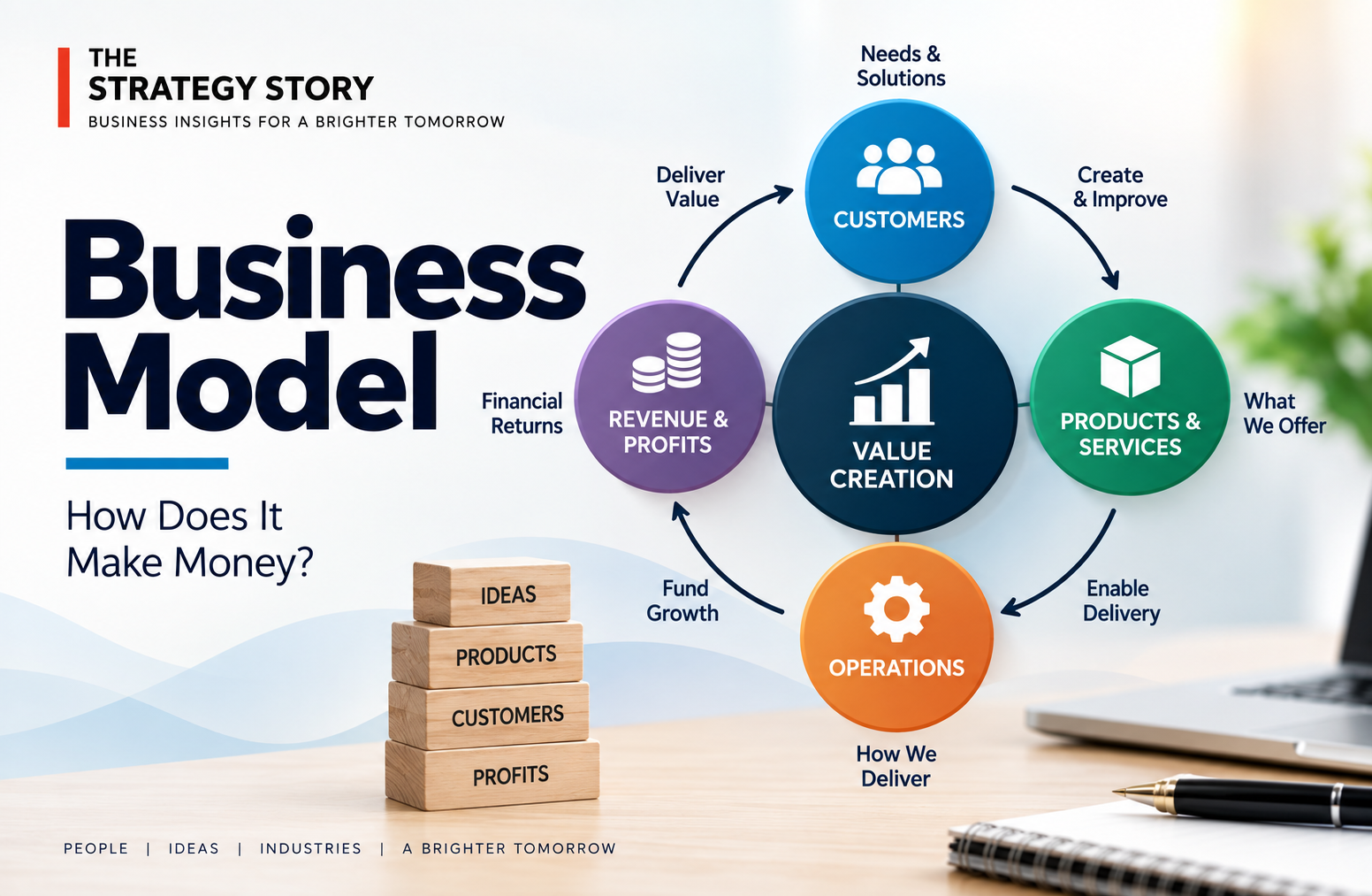
CrowdStrike is an AI-native cybersecurity company built around the Falcon platform. Its business model is overwhelmingly subscription-based: in fiscal 2026, total revenue increased 22% to $4.81 billion, subscription revenue reached $4.56 billion, and annual recurring revenue (ARR) grew 24% to $5.25 billion. The core economic idea is to land customers on a cloud-native security platform and then expand adoption across additional security modules.
Industry Problem CrowdStrike Solves
Organizations face a security environment in which attackers move across endpoints, identities, cloud workloads and data. Legacy cybersecurity architectures often require separate products, agents and management consoles, creating fragmented data and operational complexity. Security teams therefore need both stronger detection and a simpler operating architecture.
CrowdStrike addresses this through Falcon, a unified cloud-native platform built around a lightweight agent, shared data and AI-driven detection. Rather than deploying an independent architecture for every security problem, customers can activate additional Falcon modules on the same platform.
This consolidation logic is central to the CrowdStrike Business Strategy 2026.
CrowdStrike’s Unique Solution
Falcon combines endpoint protection, identity protection, cloud security, next-generation SIEM, exposure management and other capabilities on one architecture. CrowdStrike’s differentiation is not merely individual security features; it is the ability to collect security telemetry at scale and use that data across multiple modules.
The platform model creates a data flywheel. More customers and workloads generate more telemetry; that data can improve threat intelligence and AI models; stronger detection can improve platform value; and higher value can support adoption of additional modules.
The model also creates concentration around a single platform, which increases both operating leverage and operational risk. Those trade-offs are examined in our CrowdStrike SWOT Analysis 2026.
CrowdStrike Business Model
Subscription software
Subscription revenue was $4.565 billion in fiscal 2026, representing approximately 95% of total revenue. Customers subscribe to Falcon modules, creating recurring revenue that can expand as they add endpoints, workloads or additional security capabilities.
Professional services
Professional services revenue reached $247.3 million, up 29%. Services include incident response and other expertise that can strengthen customer relationships and expose organizations to CrowdStrike’s platform capabilities.
Land-and-expand platform economics
CrowdStrike can initially enter through one use case and expand into adjacent modules. This reduces the need to acquire a completely new customer for each incremental product and makes module adoption an important growth lever.
Partner ecosystem
Channel, technology and cloud relationships extend distribution and integrations. The platform must coexist with complex enterprise environments while competing to consolidate security spending.
Regulatory, AI and cybersecurity forces shaping these economics are discussed in our CrowdStrike PESTEL Analysis 2026.
How Does CrowdStrike Make Money?
CrowdStrike primarily makes money through recurring subscriptions. Fiscal 2026 subscription revenue grew 21% to $4.565 billion. Professional services added $247.3 million, bringing total revenue to $4.812 billion.
ARR reached $5.253 billion at January 31, 2026, up 24%, with approximately $1.0 billion of net new ARR added during the year. ARR is strategically important because it captures the annualized value of customer subscription contracts and therefore provides a forward-looking indicator of the recurring revenue base.
Gross profit reached $3.593 billion, producing an overall gross margin of roughly 75%. Subscription software economics support high gross margins, but CrowdStrike continues to invest heavily in sales, marketing, R&D and platform infrastructure to capture market share.
CrowdStrike Financial Analysis
Total revenue increased $858.4 million, or 22%, to $4.812 billion. Subscription revenue accounted for 95% of revenue in both fiscal 2026 and fiscal 2025, demonstrating that CrowdStrike remains fundamentally a recurring-software business rather than a services company.
Gross profit rose to $3.593 billion from $2.963 billion, broadly tracking revenue growth. Sales and marketing expense increased 20% to $1.831 billion, while general and administrative expense increased 39% to $670.3 million. CrowdStrike therefore continues to invest aggressively even at substantial scale.
The company reported a GAAP net loss attributable to CrowdStrike in fiscal 2026. Expenses associated with the July 19 Incident and related matters contributed to higher costs, illustrating how operational failures can create financial consequences beyond immediate service disruption.
The more important strategic signal is recurring revenue growth: ARR expanded faster than reported revenue, to $5.25 billion. If CrowdStrike can continue converting platform adoption into module expansion while controlling operating costs, recurring growth can create substantial operating leverage over time.
Future of CrowdStrike’s Business Model
The future model is increasingly about security-platform consolidation. Customers face pressure to reduce tool sprawl, and CrowdStrike wants Falcon to absorb spending that historically went to separate endpoint, identity, cloud, SIEM and exposure-management vendors.
AI expands both the opportunity and the threat. CrowdStrike can use AI to improve detection and automate security workflows, but attackers can also use AI to accelerate attacks. The platform’s ability to turn large-scale telemetry into useful automated security decisions will therefore be central to differentiation.
ARR growth of 24% and $1.0 billion of net new ARR show that the platform still has strong expansion momentum. The challenge is maintaining trust, resilience and innovation as Falcon becomes more deeply embedded in customer infrastructure.
If CrowdStrike successfully broadens customer module adoption, each new capability can increase revenue without requiring an entirely separate architecture. That is the fundamental scalability of the business model: one agent, one data layer and an expanding set of recurring security subscriptions.
Source: CrowdStrike, FY2026 Annual Report / Form 10-K.