
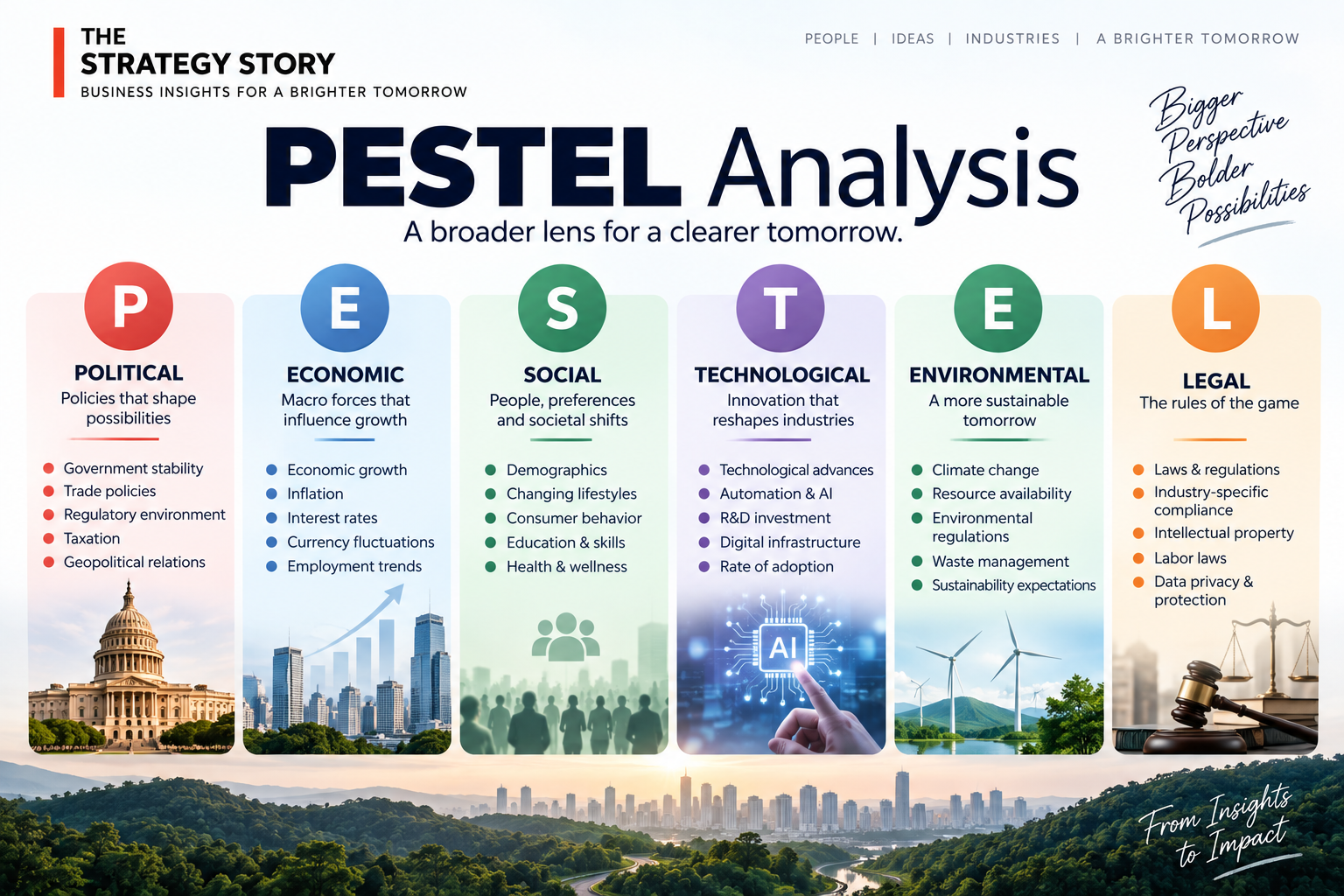
Texas Instruments operates within a semiconductor industry shaped by industrial policy, global trade, technology cycles and massive manufacturing investments. Its strategy increasingly depends on internally controlled 300-millimeter capacity, making external policy and economic conditions important to long-term returns. This PESTEL uses only TI’s 2025 Annual Report/Form 10-K.
Political Factors
1. U.S. semiconductor policy
Government incentives for domestic semiconductor manufacturing can influence the economics and timing of TI’s U.S. capacity investments.
2. U.S.-China technology tensions
Geopolitical competition can affect market access, customer behavior and semiconductor supply chains.
3. Export controls
Restrictions on semiconductor technology and sales to certain customers or regions can limit addressable demand.
4. Tariffs and trade policy
Tariffs can affect component costs, customer electronics production and the relative attractiveness of manufacturing locations.
5. Industrial localization
Governments increasingly view semiconductors as strategic infrastructure, encouraging more geographically resilient production. These risks are considered further in our Texas Instruments SWOT Analysis 2026.
Economic Factors
1. Semiconductor cyclicality
Customer inventory corrections and changes in end demand can produce sharp swings in orders and factory utilization.
2. Manufacturing utilization
TI’s cost structure depends increasingly on filling new fabrication capacity. Higher utilization can improve economics; weak utilization magnifies fixed costs.
3. Industrial capital spending
Demand from factories and infrastructure customers depends partly on business investment and economic confidence.
4. Automotive production
Vehicle production and electronic content influence demand for TI’s analog and embedded products.
5. Free-cash-flow economics
Large capital expenditures temporarily reduce free cash flow but are intended to strengthen long-term manufacturing economics. See our Texas Instruments Business Model 2026.
Social Factors
1. Growing electronics intensity
Consumers and businesses increasingly rely on electronics across vehicles, factories, homes and infrastructure.
2. Vehicle electrification and automation
More sophisticated vehicles require additional sensing, power management and embedded control functions.
3. Reliable supply expectations
Recent semiconductor shortages increased customer attention to supply assurance and geographic manufacturing resilience.
4. Energy-efficiency demand
Customers increasingly value semiconductors that improve power conversion and system efficiency.
5. Engineering talent
Semiconductor design and manufacturing require specialized technical employees, creating sustained competition for talent.
Technological Factors
1. Analog innovation
Performance improvements in power management and signal-chain products create opportunities across nearly every electronic system.
2. Embedded processing
More intelligent edge devices require microcontrollers and processors to control local functions.
3. 300-millimeter manufacturing
TI’s shift toward larger wafers is central to its cost strategy and manufacturing differentiation.
4. Long product life cycles
Analog products often evolve more slowly than leading-edge digital processors, allowing successful designs to generate revenue for years.
5. Process and packaging technology
Continued innovation in semiconductor processes and packaging supports the competitive advantages underlying the Texas Instruments Business Strategy 2026.
Environmental Factors
1. Water-intensive manufacturing
Semiconductor fabrication requires significant water resources, making availability and conservation important to factory operations.
2. Energy consumption
Wafer fabs consume substantial electricity, making energy reliability and efficiency important operating considerations.
3. Chemical and waste management
Semiconductor manufacturing uses specialized chemicals and materials subject to environmental handling and disposal requirements.
4. Extreme weather
Severe weather can disrupt manufacturing sites, suppliers, logistics and utilities.
5. Customer efficiency goals
TI’s power-management products can help electronic systems use energy more efficiently, though the annual report does not support attributing a specific revenue amount to environmental benefits.
Legal Factors
1. Intellectual-property protection
TI depends on patents, trade secrets and proprietary semiconductor designs to protect product differentiation.
2. Export-control compliance
Global semiconductor sales require compliance with evolving trade restrictions and sanctioned-party rules.
3. Environmental regulation
Fabrication facilities are subject to rules covering emissions, water, chemicals and waste.
4. Product liability
Semiconductors used in automotive, industrial and other critical systems can create liability if failures contribute to customer-system problems.
5. Data and cybersecurity law
TI must protect corporate, customer and technical information and comply with evolving privacy and cybersecurity requirements.
Source: Texas Instruments, 2025 Annual Report / Form 10-K.