
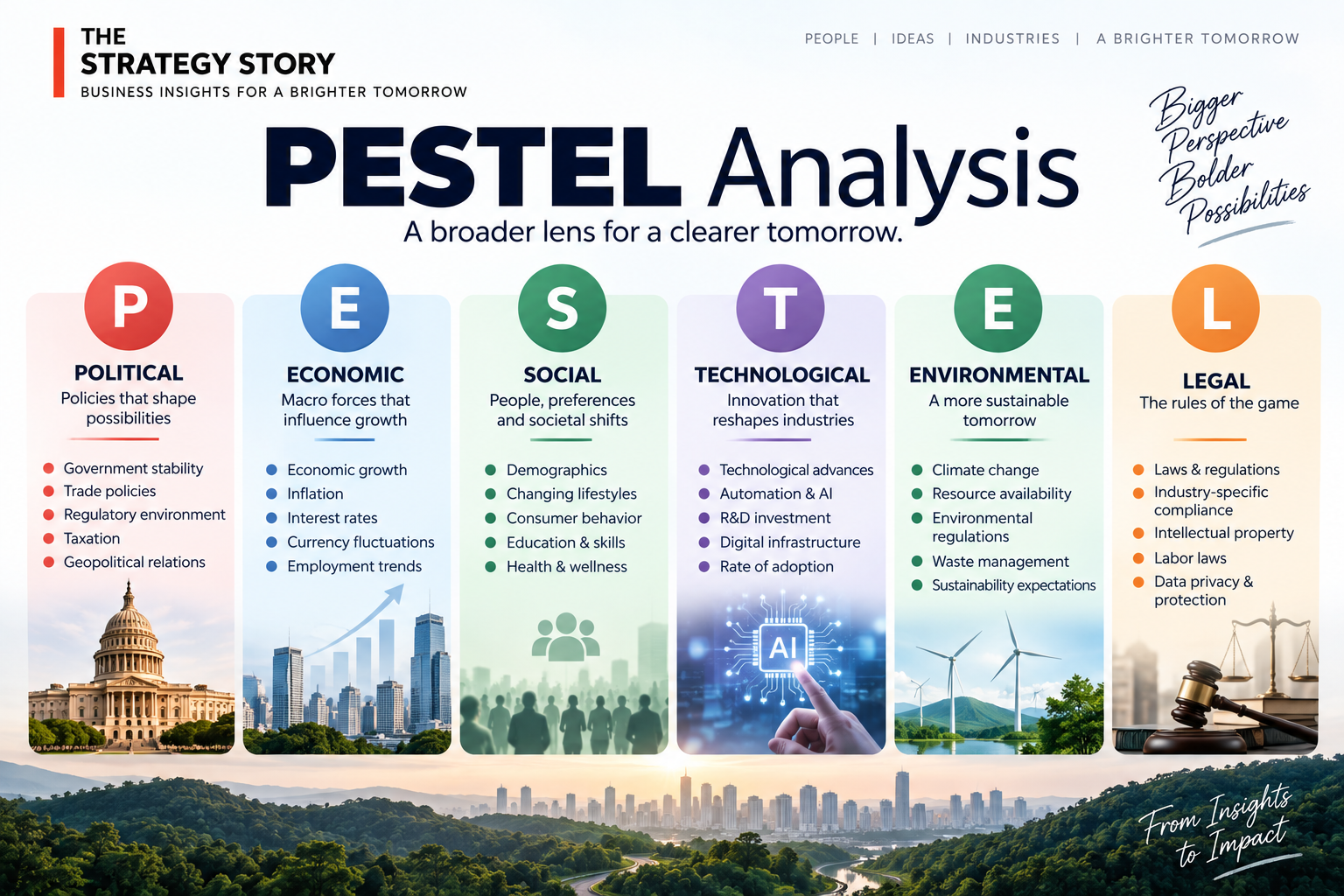
Goldman Sachs operates inside a dense network of monetary policy, financial regulation, capital markets, technology and global economic conditions. As a bank holding company and globally systemically important financial institution, external policy directly influences its capital, liquidity and business economics. This PESTEL uses only Goldman Sachs’ 2025 Form 10-K.
Political Factors
1. Financial regulation
Goldman is regulated by the Federal Reserve and numerous authorities globally. Changes in capital, liquidity or activity restrictions can materially alter business economics.
2. International trade policy
The 2025 environment included uncertainty from changing trade policies and tariffs, contributing to market volatility and recession concerns.
3. Geopolitical conflict
Wars and political instability can disrupt markets, counterparties and client activity across Goldman’s global businesses.
4. Tax policy
Goldman is subject to a 1% non-deductible federal excise tax on certain share repurchases, illustrating how tax policy affects capital-return decisions.
5. Regulatory divergence
Overlapping and divergent rules across jurisdictions increase compliance complexity. These constraints are discussed further in our Goldman Sachs SWOT Analysis 2026.
Economic Factors
1. Interest rates
Rates affect funding costs, client activity, asset values and net interest income. Goldman’s 2025 net interest income rose 68% to $13.56 billion, partly because interest expense declined.
2. Capital-market activity
M&A, underwriting and trading revenues depend on investor confidence, valuations, financing availability and corporate activity.
3. Market volatility
Volatility can increase trading activity but also raises market and counterparty risks. Its impact depends on liquidity, client flows and positioning.
4. Credit conditions
Credit spreads and borrower health affect lending, financing and investment portfolios as well as client transaction activity.
5. Asset values
Asset & Wealth Management fees are influenced by client assets and investment performance. The economics are detailed in our Goldman Sachs Business Model 2026.
Social Factors
1. Competition for specialized talent
Goldman’s services depend heavily on skilled employees. Its workforce represented more than 190 countries and spoke over 175 languages at December 2025.
2. Geographic workforce evolution
45% of employees worked in strategic locations, reflecting a shift toward global centers of excellence outside traditional financial hubs.
3. Client expectations for integrated service
Institutional clients increasingly expect seamless access to advice, financing, markets and investment solutions, reinforcing the One Goldman Sachs model.
4. Wealth creation and demographics
Growth in private wealth can expand demand for investment management, financial planning and advisory services.
5. Reputation and trust
Client relationships and regulatory standing depend on confidence in Goldman’s conduct, controls and risk management.
Technological Factors
1. AI adoption
AI can improve productivity and analytics but also creates emerging operational and information-security risks.
2. Cybersecurity
Goldman identifies cybersecurity as a risk to data confidentiality, integrity, systems, reputation and the broader financial system.
3. Cloud dependence
Use of cloud-hosted services diversifies data across external providers, increasing third-party information risk.
4. Electronic markets
Technology is integral to institutional trading, pricing, risk management and execution, requiring continued infrastructure investment.
5. Scalable operating platforms
Technology and strategic locations can industrialize internal processes while supporting global client service. This forms part of the Goldman Sachs Business Strategy 2026.
Environmental Factors
1. Extreme weather risk
Goldman identifies extreme weather and natural disasters as events capable of disrupting markets, operations and counterparties.
2. Client transition needs
Goldman’s sustainability approach centers on helping clients pursue their own strategic priorities, creating advisory and financing needs as industries evolve.
3. Sustainability regulation
The firm is subject to laws and regulations concerning sustainability-related risk oversight, disclosure and practices.
4. Physical operational disruption
Natural disasters can impair offices, infrastructure, travel and business continuity, making operational resilience important.
5. Changing disclosure expectations
Divergent sustainability rules across jurisdictions can raise compliance costs and create reporting complexity.
Legal Factors
1. Pervasive financial-services law
Goldman faces extensive regulation globally and can be fined, sanctioned or restricted if authorities challenge its compliance.
2. Capital and liquidity requirements
Legal and regulatory rules determine minimum capital, liquidity and funding standards and can constrain distributions from subsidiaries.
3. Data privacy regulation
Rules governing access to and use of personal financial data create accuracy, retention, security and compliance obligations.
4. Litigation and enforcement
Goldman is exposed to private litigation and enforcement by law, regulatory and tax authorities across jurisdictions.
5. Resolution-planning requirements
As a major financial institution, Goldman maintains resolution capital and liquidity frameworks intended to support an orderly wind-down if the parent were to enter bankruptcy.
Source: Goldman Sachs, 2025 Form 10-K.