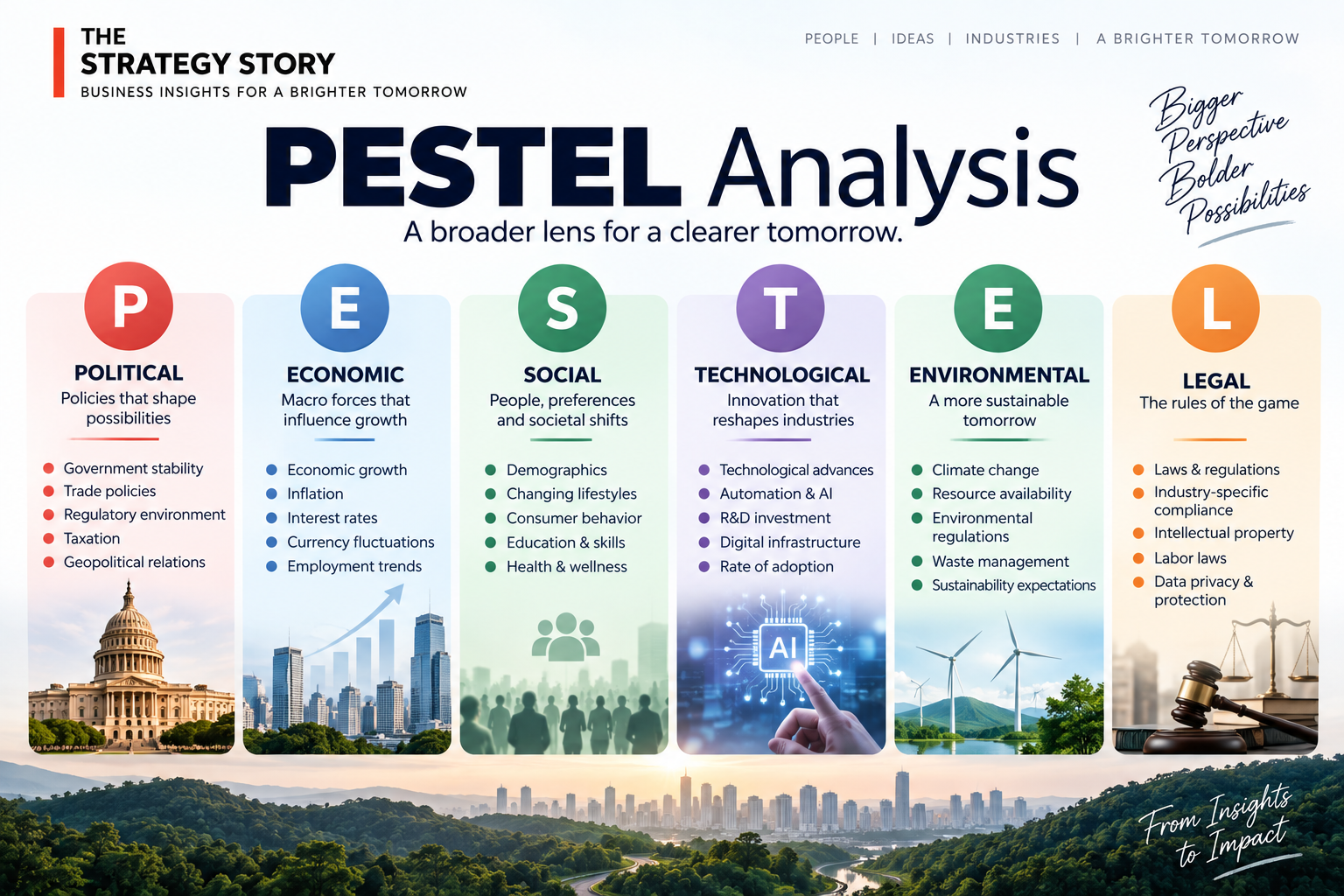

Applied Materials operates at the intersection of advanced technology, global manufacturing and national industrial policy. That makes external forces unusually important to its economics. In fiscal 2025 the company generated $28.37 billion of revenue across a globally distributed customer base, while China alone represented 30%. This PESTEL analysis uses only Applied Materials’ FY2025 Form 10-K.
Political Factors
1. U.S. semiconductor export controls
U.S. regulations restrict certain semiconductor technologies, products and services supplied to China. Applied must obtain additional export licenses for some transactions, and licenses may be difficult or impossible to secure.
2. China-U.S. strategic competition
China revenue fell 16% to $8.53 billion in 2025. The scale of this exposure means geopolitical decisions can materially affect revenue mix and customer relationships. See our Applied Materials SWOT Analysis 2026 for how this translates into company-level risk.
3. Tariffs and retaliatory trade measures
Applied notes increased U.S. tariffs and retaliatory measures by China and other countries. These actions create uncertainty for sourcing, manufacturing economics and customer investment decisions.
4. Industrial-policy incentives
Government incentives can influence where semiconductor capacity and R&D are built. Applied reported $1.2 billion of capital-expenditure-related incentives reducing gross property, plant and equipment as of fiscal year-end, showing that policy can directly affect investment economics.
5. Regulatory fragmentation
Semiconductor supply chains span the U.S., Asia, Europe and Israel. Different national security, trade and technology policies increase compliance complexity and can reshape which customers Applied can serve.
Economic Factors
1. Semiconductor capital-spending cycles
Applied’s core equipment demand depends on fab capacity and technology investment. Semiconductor Systems generated $20.80 billion in 2025, making capital-spending cycles central to company performance.
2. AI-led investment cycle
Management identifies AI and data-center computing as long-term semiconductor growth drivers. Strong investment in leading-edge logic, HBM and packaging can increase demand for Applied’s equipment.
3. Revenue mix and margin economics
Consolidated revenue rose 4.4% to $28.37 billion while gross profit rose 7.1% to $13.81 billion. Semiconductor Systems gross margin expanded to 54.2%, illustrating how product mix, pricing and manufacturing costs can amplify economic outcomes.
4. Service revenue provides partial stabilization
AGS generated $6.39 billion of revenue and benefits from the installed base rather than only new fab construction. The interaction between equipment and services is explained in our Applied Materials Business Model 2026.
5. Backlog supports visibility but not certainty
Year-end backlog was about $15.0 billion, but 31% was not expected to be filled within 12 months. Applied cautions that orders can be amended, delayed or cancelled and can be affected by export rules.
Social Factors
1. Digitization expands semiconductor demand
Applied identifies AI, IoT, robotics, connected devices and smart vehicles as secular drivers. Greater digital intensity across society expands the long-term need for semiconductors.
2. Consumer device refresh cycles
PC and smartphone replacement cycles remain relevant demand drivers. Even as AI becomes more important, mainstream consumer electronics continue to influence semiconductor investment.
3. Global engineering talent
Applied conducts product development and engineering primarily in the U.S., India and Israel. Its ability to access specialized technical talent across these regions is important to innovation.
4. Customer proximity matters
Customer demonstrations occur primarily in the U.S., China, Taiwan, Israel and South Korea. Close technical collaboration is socially and organizationally important because equipment must be qualified within customer process roadmaps.
5. Automation changes manufacturing requirements
As fabs become more automated and complex, customers need software and services that improve productivity. AGS factory-automation software positions Applied to participate in this shift.
Technological Factors
1. Increasing device complexity
Smaller dimensions, complex architectures and new materials increase manufacturing difficulty. Applied’s strategy is designed around this rising materials-engineering intensity.
2. Advanced packaging
Advanced packaging is becoming increasingly important for combining logic and memory in high-performance systems. Applied identifies it as an area supporting future equipment investment.
3. High-bandwidth memory
HBM adoption is expected to support semiconductor equipment demand. AI systems require large amounts of high-performance memory, creating opportunities across memory fabrication and packaging.
4. Continuous RD&E requirements
Applied invested $3.57 billion in RD&E in 2025, up about 10%. The company must develop products before strong demand emerges because customers select manufacturing technologies well ahead of volume production.
5. Technology co-optimization
Applied’s broad portfolio enables it to connect process technologies rather than optimize tools independently. This is a central pillar of the Applied Materials Business Strategy 2026.
Environmental Factors
1. Resource intensity of semiconductor manufacturing
Semiconductor fabrication requires complex manufacturing infrastructure. Applied’s equipment design and factory optimization can influence customers’ production efficiency, although the 10-K does not quantify a company-wide environmental benefit from these technologies.
2. Manufacturing footprint exposure
Applied operates globally, so facilities and supply chains can be exposed to environmental disruptions. Business continuity therefore depends partly on resilient operations and supplier networks.
3. Customer sustainability requirements
Large semiconductor manufacturers increasingly manage energy, water and materials across advanced fabs. Applied must align equipment development with customer production requirements; the 10-K, however, does not provide enough evidence to quantify the revenue impact of sustainability demand.
4. Environmental regulation
Global manufacturing activities are subject to environmental rules that can affect facilities, materials handling and operating costs. Compliance is part of the broader regulatory burden of operating across multiple jurisdictions.
5. Long equipment life increases service relevance
Customers seek to optimize the performance and productivity of installed equipment. Services and spares can support continued operation of existing tools, making lifecycle management economically important even though the filing does not quantify its environmental effect.
Legal Factors
1. Export-license compliance
Applied must comply with complex and evolving U.S. export rules. Violations or inability to secure licenses can restrict sales and services to specific customers and markets.
2. Intellectual-property protection
Advanced semiconductor equipment depends on proprietary process knowledge. Protecting intellectual property is critical because technology differentiation underpins equipment qualification and pricing.
3. Cybersecurity obligations
Applied warns that cyber incidents could disrupt product development, manufacturing, customer interactions and financial reporting, while also exposing confidential information and intellectual property.
4. Global compliance complexity
Operating across multiple countries exposes Applied to different trade, tax, employment, data and business regulations. Changes in interpretation can increase compliance costs and uncertainty.
5. Contractual exposure in backlog
Backlog includes accepted orders and contractual service revenue, but customers may delay deliveries or cancel orders subject to possible penalties. Legal contract terms therefore influence how much backlog ultimately converts into revenue.
Source: Applied Materials, FY2025 Form 10-K.