
Micron Technology is one of the world’s leading semiconductor companies specializing in memory and storage solutions. Founded in 1978 and headquartered in Boise, Idaho, the company designs, manufactures, and sells DRAM, NAND, and NOR memory products that power everything from smartphones and personal computers to cloud data centers, automobiles, industrial equipment, and artificial intelligence (AI) systems. Unlike many semiconductor companies that outsource manufacturing, Micron owns and operates advanced fabrication facilities across the United States, Taiwan, Japan, Singapore, Malaysia, China, and India, giving it greater control over technology development, production, and product quality.

The company operates through four business units: the Cloud Memory Business Unit, Core Data Center Business Unit, Mobile and Client Business Unit, and Automotive and Embedded Business Unit, allowing it to serve diverse end markets with specialized memory solutions. Its portfolio includes high-bandwidth memory (HBM), DDR5, LPDDR, GDDR, enterprise SSDs, managed NAND, and automotive-grade memory products that support next-generation AI and data-intensive applications.
As AI adoption accelerates worldwide, demand for high-performance memory has become a major growth driver for Micron. Modern AI models, cloud infrastructure, and high-performance computing systems require significantly greater memory bandwidth, storage capacity, and energy efficiency than previous computing workloads. Micron has positioned itself to capitalize on this trend through continuous investments in advanced manufacturing technologies, including its 1γ (1-gamma) DRAM process, G9 NAND technology, and next-generation High-Bandwidth Memory (HBM) products. These innovations have helped the company become one of the most important suppliers of memory chips powering the global AI ecosystem.

Industry Background and the Problem
The semiconductor memory industry forms the foundation of modern digital computing. Every smartphone, personal computer, cloud server, automobile, industrial system, and AI application depends on memory and storage technologies to process, store, and retrieve enormous amounts of data. As digital transformation accelerates, the amount of data being generated worldwide continues to grow rapidly, driving demand for faster, denser, and more energy-efficient memory solutions. Emerging technologies such as artificial intelligence (AI), high-performance computing (HPC), 5G, autonomous vehicles, and edge computing are significantly increasing memory requirements, making advanced memory a critical enabler of next-generation computing.
However, meeting this demand presents significant challenges. AI models require substantially higher memory bandwidth and capacity than traditional computing applications, while cloud data centers must process massive workloads with lower latency and improved power efficiency. At the same time, smartphones and automotive systems require memory that delivers higher performance while consuming less power and occupying smaller physical footprints. As computing workloads become increasingly data-intensive, memory performance has become one of the primary bottlenecks limiting overall system performance.
The industry itself is also highly complex and capital intensive. Developing advanced memory technologies requires continuous investment in research and development, cutting-edge semiconductor manufacturing processes, and large-scale fabrication facilities that cost billions of dollars to build and operate. Technology cycles are rapid, product lifecycles are short, and manufacturers must continually improve chip density, performance, and manufacturing efficiency while reducing production costs. In addition, memory markets are cyclical, with supply-demand imbalances often causing significant fluctuations in pricing and profitability.

These trends have increased the importance of companies capable of delivering innovative memory technologies at scale. Manufacturers must not only develop faster and more power-efficient memory products but also maintain reliable global manufacturing capacity to support growing demand across data centers, AI infrastructure, consumer electronics, automotive systems, and industrial applications. As AI becomes one of the biggest drivers of semiconductor demand, advanced memory has evolved from a supporting component into a strategic technology that directly influences the performance and capabilities of modern computing systems.
How Micron Solves the Problem
Micron addresses the growing demand for faster and more efficient computing by developing advanced memory and storage technologies that power modern digital systems. Rather than focusing on processors, Micron specializes in high-performance memory solutions that enable processors and AI accelerators to rapidly access, process, and store vast amounts of data. Its portfolio spans DRAM, NAND, and NOR memory products, serving diverse markets including cloud data centers, artificial intelligence (AI), personal computers, mobile devices, automotive systems, industrial equipment, and networking infrastructure.
The company’s DRAM portfolio is designed to meet the varying performance requirements of different applications. For AI servers and high-performance computing, Micron offers High-Bandwidth Memory (HBM), which significantly increases memory bandwidth while reducing power consumption, enabling AI accelerators to process increasingly complex models. It also provides DDR5 DRAM for servers, LPDDR memory for smartphones and mobile devices, and GDDR memory for graphics-intensive applications. These products help improve system responsiveness, increase computational throughput, and reduce energy consumption across a wide range of workloads.
Complementing its DRAM portfolio is Micron’s NAND flash business, which delivers high-capacity storage solutions for enterprise, consumer, and embedded applications. The company manufactures enterprise solid-state drives (SSDs), client SSDs, managed NAND products, removable storage, and automotive storage solutions that provide faster data access, greater storage density, and improved reliability compared to traditional storage technologies. These products enable organizations to manage rapidly expanding data volumes while supporting cloud infrastructure, AI applications, and edge computing environments.
Micron’s ability to solve customers’ challenges is also supported by continuous technology innovation and advanced manufacturing. The company invests heavily in research and development to improve memory density, speed, and power efficiency through new process technologies such as 1γ (1-gamma) DRAM and G9 NAND. Unlike many semiconductor companies, Micron owns and operates a global network of fabrication and assembly facilities, allowing it to tightly integrate product design, manufacturing, testing, and packaging while maintaining quality and supply reliability.
By combining leading-edge memory technologies, global manufacturing capabilities, and continuous process innovation, Micron provides the critical memory and storage infrastructure required to support AI, cloud computing, data centers, automotive electronics, and the next generation of intelligent devices. As computing workloads continue to become more data-intensive, the company’s solutions help customers improve system performance, increase efficiency, and unlock new capabilities across virtually every segment of the digital economy.
Micron Business Model
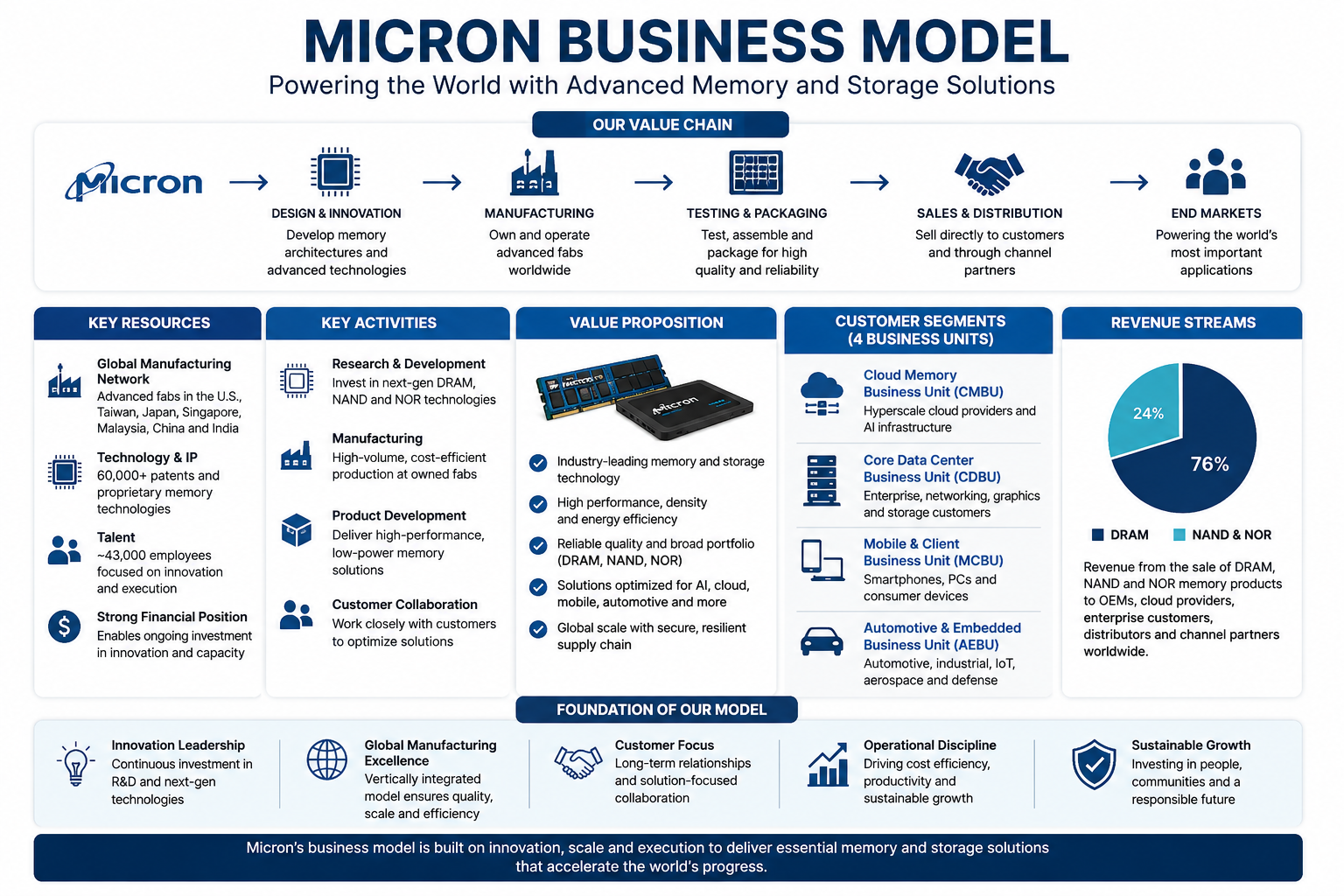
Micron operates a vertically integrated semiconductor business model, designing, manufacturing, and selling advanced memory and storage products to customers worldwide. Unlike fabless semiconductor companies that outsource manufacturing, Micron owns and operates a global network of fabrication, assembly, and testing facilities. This integrated approach allows the company to control product development, manufacturing quality, production capacity, and supply chain efficiency while accelerating the commercialization of new memory technologies. Its business model is centered on continuous innovation, manufacturing scale, and serving diverse end markets that increasingly rely on high-performance memory.
The company organizes its operations through four customer-focused business units, enabling it to develop specialized products for different industries. The Cloud Memory Business Unit (CMBU) supplies DRAM products for hyperscale cloud providers and AI infrastructure. The Core Data Center Business Unit (CDBU) focuses on enterprise servers, networking, graphics, and storage solutions. The Mobile and Client Business Unit (MCBU) serves smartphone manufacturers, personal computer companies, and consumer device makers, while the Automotive and Embedded Business Unit (AEBU) develops memory products for vehicles, industrial automation, aerospace, defense, and Internet of Things (IoT) applications. This diversified structure reduces dependence on any single market while allowing Micron to capitalize on multiple long-term technology trends.
Micron’s business model is driven by significant investments in research and development. The company continuously develops new DRAM and NAND process technologies, advanced packaging solutions, and next-generation memory architectures to improve performance, storage density, and energy efficiency. These innovations are then manufactured at scale through Micron’s global production network before being sold directly to original equipment manufacturers (OEMs), cloud providers, enterprise customers, distributors, and channel partners. The company also markets certain consumer products under the Crucial brand, expanding its reach into retail and enthusiast markets.
The model creates a self-reinforcing cycle. Continuous R&D drives technological leadership, manufacturing scale lowers production costs, and strong customer relationships generate recurring demand across AI, cloud computing, mobile devices, automotive systems, and industrial applications. As demand for memory-intensive workloads continues to grow, particularly in artificial intelligence, Micron’s vertically integrated business model enables it to rapidly commercialize new technologies while maintaining operational efficiency and long-term competitiveness.
How Micron Makes Money
Micron generates revenue by designing, manufacturing, and selling memory and storage products to customers across cloud computing, data centers, mobile devices, personal computers, automotive, industrial, and consumer markets. Its revenue is primarily derived from the sale of DRAM, NAND, and NOR memory products, with DRAM representing the largest contributor. Products are sold directly to original equipment manufacturers (OEMs), hyperscale cloud providers, enterprise customers, distributors, and channel partners. Because memory chips are essential components in virtually every modern computing device, Micron benefits from demand across multiple high-growth industries, particularly artificial intelligence (AI) and cloud infrastructure.
DRAM is Micron’s largest revenue generator. In fiscal 2025, DRAM contributed approximately 76% of total revenue, driven by strong demand from AI servers, cloud data centers, enterprise computing, smartphones, and personal computers. The rapid adoption of generative AI significantly increased demand for High-Bandwidth Memory (HBM), a specialized DRAM technology that enables AI accelerators to process large datasets at much higher speeds. Management identified HBM as one of the company’s fastest-growing product categories as hyperscale cloud providers continue expanding AI infrastructure.
The remaining 24% of revenue came primarily from NAND and NOR flash memory products. NAND is used in enterprise solid-state drives (SSDs), client SSDs, smartphones, and embedded storage solutions, while NOR memory serves automotive, industrial, networking, and embedded applications where reliability is critical. Together, these products diversify Micron’s revenue across multiple end markets while reducing dependence on any single customer segment.
Micron’s revenue growth in 2025 was fueled by AI-driven demand and improving memory pricing. The company reported $35.0 billion in fiscal 2025 revenue, a significant increase from $25.1 billion in 2024. Gross margin improved to approximately 37%, while operating income reached $8.5 billion, reflecting stronger pricing, higher sales volumes, and an improved product mix led by AI memory solutions.
Beyond product sales, Micron strengthens its earnings through continuous technology leadership. By introducing advanced products such as HBM, DDR5, 1γ (1-gamma) DRAM, and G9 NAND, the company captures higher-value opportunities in AI, cloud computing, and high-performance computing. Its vertically integrated manufacturing model also enables greater control over production costs, product quality, and supply, helping maintain long-term profitability even as the memory industry experiences cyclical demand. As AI infrastructure investment accelerates globally, Micron is increasingly positioned to generate a larger share of its revenue from premium, high-performance memory products rather than commodity memory alone.
Future Outlook
Micron’s future is closely tied to the rapid expansion of artificial intelligence, cloud computing, and data-intensive applications, which are driving unprecedented demand for advanced memory and storage solutions. The company expects AI to remain its largest long-term growth opportunity, particularly through increasing adoption of High-Bandwidth Memory (HBM) used in AI accelerators and next-generation data centers. To strengthen its technology leadership, Micron continues investing in next-generation products such as 1γ (1-gamma) DRAM, G9 NAND, and future HBM generations, while expanding advanced packaging capabilities to meet growing customer demand. The company is also increasing manufacturing capacity through investments in the United States and internationally, supported by government incentive programs aimed at strengthening domestic semiconductor production.
Beyond AI, Micron expects long-term growth from cloud infrastructure, automotive electronics, industrial automation, and edge computing, all of which require faster, denser, and more energy-efficient memory solutions. Management believes these structural demand drivers will support continued growth in memory content per device across multiple end markets. By combining leading-edge technology, a globally integrated manufacturing network, disciplined capital investments, and close collaboration with customers, Micron aims to strengthen its position as one of the world’s leading memory manufacturers and capitalize on the increasing importance of memory in the AI-driven digital economy.