
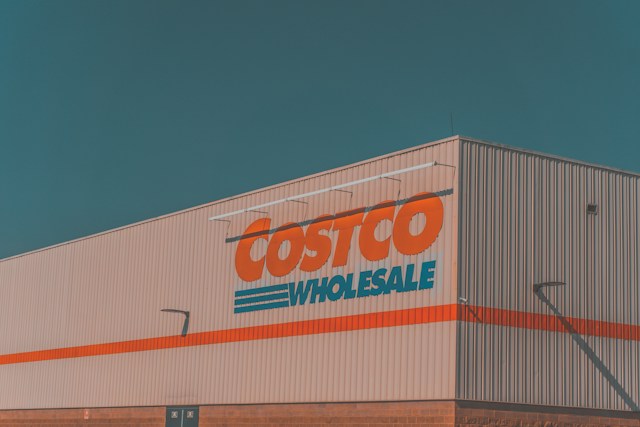
Costco’s membership-warehouse model operates across a complex external environment shaped by trade policy, consumer spending, demographics, retail technology, environmental conditions and regulation. In fiscal 2025, Costco generated $275.24 billion of total revenue across 914 warehouses worldwide, making changes in these external forces relevant to both merchandise economics and member loyalty.
For how Costco’s membership and merchandise economics work together, read our Costco Business Model 2026.
Political Factors
1. Tariff and trade-policy changes
Costco sources merchandise through global supply chains, so tariffs and trade restrictions can raise product costs or alter sourcing decisions. Because its strategy emphasizes low member prices, higher import costs create a trade-off between passing costs through and absorbing pressure in Costco’s relatively thin merchandise margins.

2. Cross-border operating regulation
Costco operates warehouses across North America, Europe and Asia-Pacific markets. Each jurisdiction can impose different retail, employment, product, tax and import requirements. International expansion therefore requires Costco to adapt operations while preserving a consistent membership and low-price proposition.
3. Tax policy
Changes in corporate, sales, property and other taxes can affect Costco’s costs and investment returns. The company’s effective tax rate was 25.1% in fiscal 2025, compared with 24.4% in 2024, demonstrating that tax outcomes can influence net income even when underlying retail operations grow.
4. Government policy affecting labor
Warehouse retail is labor intensive. Changes in wage requirements, benefits rules, scheduling regulations or other employment policies can increase operating costs. Costco must manage these requirements while maintaining service levels and preserving the cost structure needed to support low merchandise prices.

5. Geopolitical and supply-chain disruption
Political instability or international disputes can affect transportation, sourcing and product availability. Costco’s large purchasing scale provides options, but global sourcing also creates dependencies. Disruption can require alternative suppliers or routes, potentially increasing cost and reducing the availability of selected merchandise.
For how Costco is strategically responding to growth and operating complexity, see our Costco Business Strategy 2026.
Economic Factors
1. Consumer spending conditions
Costco sells food, household goods, discretionary non-food items and services. Economic weakness can change category mix and discretionary demand. The membership model and value positioning may support traffic, but member spending and average ticket remain influenced by employment, income, inflation and consumer confidence.
2. Inflation and deflation
Changes in merchandise costs directly affect reported sales and margins. Costco’s low-price strategy can limit its willingness to pass all inflation through. Deflation also matters: lower gasoline prices reduced fiscal 2025 net sales by $2.33 billion even though fuel volume increased approximately 2%.
3. Foreign-exchange movements
Currency changes reduced 2025 net sales by approximately $1.94 billion and net income by $97 million. With significant Canadian and Other International operations, Costco’s reported dollar results can diverge from local-market performance, creating volatility as the company expands internationally.
4. Interest rates and capital costs
Warehouse expansion, logistics facilities and technology require capital. Interest-rate conditions can influence financing economics and broader consumer behavior. Costco’s strong operating cash generation reduces dependence on external funding, but capital costs still affect the economic environment in which expansion decisions are made.
5. Fuel economics
Costco operated 747 gas stations, and gasoline represented approximately 10% of 2025 net sales. Fuel prices can materially change reported revenue, gross-margin percentages and customer traffic. The business therefore creates both a member-frequency advantage and exposure to commodity-price movements.
For a consolidated assessment of Costco’s strengths, weaknesses, opportunities and threats, read our Costco SWOT Analysis 2026.
Social Factors
1. Consumer demand for value
Costco’s proposition is built around low prices and quality. When households focus on value, bulk purchasing and private label can become more attractive. Maintaining member trust in savings is essential because the annual membership must continue to feel economically worthwhile.
2. Loyalty to membership ecosystems
Renewal rates were 92.3% in the U.S. and Canada and 89.8% worldwide in 2025. These rates show the importance of habit and loyalty in Costco’s model. Consumer willingness to pay recurring fees depends on perceived savings, product quality, convenience and the breadth of membership benefits.
3. Changing shopping preferences
Members increasingly expect both physical and digital convenience. Costco’s comparable e-commerce sales grew 16% in 2025, well above total company comparable growth. The company must respond to online shopping preferences without undermining the economics and experiential advantages of its warehouse model.
4. Private-label acceptance
Kirkland Signature relies on consumer trust in Costco’s quality standards. Costco expects private-label penetration to rise and notes that Kirkland generally earns higher margins. Growing acceptance creates opportunity, while a quality failure could have wider reputational consequences because the Costco name is closely associated with the brand.
5. Workforce expectations
Costco’s warehouses, logistics network and ancillary services depend on a large workforce. Employee expectations around wages, benefits, scheduling, safety and career development can influence retention and operating costs. Labor availability can also affect Costco’s ability to open and operate new locations successfully.
Technological Factors
1. E-commerce expansion
E-commerce represented approximately 7% of total net sales and comparable e-commerce sales grew 16% in 2025. Technology enables Costco to offer broader selection and convenience, but the company states that e-commerce carries a lower gross-margin percentage than warehouse operations.
2. Digital membership acquisition
Online channels can expand membership acquisition, including through digital promotions. Costco notes, however, that memberships sold online renew at a slightly lower average rate. Technology therefore expands the top of the membership funnel while creating a need to improve engagement and renewal of digitally acquired cohorts.
3. Logistics and fulfillment technology
Costco’s e-commerce operations use depots, logistics operations, supplier drop-ship arrangements and other delivery methods. Technology that improves inventory visibility, routing and fulfillment can support convenience and efficiency as digital sales grow, while failures can disrupt member service.
4. Payment and retail systems
Costco depends on technology across point-of-sale transactions, membership records, inventory, payments and financial reporting. Reliable systems are essential because high warehouse volumes can amplify the impact of outages. Technology investment must therefore support both operating efficiency and resilience.
5. Cybersecurity
Costco identifies cybersecurity as an enterprise risk and acknowledges that protective actions cannot guarantee system security. A breach could affect member information, payments, operations or e-commerce. Growing digital engagement increases the importance of governance, monitoring, controls and third-party technology risk management.
Environmental Factors
1. Severe-weather disruption
Warehouses, logistics facilities and supply routes can be affected by storms, floods, fires and other physical events. Disruption can reduce store availability, delay merchandise or raise logistics costs. A geographically broad network diversifies some exposure but also creates more locations potentially affected by regional events.
2. Energy use across a large footprint
Costco operated approximately 134.7 million square feet of warehouse floor space plus 32.2 million square feet of distribution and logistics facilities. Operating a network of this scale requires substantial energy and facility management, making efficiency relevant to long-term operating costs.
3. Fuel business exposure
With 747 gas stations and gasoline accounting for roughly 10% of net sales, Costco has meaningful exposure to changes affecting fuel retail. Environmental policy, vehicle technology and consumer behavior can influence fuel demand over time, while near-term gasoline economics continue to affect reported sales.
4. Packaging and merchandise footprint
Costco’s high-volume retail model involves large flows of packaged goods. Changes in packaging regulation, waste requirements or supplier practices can affect sourcing and cost. Limited assortment and purchasing scale can also make supplier-level changes material across large unit volumes.
5. Supply-chain resilience
Environmental events can affect agriculture, manufacturing, transportation and supplier availability. Costco’s value proposition depends on consistent quality and availability, particularly for Kirkland Signature. Supply disruptions may require alternative sourcing and can challenge the balance between low prices and dependable inventory.
Legal Factors
1. Product safety and liability
Costco sells food, pharmaceuticals, consumer goods and private-label products. Product defects, contamination or safety issues can create recalls, litigation and reputational damage. Kirkland Signature increases the importance of quality control because Costco’s own brand is directly associated with the affected merchandise.
2. Employment law
Costco must comply with wage, hour, benefits, workplace-safety and other employment requirements across many jurisdictions. Changes in these rules can affect SG&A costs and operational flexibility. The scale of Costco’s warehouse workforce makes employment compliance a material operating consideration.
3. Data privacy regulation
Membership and e-commerce operations involve personal, transactional and payment information. Privacy laws can impose requirements on collection, storage, use and protection of data. As digital engagement expands, Costco must manage differing legal standards across the countries where it operates.
4. Competition and consumer-protection law
Pricing, promotions, memberships, supplier relationships and merchandise claims operate within competition and consumer-protection frameworks. Costco’s international footprint requires compliance across multiple legal systems, and regulatory changes can affect commercial practices or increase administrative costs.
5. Intellectual-property protection
Costco identifies its trademarks and brands, including Kirkland Signature, as important assets. Protecting trademarks, trade names, proprietary processes and other intellectual property helps preserve differentiation. Unauthorized use or brand dilution could weaken the value created by Costco’s private-label strategy.
Across these PESTEL forces, Costco’s membership model can provide some resilience but does not remove external exposure. Political or economic cost shocks can pressure low merchandise margins, social and technological change can alter shopping behavior, environmental events can interrupt supply, and legal obligations expand with geographic and digital scale. Costco must therefore preserve member value while continuously adapting the operating system behind it.
Source: Costco Wholesale Corporation, FY2025 Annual Report / Form 10-K.