
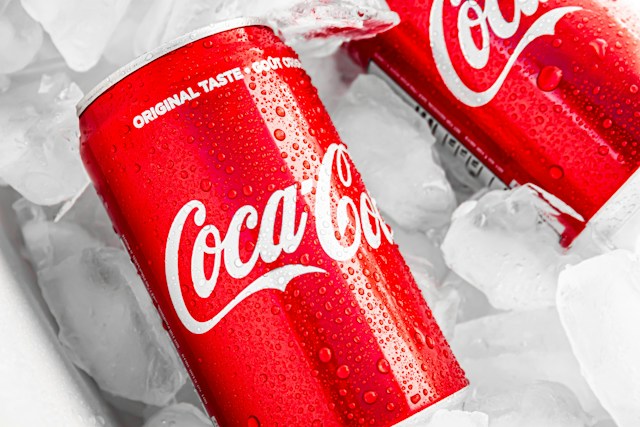
The Coca-Cola Company is one of the world’s largest nonalcoholic beverage companies, with a portfolio sold through a global system of bottling partners, distributors, wholesalers, retailers and company-owned operations. In 2025, beverages bearing trademarks owned by or licensed to Coca-Cola represented about 2.2 billion of the estimated 65 billion servings of all beverages consumed worldwide each day. The Coca-Cola system sold 33.8 billion unit cases during the year.

Coca-Cola’s business model is distinctive because the company does not need to manufacture and distribute every finished bottle or can itself. It concentrates a large part of its economics around brands, beverage concentrates, syrups and relationships with bottling partners, while its bottlers perform much of the capital-intensive manufacturing, packaging and physical distribution. Coca-Cola also operates finished-product businesses directly in selected markets and categories.
For 2025, Coca-Cola generated $47.94 billion in net operating revenue, up 2% from $47.06 billion in 2024. Concentrate operations accounted for 59% of revenue while finished-product operations represented 41%. Yet concentrate operations represented 85% of worldwide unit case volume, illustrating the economic importance of Coca-Cola’s asset-light concentrate model.

Coca-Cola Business Strategy 2026
The Beverage Industry and the Problem Coca-Cola Addresses
Coca-Cola operates in a highly competitive commercial beverage industry. Consumers can choose among sparkling soft drinks, water, sports drinks, coffee, tea, juice, dairy and plant-based beverages, energy drinks and numerous local alternatives. Demand is influenced by taste, affordability, convenience, health considerations, lifestyle changes and availability across consumption occasions.
The industry creates a difficult operating challenge. A beverage company must simultaneously build brands that consumers recognize, create products for changing preferences, make those products available at enormous scale and execute manufacturing and distribution efficiently. Coca-Cola’s annual report identifies competition, consumer spending, economic conditions, water availability and quality, consumer preferences, inflation, geopolitical conditions, regulation, foreign exchange, fuel prices, weather and health crises among the factors affecting the industry.

Global scale also creates fragmentation. Consumer preferences differ substantially by geography, package size, channel and occasion. A product that succeeds in one country may require different flavors, price points, packaging or marketing in another. Coca-Cola therefore needs a system capable of combining global brands and capabilities with local commercial execution.
Another challenge is physical distribution. Beverages are relatively heavy products, and moving finished drinks over long distances can be inefficient. Coca-Cola’s bottling architecture helps solve this problem by producing and distributing finished beverages closer to the markets where they are consumed.
How Coca-Cola Solves the Problem
Coca-Cola’s solution combines a large beverage portfolio, consumer marketing, concentrate economics and a worldwide bottling system. The company owns or licenses beverage trademarks and develops products, while authorized bottling partners manufacture, package, merchandise and distribute many finished beverages within defined territories.
This structure allows Coca-Cola to focus significant resources on consumer understanding, brand building, innovation, concentrate production and system leadership. Bottling partners contribute local manufacturing assets, sales organizations, customer relationships and distribution infrastructure. Together, the company and its partners form the Coca-Cola system.
Coca-Cola also offers a broad portfolio designed to address different beverage occasions. Its reported categories include Trademark Coca-Cola, sparkling flavors, water, sports, coffee and tea, juice, value-added dairy and plant-based beverages, and energy drinks. This breadth reduces dependence on a single consumption occasion and gives the system products that can be sold across restaurants, convenience outlets, supermarkets and other channels.
The company’s scale reinforces availability. In 2025 the system sold 33.8 billion unit cases, compared with 33.7 billion in 2024. EMEA unit case volume grew 3%, while Latin America and Asia Pacific were even and North America declined 1%. The geographic diversity of the system enables weakness in one market to be partly offset by performance elsewhere.
Coca-Cola PESTEL Analysis 2026
Coca-Cola Business Model
Coca-Cola operates two principal lines of business: concentrate operations and finished-product operations. Understanding the distinction between them is central to understanding how Coca-Cola makes money.
1. Concentrate Operations
Under concentrate operations, Coca-Cola typically generates revenue by selling beverage concentrates or bases, syrups including fountain syrups, and certain finished beverages to authorized bottling operations. Bottlers combine concentrates with sweeteners and water, prepare and package finished beverages and sell them to customers and consumers.
Coca-Cola generally authorizes bottlers to prepare, package, distribute and sell company-branded beverages in identified territories. The relationship creates specialization: Coca-Cola supplies the intellectual property, brands and beverage inputs, while bottlers provide much of the physical infrastructure required to put finished products into consumers’ hands.
The financial significance is clear. Concentrate operations produced $28.46 billion of Coca-Cola’s $47.94 billion 2025 net operating revenue, equivalent to 59%. Of that amount, $8.96 billion came from the United States and $19.51 billion internationally. Concentrate operations accounted for 85% of worldwide unit case volume.
The gap between 85% of volume and 59% of reported revenue reflects the structure of the model. In concentrate territories, Coca-Cola records the revenue associated with the concentrate or syrup it sells rather than the bottler’s entire retail value of the finished beverage. Consequently, reported revenue does not represent total consumer spending across the Coca-Cola system.
2. Finished-Product Operations
Coca-Cola’s second line of business is finished-product operations. These operations generate revenue by selling sparkling soft drinks and other finished beverages to retailers, distributors, wholesalers, bottling partners and other customers. Finished-product operations include company-owned or controlled bottling and distribution activities as well as certain finished beverages sold directly.
Finished-product operations generated $19.48 billion of revenue in 2025, or 41% of consolidated revenue. The United States contributed $10.17 billion and international markets contributed $9.31 billion. Finished products represented only 15% of worldwide unit case volume but a much larger share of reported revenue because Coca-Cola recognizes more of the finished product’s value when it owns the relevant operation.
3. The Bottling Partner Network
The bottling system is one of the most important elements of Coca-Cola’s business architecture. Independent bottlers invest in manufacturing plants, warehouses, delivery fleets, people and local customer execution. This allows the broader system to achieve extensive physical reach without Coca-Cola owning every bottling asset.
Coca-Cola periodically changes its ownership of bottling operations. The annual report notes that the company buys and sells ownership interests in bottling partners and manufacturing operations from time to time. In 2025, Bottling Investments unit case volume decreased 8%, primarily reflecting refranchising of bottling operations in the Philippines, Bangladesh and certain territories in India. This illustrates Coca-Cola’s continuing movement between direct ownership and partner ownership where appropriate.
4. Brand Portfolio and Consumer Demand
Coca-Cola’s economics ultimately depend on consumer demand for its trademarks. The company invests in marketing and innovation to keep brands relevant and to expand participation across beverage categories. The portfolio gives bottling partners products to distribute, while broad availability strengthens the consumer value of Coca-Cola’s brands.
In 2025, EMEA volume growth included increases in Trademark Coca-Cola, sparkling flavors, water, sports, coffee and tea and energy drinks, partly offset by juice, dairy and plant-based beverages. Asia Pacific reported growth in water, sports, coffee and tea and Trademark Coca-Cola, while North America experienced declines in several major categories. This demonstrates why portfolio breadth matters: individual categories and geographies can move in different directions.
5. Geographic Operating Structure
Coca-Cola manages a global business across EMEA, Latin America, North America, Asia Pacific, Global Ventures and Bottling Investments. International markets are economically important. In 2025, international operations generated $28.81 billion of total net operating revenue compared with $19.13 billion from the United States.
The international footprint creates growth opportunities but also exposes Coca-Cola to currency fluctuations and country-specific economic conditions. In 2025, foreign currency movements reduced consolidated revenue growth by approximately two percentage points. Latin America experienced an especially significant currency headwind even as price/mix contributed positively.
How Does Coca-Cola Make Money?
Coca-Cola primarily makes money by selling beverage concentrates and syrups to bottling partners and by selling finished beverages through company-controlled operations. The economics are enhanced by pricing, product and package mix, brand strength and the enormous distribution scale of the Coca-Cola system.
Revenue From Concentrate Operations
Concentrate operations were Coca-Cola’s largest source of revenue in 2025 at $28.46 billion. This increased from $27.73 billion in 2024 and $26.54 billion in 2023. Concentrate sales volume grew 1% in 2025 even though worldwide unit case volume was even. Concentrate economics allow Coca-Cola to participate in beverage consumption while bottling partners carry much of the investment required for finished-product manufacturing and delivery.
Revenue From Finished Products
Finished-product operations generated $19.48 billion in 2025, compared with $19.34 billion in 2024 and $19.22 billion in 2023. These revenues arise when Coca-Cola sells finished drinks rather than only concentrates or syrups. Finished-product operations therefore generate higher reported revenue per unit of system volume, although they also involve more direct operating activities.
Pricing and Mix
Pricing and mix are important revenue drivers. Coca-Cola’s consolidated net revenue increased 2% in 2025 despite worldwide unit case volume being even. Price/mix contributed approximately four percentage points to revenue growth, while foreign currency reduced growth by two points and acquisitions, divestitures and structural changes reduced it by one point.
The regional data highlights the importance of pricing. North America reported a 5% positive price/mix impact despite a 1% negative volume contribution. Latin America had an 11% positive price/mix contribution, although foreign currency reduced reported growth by 12%. Asia Pacific had a 4% price/mix benefit. This shows that Coca-Cola’s revenue model is not dependent solely on selling more physical cases.
Scale of the Coca-Cola System
The company’s ability to monetize brands is amplified by system scale. The Coca-Cola system sold 33.8 billion unit cases in 2025. Trademark availability across a vast network of bottlers and customer outlets creates repeated consumption opportunities and allows marketing investment to be leveraged across a very large sales base.
United States and International Revenue
Coca-Cola’s geographic diversification is visible in its revenue mix. International revenue of $28.81 billion represented roughly 60% of 2025 consolidated net operating revenue, while the United States contributed $19.13 billion. International concentrate operations alone generated $19.51 billion, demonstrating the importance of Coca-Cola’s partner-led model outside its home market.
Competitive Advantages of Coca-Cola’s Business Model
Powerful Global Trademarks
Coca-Cola’s trademarks create consumer demand that supports the economics of the entire system. Brand recognition makes it easier for bottlers and retailers to sell products, while the scale of the system allows Coca-Cola to invest heavily in marketing and consumer engagement.
Asset-Leveraged Bottling System
The concentrate model separates brand and concentrate economics from much of the capital-intensive work of bottling and delivery. With 85% of worldwide unit case volume associated with concentrate operations, Coca-Cola can participate in immense physical volume while independent bottling partners provide substantial local infrastructure.
Portfolio Breadth
Coca-Cola participates across multiple beverage categories. This gives the company opportunities to respond as consumer preferences change and enables the system to serve more occasions. Performance across categories varies, making diversification strategically valuable.
Global Distribution and Local Execution
The Coca-Cola system combines global capabilities with locally operated bottling and distribution networks. Bottlers understand local customers and routes to market, while Coca-Cola provides brands, products and system-wide capabilities. This combination is difficult to reproduce at equivalent global scale.
Pricing and Revenue Management
2025 results demonstrate the importance of price/mix. Consolidated price/mix contributed four percentage points to revenue growth while unit case volume was flat. The ability to manage price, package architecture and mix can support revenue even when physical volume growth is limited.
Key Risks in the Coca-Cola Business Model
The same global scale that creates advantages also creates exposure. Coca-Cola identifies intense beverage competition, changes in consumer preferences, economic conditions, inflation, foreign exchange, geopolitical developments, water availability, regulation, commodity and fuel costs and weather among important factors affecting its business.
Currency is particularly relevant because international markets generate most of Coca-Cola’s revenue. A strong U.S. dollar can reduce the reported value of foreign revenue and earnings. Meanwhile, pricing actions intended to offset inflation can affect affordability and demand.
Consumer preferences are another structural risk. The company must continue adapting its portfolio to changing expectations around taste, ingredients, health and beverage occasions. Performance differences across 2025 categories illustrate that established brands cannot rely on uniform volume growth.
The bottling system also requires alignment across independent companies. Coca-Cola’s performance depends partly on bottling partners’ ability and willingness to invest, manufacture efficiently, execute in stores and maintain strong customer relationships.
Future Outlook of Coca-Cola’s Business Model
Coca-Cola enters the next phase of its development with a business model that continues to balance global brands and system scale with local bottling execution. Its 2025 results show that revenue can grow through price and mix even in a year of essentially flat worldwide unit case volume. The company generated $47.94 billion in revenue, with the majority coming from concentrate operations and international markets.
Future performance will depend on Coca-Cola’s ability to grow consumer demand, maintain affordability, innovate across beverage categories and work effectively with bottling partners. Refranchising activity also shows that Coca-Cola continues to optimize which operations it owns directly and which are better operated by partners.
The central economics of the model remain clear: Coca-Cola owns and develops valuable beverage brands, monetizes many of them through high-scale concentrate relationships, supplements that model with selected finished-product operations and relies on a vast bottling network to convert brand demand into physical availability. This combination of intellectual property, marketing, product innovation, pricing and distributed operating infrastructure is the foundation of how Coca-Cola makes money.
Source: The Coca-Cola Company, 2025 Annual Report / Form 10-K.