
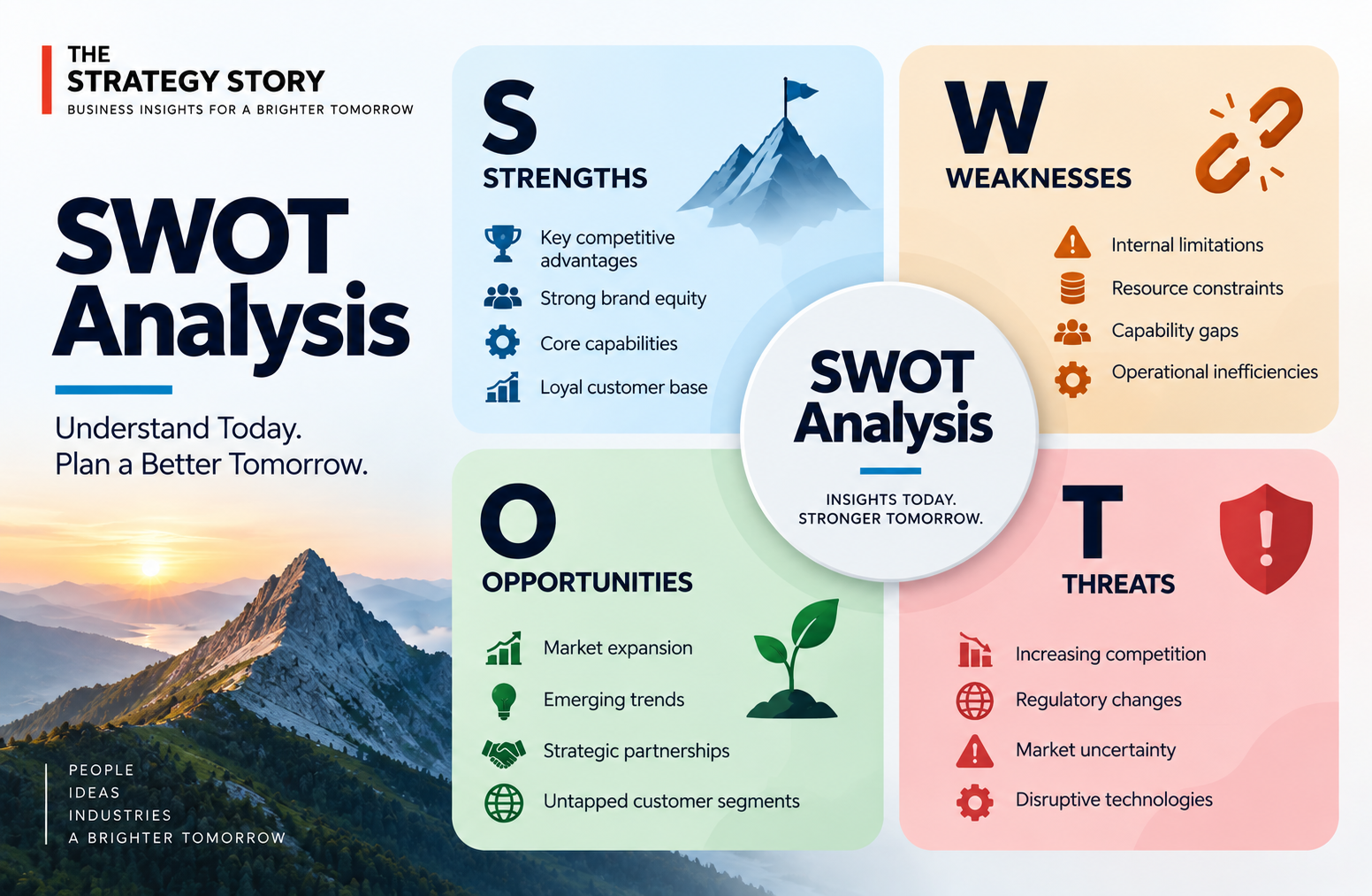
CrowdStrike enters 2026 with $5.25 billion of ARR, 22% fiscal-year revenue growth and a broad AI-native security platform. Its scale and recurring model are major strengths, while platform concentration and the consequences of the July 19 Incident highlight meaningful operational risk. This SWOT uses only CrowdStrike’s FY2026 Form 10-K.
Strengths
1. Strong recurring-revenue engine
ARR reached $5.253 billion, up 24%, while subscription revenue represented 95% of fiscal 2026 revenue. See our CrowdStrike Business Strategy 2026.
2. Unified Falcon platform
Falcon spans endpoint, identity, cloud, SIEM and other security workloads through a shared cloud-native architecture.
3. AI-native security data advantage
Large-scale security telemetry and threat intelligence support machine-learning detection and AI-assisted security workflows.
4. High gross margin
Gross profit reached $3.593 billion on $4.812 billion of revenue, an overall gross margin of about 75%.
5. Land-and-expand economics
Customers can add modules after initial deployment, allowing CrowdStrike to grow wallet share without rebuilding the platform. See our CrowdStrike Business Model 2026.
Weaknesses
1. Operational concentration
A unified platform creates efficiency but also means software or deployment failures can affect a large customer base simultaneously.
2. July 19 Incident consequences
Fiscal 2026 expenses included significant costs associated with the incident and related matters, demonstrating the financial cost of operational failure.
3. Continued GAAP loss
CrowdStrike reported a GAAP net loss attributable to the company in fiscal 2026 despite strong revenue and ARR growth.
4. High sales and marketing spending
Sales and marketing expense reached $1.831 billion, showing the substantial investment required to sustain growth and competition.
5. Stock-based compensation burden
Stock-based compensation contributes materially to operating expenses and can create shareholder dilution over time.
Opportunities
1. Security-platform consolidation
Customers seeking fewer vendors can move additional endpoint, identity, cloud and SIEM spending onto Falcon.
2. AI-powered security operations
AI can automate investigation and response, increasing the value of CrowdStrike’s security telemetry and platform.
3. Next-generation SIEM
SIEM creates an opportunity to compete for a large security-operations budget and deepen Falcon’s role as a system of action.
4. Cloud security expansion
Growth in cloud workloads creates demand for protection beyond traditional employee endpoints.
5. Existing-customer module expansion
A $5.25 billion ARR base provides a large population into which CrowdStrike can cross-sell additional modules.
Threats
1. Intense cybersecurity competition
CrowdStrike competes with large platform vendors and specialized security companies across each workload it enters.
2. Cyberattacks against CrowdStrike
As a security provider, CrowdStrike itself is a high-value target. A breach could damage customers and trust.
3. Legal and regulatory exposure
Security incidents and data handling can trigger litigation, contractual claims and regulatory scrutiny. See our CrowdStrike PESTEL Analysis 2026.
4. Rapid technology change
AI can alter both attacker capabilities and defensive architectures, requiring continuous innovation.
5. Customer trust risk
Because Falcon is deeply integrated into customer systems, failures can have outsized reputational and renewal consequences.
Source: CrowdStrike, FY2026 Annual Report / Form 10-K.