
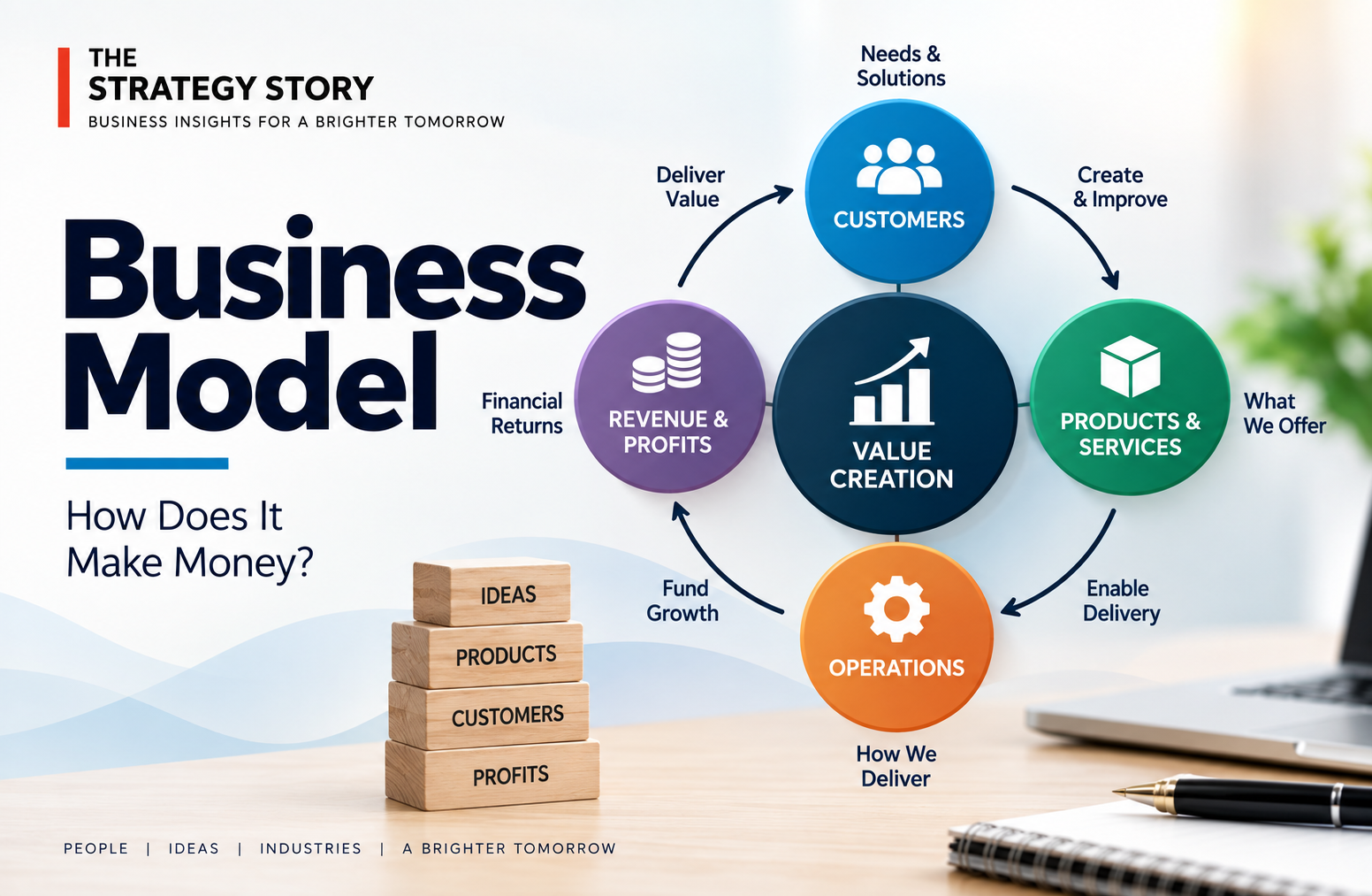
Texas Instruments (TI) is one of the world’s largest analog and embedded semiconductor companies. Its business model is built around selling tens of thousands of chips into a highly diversified customer base, manufacturing an increasing share internally, and keeping products in the portfolio for long periods. TI’s objective is long-term growth of free cash flow per share rather than maximizing short-term revenue.
Industry Problem Texas Instruments Solves
Nearly every electronic system must sense real-world signals, convert power, process data and control physical functions. Analog chips translate phenomena such as temperature, sound, pressure and voltage into usable electrical information, while embedded processors provide localized computing and control. Customers need these functions across automotive, industrial, personal electronics, communications and enterprise systems.
TI solves this through an unusually broad catalog and global sales reach. A customer designing a factory controller, vehicle, appliance or medical device can source multiple signal-chain, power-management and embedded products from one supplier. This breadth reduces TI’s dependence on any single device or application.
The strategic logic behind this model is explored in our Texas Instruments Business Strategy 2026.
Texas Instruments’ Unique Solution
TI describes four sustainable competitive advantages: manufacturing and technology, a broad product portfolio, reach of market channels, and diverse and long-lived product positions. These advantages reinforce one another. A broad portfolio increases customer relevance; direct channels provide demand insight; internal manufacturing can improve cost and supply control; long product lives allow investments to generate returns over many years.
The manufacturing strategy is particularly important. TI has invested heavily in 300-millimeter wafer capacity because larger wafers can reduce chip manufacturing costs relative to 200-millimeter production. Internal capacity can also improve supply assurance, an important purchasing criterion after industry shortages exposed the risks of fragile semiconductor supply chains.
The associated risks are assessed in our Texas Instruments SWOT Analysis 2026.
Texas Instruments Business Model
Analog
Analog is TI’s largest business. It includes power-management and signal-chain products used across a huge range of electronic systems. Analog products often have long life cycles and sell into many customers, creating diversified positions rather than dependence on a handful of blockbuster chips.
Embedded Processing
Embedded Processing includes microcontrollers and processors that provide computing and control functions inside electronic systems. These products complement analog components and increase TI’s ability to capture more semiconductor content within customer designs.
Other businesses
TI also reports Other activities, including DLP products, calculators and certain application-specific products. These businesses are smaller than Analog and Embedded Processing but contribute to overall revenue and cash generation.
Direct customer relationships
TI has expanded direct sales and digital channels. Direct relationships provide better visibility into customer demand and can reduce reliance on distributors. They also help TI present its broad portfolio to engineers at the design stage.
Trade, industrial-policy and technology forces affecting the model are covered in our Texas Instruments PESTEL Analysis 2026.
How Does Texas Instruments Make Money?
TI primarily makes money by selling semiconductor products. The economics are driven by unit volume, average selling prices, manufacturing utilization and product mix. Because analog and embedded products can remain in production for many years, successful designs may generate revenue over long periods without requiring constant replacement by entirely new architectures.
Gross margin is strongly influenced by manufacturing. Building internal 300-millimeter capacity requires substantial upfront capital, but once utilization rises, lower unit costs can strengthen free cash flow economics. The trade-off is that underutilized factories carry depreciation and fixed costs during weaker demand periods.
TI’s broad catalog also changes the risk profile. Rather than depending primarily on one cutting-edge product generation, the company sells many products across many applications. Individual product volumes may be modest, but collectively the portfolio can produce large and durable cash flows.
Texas Instruments Financial Analysis
TI’s financial framework prioritizes free cash flow per share over the long term. This leads management to evaluate investments not merely on near-term earnings impact but on whether manufacturing capacity, R&D and market-channel investments can strengthen future cash generation.
The recent investment cycle has temporarily increased capital intensity. New 300-millimeter fabrication facilities require billions of dollars before reaching efficient utilization. As these factories ramp, the key financial question is whether revenue growth can absorb depreciation and fixed manufacturing costs while realizing the anticipated structural cost advantage.
TI retains substantial profitability because analog semiconductors benefit from differentiated designs, long product lives and relatively low obsolescence compared with leading-edge digital chips. R&D and selling investments are spread across a broad revenue base, while manufacturing ownership gives TI greater influence over cost and supply.
Capital allocation follows a clear hierarchy: invest in attractive organic opportunities, maintain a strong balance sheet and return remaining cash through dividends and share repurchases. This framework aligns management’s stated objective with per-share cash generation rather than empire building.
Future of Texas Instruments’ Business Model
The future model depends on converting a period of unusually high manufacturing investment into stronger long-term free cash flow. TI is building capacity ahead of expected demand in analog and embedded markets, especially industrial and automotive applications where semiconductor content can grow for years.
The strategic advantage is optionality. Because TI serves many end markets and maintains tens of thousands of products, new capacity does not need one application to succeed. It can support a diversified portfolio as demand shifts among automotive, factories, energy infrastructure and electronics.
The main risk is timing. Semiconductor cycles can remain weak longer than expected, leaving factories underutilized and depressing near-term margins. Trade restrictions and geographic supply-chain policies can also influence where customers want chips manufactured.
If utilization rises as anticipated, TI’s combination of 300-millimeter manufacturing, long-lived analog products and broad direct customer reach can create a powerful cash-flow flywheel: lower unit costs improve economics, reliable supply wins more designs, more designs increase utilization, and higher utilization strengthens free cash flow.
Source: Texas Instruments, 2025 Annual Report / Form 10-K.