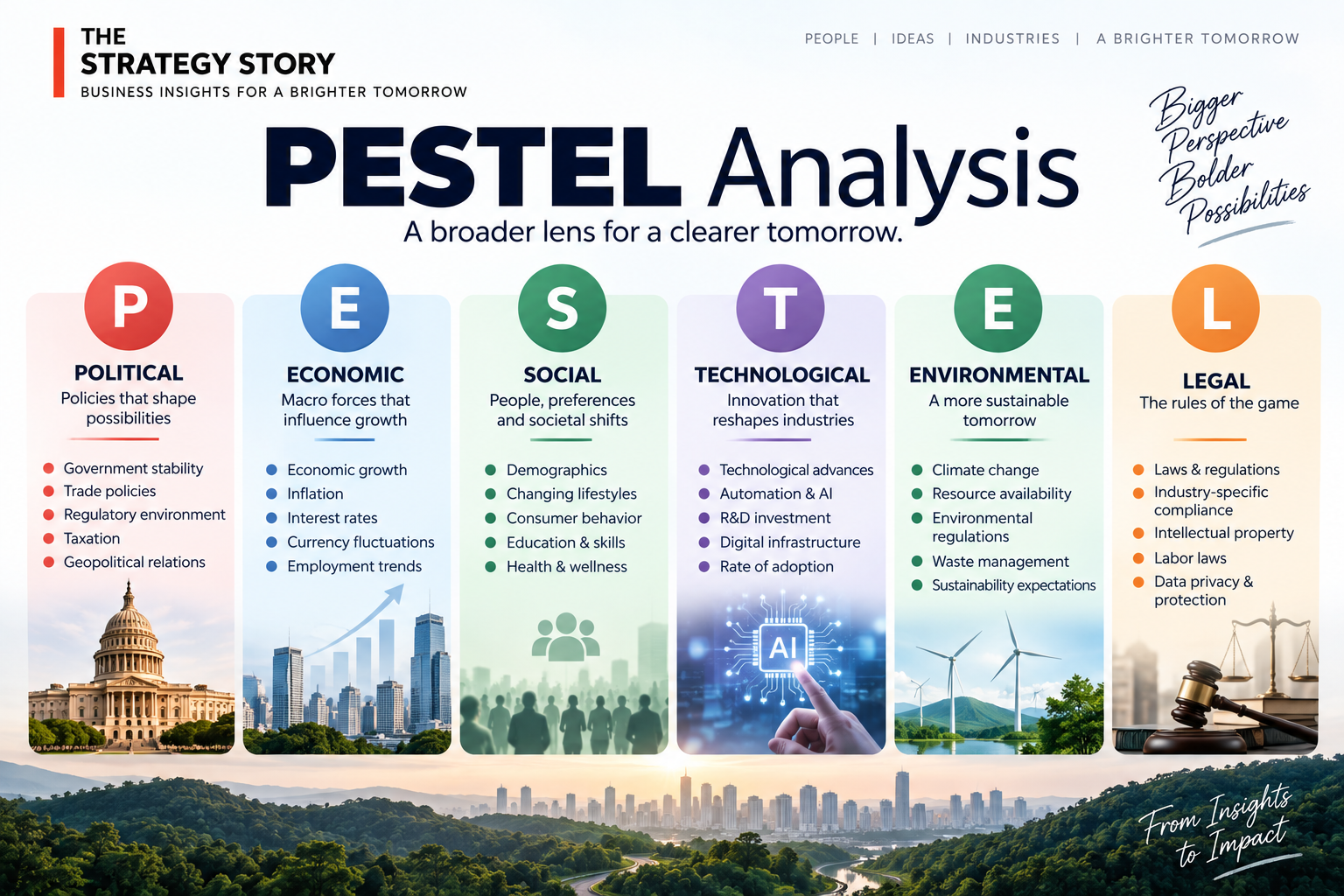

Morgan Stanley’s 2026 external environment is shaped by financial regulation, interest rates, capital-market conditions, investor behavior, rapid technological change, operational resilience and legal obligations. As a global financial institution, political and regulatory decisions can directly affect capital allocation and product economics. This PESTEL analysis is based strictly on Morgan Stanley’s 2025 Form 10-K.
For how Morgan Stanley makes money within this environment, read our Morgan Stanley Business Model 2026.
Political Factors
1. Financial regulatory policy
Morgan Stanley operates under extensive supervision across banking, broker-dealer and investment-management activities. Political priorities can influence capital, liquidity, consumer and market rules. Changes may require more resources, alter returns or constrain specific activities, making regulatory policy a direct strategic and economic variable for the firm.
2. International geopolitical tensions
Global client activity exposes Morgan Stanley to geopolitical conflict, sanctions and cross-border restrictions. Tensions can increase market volatility, disrupt transactions and affect clients operating in exposed regions. The firm must monitor both direct exposures and indirect effects transmitted through financial markets and counterparties.
3. Sanctions and trade restrictions
Government sanctions can restrict transactions with individuals, entities or jurisdictions. Compliance requires screening, monitoring and rapid operational updates. Failures can create significant legal and reputational consequences, while expanding restrictions can reduce available business and complicate existing client relationships in affected markets.
4. Fiscal and government borrowing policy
Government deficits and debt issuance influence fixed-income markets, interest rates and institutional client activity. Changes in fiscal policy can affect economic expectations and market volatility, which in turn influence trading, financing and investment decisions across Morgan Stanley’s businesses.
5. Cross-border regulatory coordination
Morgan Stanley operates across jurisdictions whose rules may differ or change independently. Divergent capital, privacy or market requirements can increase complexity and limit the ability to use one operating model globally. Political cooperation or fragmentation therefore affects the efficiency of cross-border financial services.
For the firm’s strategic response to changing markets and client needs, see our Morgan Stanley Business Strategy 2026.
Economic Factors
1. Interest-rate changes
Interest rates affect deposit costs, lending economics, bond markets, asset valuations and corporate financing. Rapid changes can alter client behavior and net interest income. Higher rates may support some interest revenues while reducing borrowing demand or asset values, making the overall effect dependent on balance-sheet positioning and customer responses.
2. Capital-market activity
Mergers, underwriting and trading revenues depend on market confidence and transaction volumes. Strong equity and debt markets can encourage issuance and deals, while uncertainty can cause clients to postpone transactions. Institutional Securities therefore has meaningful exposure to the broader capital-markets cycle.
3. Economic growth and recession risk
A recession can reduce corporate activity, lower asset values and increase credit losses. Wealth clients may become more defensive while investment-management flows can change. Diversification across businesses helps, but a broad downturn can pressure several revenue streams simultaneously and weaken collateral values.
4. Inflation
Inflation influences monetary policy, wages, operating costs and asset prices. Higher compensation and technology expenses can pressure margins, while inflation-driven rate changes affect deposits and financing. Market expectations about inflation can also increase volatility and influence client portfolio allocations.
5. Currency and global market movements
As a global firm, Morgan Stanley serves clients and operates in multiple currencies. Exchange-rate changes can affect reported results, client portfolios and cross-border transactions. Currency volatility can create both trading demand and risk-management challenges across institutional and investment businesses.
For a consolidated view of Morgan Stanley’s strengths, weaknesses, opportunities and threats, read our Morgan Stanley SWOT Analysis 2026.
Social Factors
1. Growing demand for financial advice
Clients face complex decisions involving retirement, investments, borrowing and wealth transfer. Morgan Stanley’s advisor platform can benefit when clients seek professional guidance. The challenge is delivering advice efficiently across different wealth levels and life stages while maintaining appropriate standards and personalization.
2. Shift toward digital investing
Investors increasingly expect mobile and self-directed capabilities alongside traditional advice. E*TRADE gives Morgan Stanley a digital channel that can serve clients who do not initially require full-service advice. Expectations for speed, availability and usability continue to rise as digital financial services become more common.
3. Intergenerational wealth transfer
Wealth can move between generations, creating both opportunity and retention risk. Morgan Stanley must build relationships with heirs and younger investors before assets transfer. Digital capabilities and workplace channels can help broaden engagement beyond the traditional primary wealth client.
4. Trust in financial institutions
Clients entrust Morgan Stanley with assets, sensitive information and strategic decisions. Conduct failures, data breaches or poor advice can damage trust rapidly. Reputation is therefore an economic asset across investment banking, wealth and asset management, influencing both retention and new business.
5. Competition for skilled professionals
Bankers, traders, advisors, technologists and investment professionals are central to the franchise. Employee expectations around compensation, culture and career development influence retention. Losing productive teams can affect client relationships, investment performance and revenue, making human capital a strategic social factor.
Technological Factors
1. Artificial intelligence adoption
AI can support research, information retrieval, employee productivity and client service. Financial applications require strong governance because inaccurate outputs or inappropriate data use can create regulatory and reputational risks. Morgan Stanley must balance innovation with supervision, privacy and the responsibilities of financial professionals.
2. Cybersecurity threats
Financial institutions are attractive cyber targets because they hold money and sensitive data. Attacks can interrupt trading or wealth services and expose client information. Continuous investment in prevention, monitoring and recovery is essential to maintaining trust and operational continuity across digital and institutional platforms.
3. Digital wealth platforms
Clients expect seamless digital access to portfolios, trading and banking. Morgan Stanley’s digital and advisor channels must work together so customers can move between self-service and human advice. Weak digital experiences can increase competitive vulnerability and make client-asset retention more difficult.
4. Trading and market infrastructure
Institutional trading depends on high-performance technology, data and connectivity. System speed and reliability influence execution quality and risk management. Outages during volatile markets can create financial and reputational consequences while limiting the firm’s ability to serve clients when activity is highest.
5. Data analytics and automation
Better data can improve client personalization, fraud detection, risk management and operational efficiency. Automation can reduce manual processes, but financial data must be governed carefully for privacy, accuracy and regulatory compliance. Scale increases both the potential productivity benefit and the consequence of errors.
Environmental Factors
1. Physical climate risk
Severe weather and other physical events can affect Morgan Stanley offices, employees, counterparties and borrowers. Business continuity planning and geographic redundancy help maintain operations when local infrastructure is disrupted. Physical events can also affect asset values and client exposures beyond Morgan Stanley’s own facilities.
2. Climate effects on clients and portfolios
Environmental changes can affect the financial condition and valuations of companies and assets in which clients invest or to which Morgan Stanley has exposure. Risk assessment may therefore need to consider how physical conditions affect counterparties, borrowers and investments across different sectors and geographies.
3. Transition-related market changes
Changes in energy systems, regulation and customer behavior can affect industries and asset valuations. These shifts can create financing and advisory activity while also changing credit and investment risks across client portfolios. The timing and direction of transitions can remain uncertain.
4. Operational footprint
Offices, data centers and business travel create an environmental footprint. Efficiency initiatives can reduce resource use and operating costs, although Morgan Stanley’s largest environmental exposures arise indirectly through financial activities rather than physical manufacturing. Operational resilience remains important for facilities and technology infrastructure.
5. Environmental disclosure expectations
Investors and regulators may require information about environmental risks and practices. Disclosure requirements can create data and compliance demands for Morgan Stanley and its corporate clients, influencing advisory, risk and reporting processes. Inconsistent standards across jurisdictions can add implementation complexity.
Legal Factors
1. Securities and market-conduct laws
Investment banking, trading and brokerage activities are subject to extensive rules governing disclosures, market behavior and client treatment. Violations can lead to fines, litigation and restrictions. Strong supervision is essential across a large global platform where many employees interact with markets and clients.
2. Fiduciary and advisory obligations
Wealth and investment-management businesses must meet legal and contractual duties to clients. Product recommendations, conflicts and investment processes require controls designed to protect client interests. Failures can damage both finances and reputation and may cause clients to move assets elsewhere.
3. Privacy and data-protection laws
Morgan Stanley handles highly sensitive financial and personal information. Privacy requirements affect how data is collected, shared and stored across jurisdictions. New technology, analytics and AI must be implemented within these legal constraints while still delivering useful client and employee capabilities.
4. Litigation and enforcement exposure
Large financial institutions can face private litigation, regulatory investigations and enforcement actions. Legal matters can create financial costs, management distraction and reputational damage even when individual issues do not threaten the overall franchise. Strong documentation, controls and remediation capabilities are therefore important.
5. Capital and resolution requirements
Legal and regulatory frameworks require major financial institutions to maintain capital, liquidity and plans for stress or resolution. These requirements protect system stability but can constrain balance-sheet deployment and increase the cost of operating complex financial businesses, directly influencing strategic capital allocation.
Social expectations around trust and service remain particularly important in wealth management. Clients can move assets when they lose confidence in advice, security or conduct, turning reputation into a direct financial variable.
Environmental risks are less tied to Morgan Stanley’s own physical production than to offices, infrastructure, counterparties and portfolios. Physical events or transition-related changes can affect borrowers and investments, requiring risk processes capable of assessing financial consequences.
Legal obligations cut across every business. Securities rules affect Institutional Securities, fiduciary obligations shape asset and wealth management, and privacy laws affect the entire digital platform. The breadth of the franchise therefore creates significant compliance complexity.
Source: Morgan Stanley, 2025 Form 10-K.