
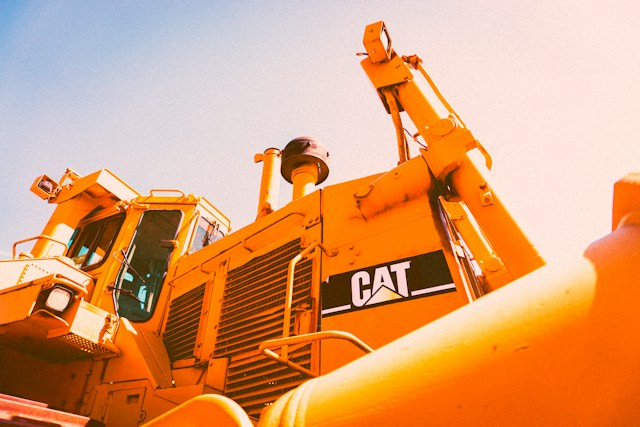
Caterpillar operates across construction, mining, energy and transportation markets, making its external environment unusually broad. Government infrastructure policy, economic cycles, trade rules, technology transitions and environmental requirements can all affect equipment demand and manufacturing economics.

For Caterpillar’s revenue model, read our Caterpillar Business Model 2026.
Political Factors
1. Infrastructure policy
Public investment in roads, utilities and other infrastructure can influence demand for construction equipment. Government spending decisions therefore affect customers’ project pipelines and ultimately machine utilization and replacement demand.

2. Tariffs and trade policy
Caterpillar manufactures and sources globally. Tariffs can raise component and product costs, alter sourcing economics and affect customer pricing. Trade restrictions can also complicate access to important markets.
3. Geopolitical tensions
Conflict and geopolitical instability can disrupt logistics, suppliers, energy markets and customer investment. Sanctions and export restrictions can limit transactions in affected jurisdictions and increase compliance requirements.
4. Energy policy
Government policies influence power generation, fuels, mining and emissions. Because Caterpillar serves both traditional and emerging energy applications, policy changes can shift demand between technologies and end markets.

5. Industrial policy
Policies supporting domestic manufacturing, critical minerals or energy security can stimulate equipment demand while also encouraging localization requirements. Caterpillar must align capacity and supply chains with changing regional priorities.
For Caterpillar’s response to these forces, see our Caterpillar Business Strategy 2026.
Economic Factors
1. Construction and capital-spending cycles
Heavy equipment demand is sensitive to customer investment. Economic weakness can delay projects and replacement purchases, while stronger activity increases equipment utilization and aftermarket demand.
2. Commodity prices
Mining customers’ investment decisions are influenced by commodity economics. Stronger prices can support mine expansion and fleet purchases, while prolonged weakness can reduce capital spending.
3. Interest rates
Financing costs affect construction activity and equipment affordability. Rates also influence Cat Financial’s funding and customer behavior, connecting monetary conditions directly to both equipment and finance economics.
4. Inflation and input costs
Steel, components, labor and logistics costs influence manufacturing profitability. Caterpillar must balance cost recovery through pricing with competitive conditions and customer willingness to pay.
5. Currency movements
Global operations expose Caterpillar to exchange-rate changes that can affect reported results and product competitiveness. Currency movements can also influence customer economics in markets where equipment or components are imported.
Social Factors
For how these factors translate into strengths, weaknesses, opportunities and threats, read our Caterpillar SWOT Analysis 2026.
1. Skilled-labor availability
Manufacturing, servicing and operating sophisticated equipment require skilled workers. Labor shortages can constrain Caterpillar, dealers and customers, increasing the value of automation and productivity technologies.
2. Customer focus on safety
Mining and construction involve hazardous environments. Technologies that reduce operator exposure or improve situational awareness can create customer value beyond direct productivity gains.
3. Expectations for uptime
Customers increasingly expect equipment providers to support availability throughout the asset lifecycle. Caterpillar’s service agreements and condition monitoring respond to demand for predictable maintenance and lower downtime.
4. Digital customer expectations
Industrial buyers increasingly expect digital purchasing, fleet information and service access. Caterpillar is expanding e-commerce, connected equipment and AI-enabled tools to simplify customer interactions.
5. Workforce development
Advanced manufacturing and digital equipment require new skills. Caterpillar’s ability to attract and develop employees and support dealer technicians affects both innovation and customer service quality.
Technological Factors
1. Autonomous equipment
Caterpillar operated 827 autonomous haul trucks in 2025 and is expanding autonomy into additional applications. Continued development can improve safety and productivity while differentiating the installed ecosystem.
2. Connected assets
More than 1.6 million connected and reporting assets provide data for maintenance, fleet management and service. Connectivity can strengthen customer relationships while increasing cybersecurity requirements.
3. Artificial intelligence
AI-enabled tools can assist operators, technicians and fleet managers. Successful adoption depends on useful outputs, secure data handling and integration into industrial workflows where reliability matters.
4. Electrification and alternative power
Changing energy systems require Caterpillar to develop solutions across multiple power technologies. The pace of adoption varies by application because heavy-duty customers prioritize range, uptime, infrastructure and total economics.
5. Advanced manufacturing
Automation, analytics and modern manufacturing systems can improve quality and productivity. These capabilities are increasingly important as Caterpillar seeks profitable growth while managing a complex global production network.
Environmental Factors
1. Emissions requirements
Customers and regulators increasingly focus on equipment emissions. Caterpillar must continue improving efficiency and offering technologies that help customers meet operating and sustainability objectives.
2. Energy transition
Changes in energy production can alter demand across mining, engines, turbines and distributed power. Caterpillar serves customers on multiple sides of this transition, creating both opportunities and portfolio risks.
3. Remanufacturing
Remanufactured products can extend component life and reduce material requirements while creating aftermarket value. Caterpillar highlighted growth in remanufactured products as part of progress toward its 2030 sustainability goals.
4. Physical climate risk
Severe weather can disrupt factories, suppliers, dealers and customer jobsites. It can also create reconstruction demand, making physical climate effects operationally significant in multiple directions.
5. Resource efficiency
Fuel, materials and machine productivity influence customers’ total cost of ownership. Technologies that reduce resource use can therefore support environmental objectives and customer economics simultaneously.
Legal Factors
1. Product safety and liability
Heavy machinery can create significant safety consequences if products fail or are misused. Design, manufacturing quality, warnings and dealer support are therefore important legal and reputational considerations.
2. Environmental regulation
Engine and equipment standards vary across jurisdictions and can require ongoing engineering investment. Regulatory changes can alter product configurations and development priorities.
3. Financial-services regulation
Cat Financial operates within lending, consumer and financial regulatory frameworks. Compliance requirements influence financing products, disclosures and risk-management processes.
4. Data privacy and cybersecurity law
Connected machines and digital platforms generate operational and customer data. Privacy and cybersecurity requirements affect how Caterpillar collects, stores and uses this information.
5. Trade and sanctions compliance
Global sales require compliance with export controls, sanctions and customs rules. Changes can restrict transactions or require rapid operational adjustments across dealers and supply chains.
These PESTEL forces interact rather than operate independently. For example, energy policy can accelerate investment in power infrastructure, while interest rates determine financing costs and technology determines which generation solutions customers select. Caterpillar therefore has to evaluate external changes as connected systems rather than isolated risks.
Trade policy is particularly important because it can affect both revenue and cost. Tariffs may raise input costs, but localization policies can also stimulate domestic construction and manufacturing investment that increases equipment demand. The net effect depends on Caterpillar’s sourcing footprint, pricing power and customer exposure.
Economic conditions also influence technology adoption. Customers are more likely to invest in autonomy, connectivity or new power systems when the productivity benefits justify capital expenditure. During weaker periods, technologies that reduce labor, fuel or downtime may still gain adoption if the payback is compelling.
Environmental regulation creates a similar two-sided effect. New standards can increase Caterpillar’s engineering costs and shorten product-development cycles, but they can also create replacement demand and reward manufacturers capable of offering compliant, efficient solutions at scale.
The dealer network helps Caterpillar respond locally to these external factors. Regulation, customer preferences, financing conditions and infrastructure investment vary substantially by geography. Local dealers provide market knowledge and service capability while Caterpillar supplies global product development, manufacturing and technology.
For 2026, the most consequential external combination is likely to be strong infrastructure and power demand alongside uncertain trade, cost and financing conditions. Caterpillar’s resilience depends on using its broad portfolio and services base to capture structural demand while managing the volatility created by policy and economic cycles.
Source: Caterpillar Inc., 2025 Annual Report / Form 10-K.