Verizon Communications is one of the largest communications technology companies in the United States, providing wireless mobility, broadband and other connectivity services to consumers, businesses and public-sector customers. Its economic engine is built primarily around recurring service revenue generated by a large network of wireless and broadband connections, supplemented by equipment sales and enterprise connectivity services.
In 2025, Verizon generated $138.2 billion in consolidated operating revenue, compared with $134.8 billion in 2024. The company operates through two reportable segments: Consumer and Business. Consumer generated $106.8 billion of operating revenue and represented about 77% of segment revenue, while Business generated $29.1 billion and represented about 21%. Corporate and Other accounted for the remainder.
The business model requires enormous network investment but can generate recurring cash flows once customers are connected. Verizon produced $37.1 billion of operating cash flow in 2025 while capital expenditures were $17.0 billion. Understanding Verizon therefore requires understanding how the company converts spectrum, fiber, network infrastructure and customer relationships into recurring wireless and broadband revenue.
Verizon Business Strategy 2026
The Connectivity Problem Verizon Solves
Consumers and organizations increasingly depend on reliable connectivity for communication, entertainment, commerce, cloud applications, remote work, security and digital services. The underlying challenge is that connectivity requires expensive physical and spectrum infrastructure. Wireless networks require licensed spectrum, radio equipment, towers, small cells, transport networks and technology upgrades. Fixed broadband requires fiber or other access infrastructure connecting premises to the network.
Customers generally do not want to build these systems themselves. They purchase access from network operators that can spread infrastructure costs across millions of connections. Verizon’s role is to build, operate and continually upgrade that shared network infrastructure and monetize it through service relationships.
The business is also shaped by increasing data consumption and changing technology. Customers expect faster speeds, broader coverage, lower latency and dependable service. Enterprises additionally need managed connectivity, security, Internet of Things solutions and advanced networking. This requires Verizon to continuously invest while keeping service pricing competitive.
How Verizon Solves the Problem
Verizon combines nationwide wireless capabilities with fixed connectivity. Consumer customers can buy postpaid and prepaid wireless services, smartphones and connected devices, Fios fiber services, fixed wireless access broadband and other connectivity products. Business customers can buy mobility, fixed wireless access, wireline broadband, IoT connectivity, advanced communications, corporate networking, voice, security and managed network services.
Wireless is particularly attractive economically because the same network can serve a very large number of customers. Verizon monetizes network access through monthly service charges, while device sales support acquisition and retention. Broadband extends the relationship into homes and businesses, increasing the number of connectivity products Verizon can sell to the same customer.
Verizon Business Model
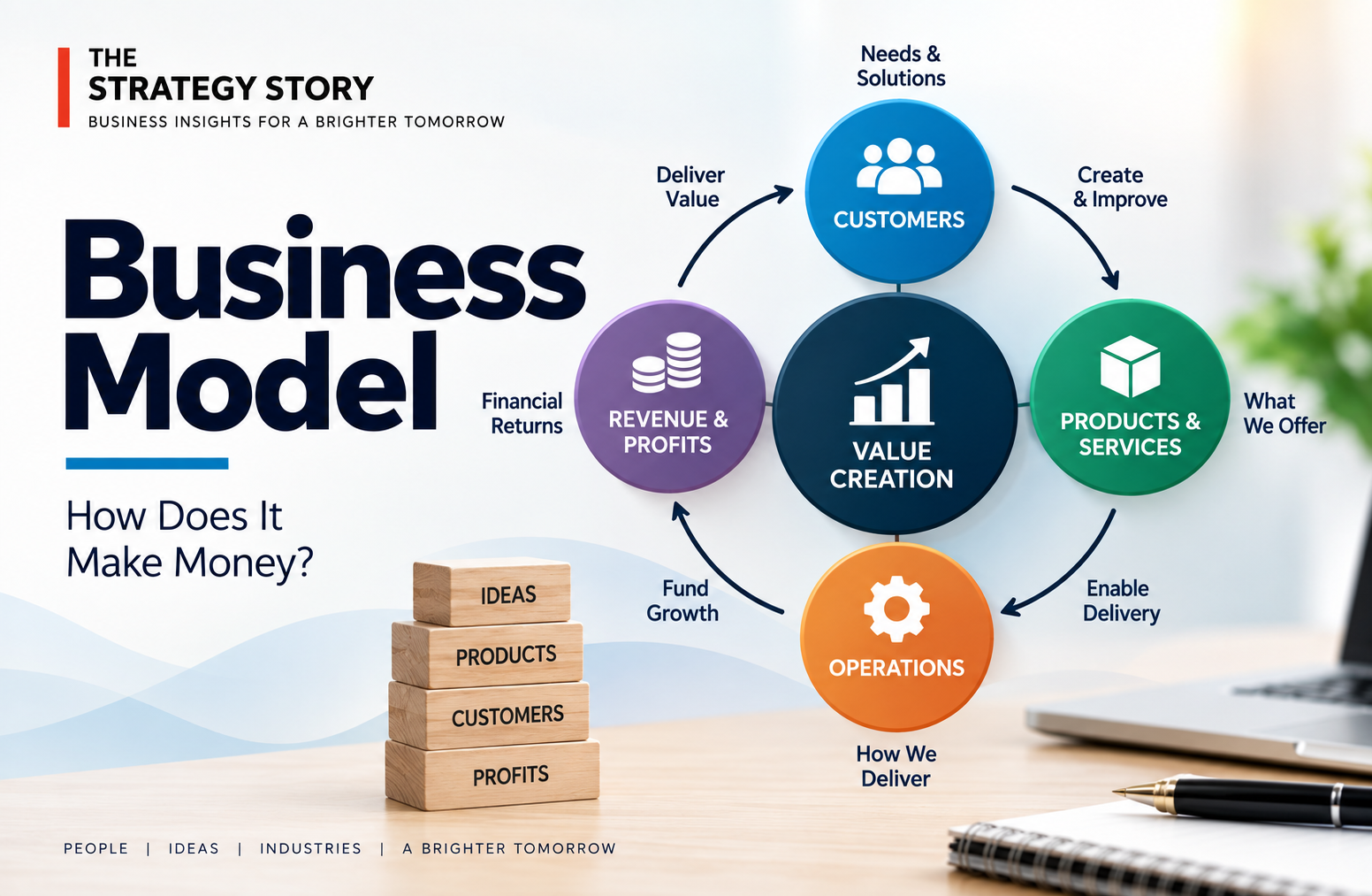
Verizon’s model is fundamentally a recurring connectivity subscription business supported by network infrastructure. Customers typically pay monthly for wireless or broadband access. Verizon also sells devices and equipment, provides enterprise connectivity and managed services and earns wholesale revenue by allowing other providers to use its network.
1. Consumer Wireless Services
The Consumer segment is Verizon’s largest business. Consumer operating revenue totaled $106.8 billion in 2025, an increase of $3.9 billion or 3.8% from 2024. The segment provides wireless services across Verizon’s network under its family of brands and through wholesale arrangements.
Postpaid customers are generally billed monthly for network access and usage. Prepaid customers pay in advance and do not require the same credit arrangements. This recurring billing structure creates predictable service revenue while customer additions and churn determine the size of the connection base over time.
Consumer external service revenue reached approximately $80.6 billion in 2025. This is the heart of Verizon’s economic model because service relationships can continue for years and do not require a new device sale every month.
2. Wireless Equipment
Verizon sells smartphones, handsets, tablets, smart watches and other connected devices. Consumer wireless equipment revenue was approximately $21.8 billion in 2025. Equipment revenue is economically different from service revenue because it is linked to device purchases and upgrades rather than recurring network access.
Devices nevertheless play an important strategic role. Promotions, trade-ins and installment arrangements can attract customers and encourage retention. Equipment also creates the endpoint through which customers consume Verizon’s network services.
3. Broadband and Fixed Wireless Access
Broadband is another important component of Verizon’s model. The company provides Fios fiber internet and fixed wireless access, which uses its 5G or 4G LTE wireless network as an alternative to traditional fixed-line broadband.
Fixed wireless access allows Verizon to monetize wireless network capacity through home and business broadband without building a dedicated fiber connection to every location. Fiber provides another high-quality connectivity platform and can support deeper customer relationships where infrastructure is available.
At year-end 2025, Verizon’s Consumer segment had roughly 11 million broadband connections, while the company continued adding fixed wireless and Fios customers. Broadband creates recurring monthly revenue and supports Verizon’s broader strategy of combining mobility and fixed connectivity.
4. Verizon Business
Verizon Business serves enterprises, small and medium businesses, public-sector organizations and carriers. Segment revenue was $29.1 billion in 2025, down 1.6% from 2024. The portfolio includes wireless mobility, FWA, wireline broadband, IoT, advanced communications, corporate networking, local and long-distance voice, security and managed network services.
Business customers had approximately 31 million wireless retail postpaid connections including FWA connections. Unlike the consumer market, enterprise relationships can combine large numbers of mobile lines with network, security and managed-service requirements.
5. Wholesale Network Access
Verizon also monetizes its infrastructure through wholesale arrangements. Rather than every communications provider building a complete national wireless network, some companies purchase network access from Verizon and offer services under their own brands. This allows Verizon to generate additional utilization and revenue from infrastructure it has already built.
How Does Verizon Make Money?
Verizon makes money primarily by charging consumers and organizations for access to wireless and broadband networks. It supplements these recurring services with equipment sales and enterprise and wholesale connectivity offerings.
Consumer Service Revenue
Consumer service revenue of approximately $80.6 billion was the largest identifiable revenue stream in 2025. Monthly wireless and broadband charges are economically attractive because they recur as long as customers remain connected. The scale of Verizon’s connection base means relatively small changes in average revenue per account, churn or subscriber growth can materially affect total revenue.
Wireless plans can incorporate different service levels, features and connected devices. Verizon can therefore seek growth not only by adding customers but also by increasing the value of relationships through plan mix and additional services.
Consumer Equipment Revenue
Consumer wireless equipment generated approximately $21.8 billion. Device sales are lower-quality recurring economics than network service subscriptions but remain important to the customer lifecycle. New devices can trigger customer acquisition, upgrades and promotional activity.
Business Revenue
Verizon Business generated $29.1 billion of revenue. Enterprise and Public Sector revenue was approximately $13.5 billion, Business Markets and Other approximately $13.6 billion and Wholesale approximately $2.0 billion. This mix demonstrates that Verizon monetizes its network well beyond individual consumer subscriptions.
Network Scale and Operating Leverage
Telecommunications requires substantial upfront and continuing capital investment. Verizon spent $17.0 billion on capital expenditures in 2025. Once network capacity exists, however, it can support millions of connections. Increasing utilization can therefore spread network costs over a larger revenue base.
This makes subscriber retention and network utilization critical. A customer that leaves reduces recurring service revenue while much of the underlying infrastructure remains. Conversely, adding connections to existing network capacity can improve asset utilization.
Cash Generation
Verizon generated $37.1 billion in cash flow from operating activities in 2025. This cash generation supports capital expenditures, debt obligations and shareholder distributions. The combination of recurring service revenue and high capital requirements is a defining characteristic of Verizon’s model.
Consumer Segment Economics
Consumer is Verizon’s dominant segment, producing $106.8 billion of 2025 operating revenue. The segment combines service revenue, equipment and other revenue. Wireless service is the economic foundation, while devices and broadband broaden the relationship.
Verizon’s large postpaid base is particularly valuable because postpaid customers generally receive monthly bills and often maintain long-term relationships with carriers. Prepaid provides another route to the market for customers who prefer to pay in advance.
Broadband expands the addressable relationship beyond mobile phones. Fixed wireless allows Verizon to use spectrum and network assets to compete for home internet, while Fios uses fiber infrastructure. A household taking both mobility and broadband can create a deeper relationship than a single wireless line.
Business Segment Economics
The Business segment is smaller and experienced revenue pressure in 2025. Legacy wireline services face structural challenges as customers migrate toward newer technologies. At the same time, wireless, FWA, IoT, security and advanced networking provide opportunities for Verizon to reposition the segment around modern connectivity.
Enterprise customers can be attractive because a single relationship may involve thousands of wireless connections and multiple network services. Public-sector customers add another large institutional market. Wholesale arrangements monetize network access through other providers.
Competitive Advantages of Verizon’s Business Model
Large Network Infrastructure
Verizon has invested heavily in spectrum, wireless and fiber infrastructure. Network scale creates a significant barrier because competing at national scale requires enormous capital, spectrum holdings, technology and operating expertise.
Recurring Service Revenue
Most of the economic value is tied to recurring connectivity. Monthly subscriptions provide a more stable revenue base than businesses dependent entirely on one-time product purchases.
Large Customer Base
Verizon serves a very large number of consumer and business connections. Scale spreads fixed network costs and creates opportunities to sell additional connectivity products.
Wireless and Broadband Convergence
Verizon can combine mobile and fixed connectivity. Fios and fixed wireless access allow the company to compete for broadband spending while wireless remains the core relationship. Bundling these services can increase customer value and potentially improve retention.
Enterprise Capabilities
Verizon Business extends the network into IoT, security, managed networks and advanced communications. These capabilities allow Verizon to serve complex organizational requirements rather than competing only for consumer mobile subscriptions.
Risks in Verizon’s Business Model
The largest structural risk is intense competition. Wireless and broadband customers can switch providers, forcing Verizon to balance pricing, promotions and network investment. Aggressive device subsidies and promotional offers can increase acquisition costs.
The model is also capital intensive. Verizon must continue investing in network capacity, fiber, spectrum and technology even when industry growth is modest. Large capital commitments and substantial debt reduce financial flexibility relative to asset-light businesses.
Technology change creates another risk. Networks must evolve as usage patterns and standards change. Legacy wireline products can decline as customers migrate to newer technologies, while new network architectures require investment.
Cybersecurity, privacy, regulation and service reliability are also critical. Verizon carries enormous volumes of customer communications and data across infrastructure that is important to businesses and society. Security incidents or prolonged network failures could damage customer trust and create financial and regulatory consequences.
Future Outlook
Verizon’s business model is increasingly centered on the convergence of mobility and broadband. Wireless remains the core recurring revenue engine, but fiber and fixed wireless expand the number of connectivity relationships Verizon can monetize. Enterprise services provide additional diversification across businesses, governments and wholesale customers.
The 2025 results demonstrate the scale of this model: $138.2 billion of revenue, $37.1 billion of operating cash flow and $17.0 billion of capital expenditures. Consumer remained dominant at $106.8 billion of revenue, while Business contributed $29.1 billion.
Long-term value creation depends on Verizon increasing customer relationships and service revenue faster than the cost of maintaining and expanding its networks. Subscriber growth, churn, pricing, broadband adoption, enterprise modernization and disciplined capital allocation will therefore determine the economics of the business.
Verizon ultimately makes money by turning expensive shared communications infrastructure into millions of recurring customer subscriptions. The durability of that model depends on network quality and the company’s ability to convince consumers and organizations that its connectivity is valuable enough to remain a recurring monthly expense.
Source: Verizon Communications Inc., 2025 Annual Report on Form 10-K.