
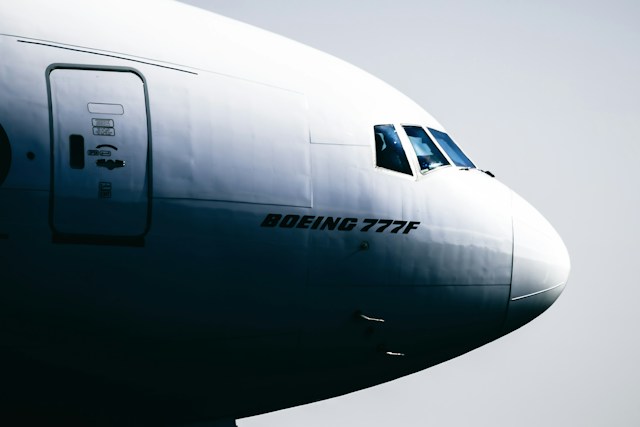
The Boeing Company is one of the world’s major aerospace companies, serving commercial airlines, governments, defense customers and aircraft operators through a portfolio spanning airplanes, military systems, space programs and aviation services. Boeing organizes its operations into three reportable segments: Commercial Airplanes (BCA), Defense, Space & Security (BDS), and Global Services (BGS).
In 2025, Boeing generated $89.46 billion in revenue, up sharply from $66.52 billion in 2024. Commercial Airplanes contributed $41.49 billion, Defense, Space & Security generated $27.23 billion, and Global Services contributed $20.92 billion. Boeing ended the year with a total backlog of $682.21 billion, including $567.29 billion at Commercial Airplanes, demonstrating the enormous amount of future demand already contracted or committed across the business.
Boeing’s business model is unusual because it combines long-cycle manufacturing with recurring services. Commercial and defense aircraft require years of engineering, certification, supply-chain coordination and capital investment. Boeing monetizes those platforms initially through aircraft and system deliveries and then continues serving customers through parts, maintenance, modifications, training, digital solutions and logistics over the operating lives of those assets.
The Aerospace Industry and the Problem Boeing Solves
Aerospace customers face a fundamental need for safe, reliable and increasingly efficient transportation and defense systems. Airlines require aircraft capable of carrying passengers and cargo economically across different route structures. Governments need military aircraft, weapons, surveillance systems, satellites and other capabilities. Operators also require extensive support to keep complex aerospace assets operating safely throughout their useful lives.
The challenge is exceptionally difficult because aerospace products combine advanced engineering, stringent regulation, global supply chains and long product cycles. Boeing notes that commercial aircraft production requires coordination with suppliers and highly skilled employees while meeting evolving regulatory, performance and reliability requirements. New aircraft and derivatives must obtain regulatory certification before entering service.
Airlines also make fleet decisions many years in advance. Once an aircraft enters service, the operator needs spare parts, maintenance, technical support, training and modifications. Defense customers similarly require long-term sustainment of military platforms. This creates an industry in which the initial product sale can establish a customer relationship lasting decades.
How Boeing Solves the Problem
Boeing addresses these needs through an integrated aerospace portfolio. Commercial Airplanes develops and manufactures jetliners for passenger and cargo markets. Its aircraft family in production includes the 737 narrow-body and the 767, 777 and 787 wide-body programs, while development continues on the 777X and 737-7 and 737-10 derivatives.
Defense, Space & Security develops, produces, modifies and supports military aircraft, autonomous systems, weapons, satellites, missile systems and space-related products. This gives Boeing exposure to government defense and space spending in addition to commercial aviation.
Global Services supports commercial and government customers throughout the life cycle of aerospace products. Its activities include supply-chain services, maintenance, engineering, modifications, training and digital solutions. This segment transforms Boeing from a manufacturer dependent only on new aircraft deliveries into a broader life-cycle aerospace provider.
Boeing Business Model
Boeing’s business model can be understood as three interconnected economic engines. Commercial Airplanes monetizes global airline demand through aircraft deliveries. Defense, Space & Security earns revenue through government and defense contracts. Global Services generates revenue from supporting fleets and aerospace systems after they enter operation.
1. Commercial Airplanes
Commercial Airplanes develops, produces and markets commercial jet aircraft principally to airlines worldwide. Revenue is driven primarily by aircraft deliveries, which means production stability and certification directly influence financial performance.
BCA revenue increased to $41.49 billion in 2025 from $22.86 billion in 2024. The substantial increase reflected higher commercial airplane deliveries. Despite the revenue recovery, BCA reported an operating loss of $7.08 billion in 2025, compared with a $7.97 billion loss in 2024. This illustrates a central feature of aircraft manufacturing: high revenue does not automatically produce profitability when programs face abnormal costs, production disruption, development charges or other execution issues.
The segment’s economic potential is visible in backlog. BCA backlog reached $567.29 billion at December 31, 2025, up from $435.18 billion a year earlier. This represented more than four-fifths of Boeing’s total backlog. The increase reflected new orders exceeding deliveries, although cancellations and accounting adjustments also affected reported backlog.
2. Defense, Space & Security
BDS provides another major revenue stream and diversifies Boeing away from commercial aviation cycles. The segment develops and supports military aircraft and weapons systems and participates in space and related government programs.
BDS generated $27.23 billion in 2025 revenue, up from $23.92 billion in 2024. Its operating loss narrowed dramatically to $128 million from $5.41 billion in 2024. The segment had $84.79 billion of backlog at year-end, compared with $64.02 billion in 2024.
Defense economics differ from commercial aircraft. Customers are predominantly governments, and contracts may involve fixed-price development and production arrangements as well as cost-type structures. Fixed-price programs can generate attractive economics when execution is strong but can also expose Boeing to substantial losses when development or production costs exceed assumptions.
3. Global Services
Global Services provides recurring and aftermarket economics around Boeing’s installed base and other supported platforms. The segment serves commercial and government customers with parts, maintenance, modifications, training, logistics and digital capabilities.
BGS generated $20.92 billion in revenue in 2025, up from $19.95 billion in 2024. Boeing’s segment table reported $13.47 billion of 2025 operating earnings for BGS, significantly influenced by a gain associated with a business disposition during the year; therefore, that figure should not be interpreted as the segment’s normal recurring operating margin. BGS backlog reached $29.72 billion at year-end.
The strategic importance of services goes beyond annual revenue. Aircraft and defense platforms remain in operation for many years, generating continuing requirements for spare parts, repairs, engineering and upgrades. This allows Boeing to monetize its relationships after the initial equipment delivery.
How Does Boeing Make Money?
Boeing makes money primarily by delivering commercial aircraft, executing defense and space contracts, and selling aviation services and support. The mix creates different revenue timing, margin and risk characteristics.
Commercial Aircraft Sales
The largest revenue source in 2025 was Commercial Airplanes. Boeing recognizes significant revenue as aircraft are delivered to customers under contractual arrangements. Because aircraft have high selling values, delivery volumes can materially change annual revenue.
BCA represented approximately 46% of Boeing’s 2025 segment revenue before eliminations. Its revenue increased by $18.63 billion from 2024. The segment therefore provides enormous revenue scale when production and deliveries are healthy.
However, airplane manufacturing requires substantial working capital, supplier coordination and program investment before delivery. Production interruptions can delay cash collection and create inventory. Boeing’s 2025 report emphasizes the importance of production health, supplier performance, certification and FAA concurrence for planned rate increases.
Defense and Space Contracts
BDS generated approximately 30% of Boeing’s 2025 segment revenue before eliminations. Revenue comes from designing, developing, manufacturing, modifying and supporting defense and space products under government and other customer contracts.
The business provides diversification because defense demand is driven by government priorities rather than airline passenger demand. Yet government funding decisions and contract structures create their own risks. Boeing identifies uncertainty around U.S. government budgets and program decisions as an important consideration.
Services and Aftermarket Revenue
Global Services generated roughly 23% of Boeing’s 2025 segment revenue before eliminations. Services include supply-chain solutions, maintenance and engineering, modifications and upgrades, training and professional services, and digital capabilities.
This part of the model benefits from the long operational lives of aerospace products. Every aircraft delivered can create future demand for parts and support. Services can therefore deepen customer relationships and reduce Boeing’s dependence on new aircraft sales alone.
The Importance of Backlog
Backlog is one of the most important indicators of Boeing’s future revenue opportunity. Total backlog reached $682.21 billion at the end of 2025, up from $521.34 billion in 2024. Contractual backlog was $639.72 billion, while unobligated backlog was $42.49 billion.
BCA accounted for $567.29 billion, BDS $84.79 billion and BGS $29.72 billion. The size of this backlog gives Boeing significant visibility into future demand, particularly in Commercial Airplanes.
Backlog is not equivalent to guaranteed revenue. Boeing excludes certain prospective orders and options, and customers can have contractual remedies or cancellation rights under specified circumstances. Delivery delays, production disruptions and certification delays can also reduce backlog or change its timing.
Production Is the Core Economic Lever
Boeing’s commercial business converts backlog into revenue only when it can build, certify and deliver aircraft. Production stability is therefore one of the most important economic levers in the entire business model.
Following the January 2024 737-9 door-plug accident, the FAA increased oversight of Boeing’s production, quality and safety management systems. Boeing slowed production and delayed planned rate increases as part of efforts to improve safety and quality. The company’s 2025 annual report states that planned 737 production includes increasing to 47 aircraft per month in 2026, with further increases requiring additional capacity and FAA concurrence.
The 787 program also increased production during 2025. Boeing moved from five to seven aircraft per month and began increasing toward eight per month in the fourth quarter. Higher stable production can increase deliveries, absorb fixed manufacturing costs and improve cash generation, while disruption can have the opposite effect.
Spirit AeroSystems and Vertical Integration
Boeing’s acquisition of Spirit AeroSystems is strategically important to its manufacturing model. Spirit had been a critical supplier to Boeing, including major structures for commercial aircraft. Bringing Spirit operations back into Boeing increases direct control over parts of the production system but also adds operational and financial responsibility.
Boeing’s annual report notes that the Spirit acquisition significantly affected its financial position, results and cash flows. The integration reflects Boeing’s focus on production health, quality and supply-chain stability after several years of disruption.
Economics of Boeing’s Business Model
Boeing generated $89.46 billion in total revenue in 2025, compared with $66.52 billion in 2024 and $77.79 billion in 2023. Segment operating earnings were $6.27 billion compared with a $9.76 billion segment operating loss in 2024. After unallocated items and the FAS/CAS service cost adjustment, Boeing reported $4.28 billion of earnings from operations.
The segment mix shows why Boeing’s economics cannot be understood from consolidated revenue alone. Commercial Airplanes produced the most revenue but remained loss-making. BDS was close to operating break-even. Global Services provided substantial earnings, although its 2025 result included a significant disposition-related gain.
This makes execution crucial. Boeing has a large fixed-cost manufacturing base and long development programs. When production is stable, deliveries can spread costs across more units and generate cash. When programs experience quality, certification or supplier problems, costs can rise while deliveries and customer payments are delayed.
Competitive Advantages of Boeing’s Business Model
Large Installed Base and Customer Relationships
Boeing aircraft and systems operate around the world. This installed base supports repeat aircraft purchases, fleet commonality and recurring demand for parts and services.
Enormous Backlog
A $682.21 billion total backlog provides substantial future demand visibility. Commercial Airplanes alone had $567.29 billion of backlog at the end of 2025.
Commercial and Government Diversification
Boeing serves both airlines and governments. Commercial aviation exposes Boeing to global passenger and cargo growth, while defense and space provide access to government spending and strategic programs.
Life-Cycle Services
Global Services allows Boeing to continue earning revenue after aircraft and systems are delivered. Parts, maintenance, modifications and training extend the economics of each platform across its operating life.
Engineering and Certification Capabilities
Aerospace products require specialized engineering, manufacturing and certification expertise. Boeing’s capabilities and decades of accumulated product knowledge create significant barriers to entry, although maintaining safety and quality performance is essential to preserving this advantage.
Risks in Boeing’s Business Model
Boeing’s biggest business-model risks arise from the complexity of its products and production system. Safety or quality failures can trigger regulatory action, production restrictions, reputational damage and substantial financial costs. The FAA’s oversight following the 737-9 accident demonstrates the direct relationship between quality performance and Boeing’s ability to increase output.
Supply-chain disruption is another major risk. Boeing relies on thousands of suppliers and specialized components. Constraints, labor instability and inflation can affect production schedules and costs.
Development and certification risk is also substantial. The 777X and 737-7 and 737-10 programs require regulatory certification. Delays can postpone deliveries, increase costs and affect backlog.
Defense programs can create losses when fixed-price contract costs exceed estimates. Commercial customers may also cancel orders or seek contractual relief following significant delays. Finally, Boeing carries meaningful debt and interest expense, making cash generation and financial discipline important.
Future Outlook
Boeing enters 2026 with a much larger revenue base and backlog than a year earlier, but the central challenge is converting demand into safe, predictable deliveries and sustainable profitability. Total 2025 revenue rose to $89.46 billion, while backlog reached $682.21 billion.
The Commercial Airplanes opportunity is particularly significant. Demand already embedded in backlog is substantial, and planned production increases could support higher deliveries if Boeing meets its safety, quality and regulatory requirements. Certification of the 737-7 and 737-10 and continued progress on the 777X remain important program milestones.
Defense, Space & Security offers another path to improved economics if Boeing can execute large development and production contracts with greater cost discipline. Global Services provides an important recurring layer around the installed fleet and customer base.
Boeing’s business model ultimately depends on trust and execution. It possesses valuable aircraft programs, major government franchises, a global services network and hundreds of billions of dollars of backlog. The economic opportunity is therefore clear. The decisive question is how efficiently and reliably Boeing can transform that demand into certified products, customer deliveries, services revenue and cash flow while maintaining the safety and quality standards on which aerospace markets depend.