
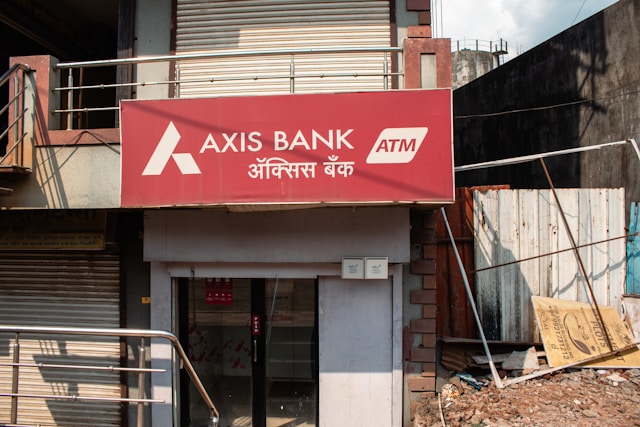
Axis Bank has evolved from a traditional private-sector bank into one of India’s most diversified financial services institutions. Today, the Bank serves retail customers, MSMEs, corporates, institutions, governments, and international clients through an integrated ecosystem spanning banking, lending, investments, insurance, wealth management, capital markets, fintech, and digital financial services. Rather than pursuing growth through scale alone, Axis Bank’s strategy focuses on creating a customer-centric, technology-enabled, and sustainable financial institution capable of delivering long-term value across multiple business segments.

The FY2024-25 Integrated Annual Report revolves around the theme “Har raah dil se open,” reflecting the Bank’s commitment to openness, inclusion, innovation, and customer-centricity. Management believes banking should extend beyond financial transactions by enabling entrepreneurship, financial inclusion, digital empowerment, and sustainable economic development. This philosophy guides every strategic decision across retail banking, wholesale banking, digital transformation, ESG, and stakeholder engagement.
Axis Bank has also strengthened its position as a universal financial services institution through the ‘One Axis’ ecosystem, where the Bank and its subsidiaries collaborate to provide integrated financial solutions across banking, investments, insurance, wealth management, brokerage, fintech, and advisory services. By combining multiple businesses into a single customer relationship, the Bank aims to improve customer lifetime value while diversifying its revenue streams.

The Bank’s long-term strategy is anchored around six strategic pillars: ‘One Axis’ in Action, Redefining Banking in the Digital-first Era, Enabling Access through Bharat Banking, Partnering in Nation-building, Making a Difference to Every Stakeholder, and Embracing the Green Way. Together, these pillars provide the strategic roadmap for sustainable growth while reinforcing Axis Bank’s competitive position in India’s rapidly evolving financial services industry.
Axis Bank Business Model in 2026: How Axis Bank Makes Money
Strategic Pillars
The first strategic pillar is ‘One Axis’ in Action, which serves as the foundation of Axis Bank’s integrated financial services strategy. Instead of operating individual subsidiaries independently, the Bank brings together banking, lending, investment banking, broking, insurance, asset management, trustee services, fintech, and invoice discounting under one unified ecosystem. Through common technology platforms, API integrations, CRM systems, and cross-selling initiatives, customers receive seamless financial solutions across every stage of their financial journey. This strategy strengthens customer engagement while increasing opportunities for fee-based income and long-term relationship growth.
The second pillar focuses on Redefining Banking in the Digital-first Era. Axis Bank is transforming banking through innovations such as ‘open’ and ‘neo’, enabling instant onboarding, intuitive lending, AI-powered customer support, multilingual banking, WhatsApp Banking, and mobile-first financial services. The Bank aims to create frictionless digital experiences that improve customer convenience while reducing operational costs and improving scalability.
The third strategic pillar is Enabling Access through Bharat Banking. Recognising India’s growing rural and semi-urban economy, Axis Bank continues expanding its branch network, correspondent banking, and digital capabilities to improve financial inclusion. Through customised products, strategic alliances, and technology-enabled delivery models, the Bank seeks to provide accessible banking solutions for farmers, MSMEs, entrepreneurs, and underserved communities while supporting inclusive economic growth.
The fourth pillar, Partnering in Nation-building, reflects Axis Bank’s collaboration with government institutions across tax collection, Direct Benefit Transfers (DBT), Smart Cities, Digital Agriculture, healthcare, education, transportation, and public finance. By supporting public sector initiatives and digital governance, the Bank strengthens its role in India’s economic development while expanding institutional banking opportunities.
The remaining strategic pillars focus on creating value for every stakeholder and embedding sustainability into business decisions. Axis Bank invests in customer experience, employee development, community impact, ESG initiatives, climate finance, green operations, and responsible governance. These initiatives reinforce the Bank’s long-term objective of creating sustainable value while balancing commercial growth with social and environmental responsibility.
Axis Bank SWOT Analysis in 2026
Strategy Analysis
Axis Bank’s strategy is centred on becoming a universal financial services platform rather than just a traditional bank. Instead of relying primarily on lending, the Bank has created an integrated ecosystem that combines banking, investments, insurance, capital markets, fintech, wealth management, and digital financial services under the ‘One Axis’ philosophy. This approach allows the Bank to serve customers throughout their financial lifecycle while generating diversified revenue streams and strengthening long-term customer relationships.
A defining feature of the strategy is the ‘One Axis’ ecosystem. Rather than operating subsidiaries independently, Axis Bank integrates businesses such as Axis Securities, Axis Capital, Axis Finance, Axis Asset Management, Freecharge, A.TReDS, Axis Trustee Services, and Axis Max Life Insurance into a single customer proposition. Through shared technology platforms, API integrations, common CRM systems, and coordinated relationship management, customers can access banking, investments, insurance, lending, payments, and advisory services through one institution. This creates significant cross-selling opportunities while improving customer stickiness and lifetime value.
Another important aspect of the strategy is its digital-first transformation. Management recognises that customer expectations have shifted from branch-led banking to seamless digital experiences. Consequently, Axis Bank has invested heavily in platforms such as ‘open’, ‘neo’, WhatsApp Banking, AI-powered Axis Aha!, mobile banking, and end-to-end digital customer journeys. With more than 96% of transactions occurring digitally, approximately 3 crore registered mobile banking customers, and over 30 million WhatsApp Banking users, digital capabilities have become a core competitive advantage rather than merely a support function.
Financial inclusion also forms an important pillar of Axis Bank’s long-term strategy. Through Bharat Banking, the Bank is expanding into rural and semi-urban India using a combination of physical branches, correspondent banking, specialised branch formats, and digital channels. This enables the Bank to capture long-term growth opportunities in underserved markets while supporting entrepreneurship, agriculture, MSMEs, and regional economic development.
The strategy is equally focused on responsible and sustainable growth. Axis Bank has embedded ESG into governance through a dedicated Board-level ESG Committee and has integrated climate finance, sustainable lending, operational decarbonisation, diversity, financial inclusion, and community development into its long-term roadmap. Rather than viewing sustainability as a compliance requirement, the Bank positions ESG as a strategic differentiator capable of creating long-term shareholder and stakeholder value.
Axis Bank PESTEL Analysis in 2026
Growth Strategy
Axis Bank’s growth strategy focuses on expanding customer relationships, accelerating digital banking, strengthening the ‘One Axis’ ecosystem, deepening financial inclusion, and growing fee-based businesses. Instead of pursuing aggressive balance-sheet expansion alone, the Bank aims to grow across multiple financial services businesses while improving profitability and customer engagement.
One of the Bank’s primary growth drivers is the continued expansion of the ‘One Axis’ ecosystem. Management intends to deepen collaboration between the Bank and its subsidiaries so that customers increasingly use multiple financial products—including banking, investments, insurance, broking, lending, and asset management—within a single relationship. This integrated model increases cross-selling opportunities while diversifying earnings beyond traditional interest income.
Technology remains another major growth engine. Axis Bank continues investing in artificial intelligence, automation, API-driven banking, cybersecurity, cloud infrastructure, digital onboarding, and omnichannel customer engagement. Platforms such as open, neo, WhatsApp Banking, and AI-powered customer support are designed to improve customer acquisition, enhance operational efficiency, and create highly personalised banking experiences while lowering servicing costs.
The Bank also plans to expand its Bharat Banking franchise by increasing its presence across rural and semi-urban India. During FY2024-25, Axis Bank added 500 new branches, taking its network to 5,879 branches across 3,194 cities. This expansion supports greater financial inclusion while strengthening the Bank’s retail, SME, and agricultural banking businesses in high-growth markets.
Growth in Wholesale & Commercial Banking remains another strategic priority. Axis Bank continues to strengthen its presence across MSMEs, mid-corporates, large corporates, trade finance, cash management, treasury, transaction banking, and institutional banking. Alongside lending growth, the Bank aims to increase fee income through investment banking, capital markets, wealth management, insurance distribution, fintech services, and digital payments, creating a more balanced earnings profile.
Challenges and Future Outlook
Axis Bank acknowledges that the banking industry is experiencing rapid transformation driven by digital disruption, fintech competition, cybersecurity risks, changing customer expectations, regulatory evolution, climate-related risks, and global economic uncertainty. The rise of embedded finance, AI-enabled financial services, and digital-native competitors is reshaping how customers interact with financial institutions, requiring continuous investment in technology and innovation.
Despite these challenges, management remains optimistic about India’s long-term growth prospects. Rising formalisation of the economy, expanding credit demand, growing household wealth, increasing digital adoption, stronger infrastructure investment, financial inclusion, and deeper capital markets are expected to create significant opportunities across retail banking, corporate banking, wealth management, insurance, and digital financial services. Guided by its six strategic pillars, diversified business model, strong governance, extensive digital capabilities, and integrated ‘One Axis’ ecosystem, Axis Bank believes it is well positioned to deliver sustainable long-term growth while strengthening its position as one of India’s leading private-sector financial institutions.
Source: Axis Bank Annual Report 2024-25