
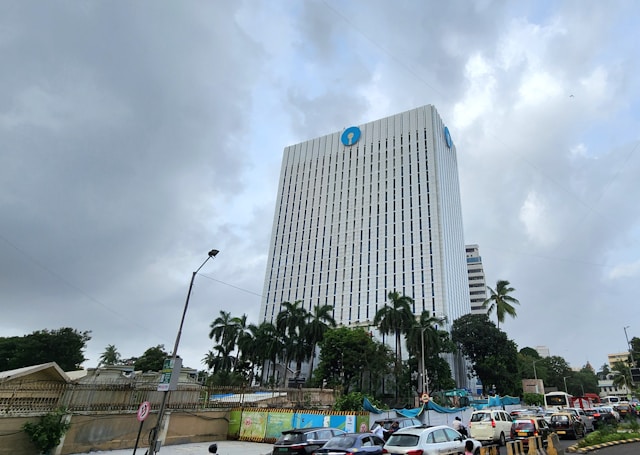
State Bank of India (SBI) operates at the centre of India’s financial system and plays a crucial role in supporting the country’s economic development. As India’s largest commercial bank, SBI serves over 530 million customers through 23,265 branches, 64,245 ATMs/ADWMs, nearly 80,000 Customer Service Points, and an expanding digital ecosystem led by YONO. During FY2025-26, the Bank crossed Rs. 109 trillion in total business, comprising Rs. 59.8 trillion in deposits and Rs. 49.3 trillion in advances, while reporting a record standalone net profit of Rs. 80,032 crore.

SBI’s long-term strategy is built around the philosophy of “Digital First, Customer First, Nation Always.” The Bank continues investing in digital transformation, artificial intelligence, financial inclusion, customer experience, sustainable finance, and operational excellence. However, its operating environment is significantly influenced by government policies, macroeconomic conditions, changing consumer behaviour, technological innovation, environmental commitments, and regulatory requirements.
A PESTEL analysis provides a structured framework to evaluate these external macro-environmental factors. Based on SBI’s FY2025-26 Annual Report, the following analysis examines the key Political, Economic, Social, Technological, Environmental, and Legal factors shaping the Bank’s strategy and future growth.

State Bank of India Business Model in 2026: How SBI Makes Money
Political Factors
1. Government Financial Inclusion Initiatives
Government schemes such as Pradhan Mantri Jan Dhan Yojana (PMJDY), PMSBY, PMJJBY, and Atal Pension Yojana continue expanding access to formal banking services. SBI’s leadership in implementing these programmes strengthens its customer base while supporting national financial inclusion objectives.
2. Policy Support for Economic Development
Government investments in infrastructure, manufacturing, agriculture, MSMEs, and digital public infrastructure create increasing demand for banking services, project finance, working capital, and transaction banking, providing long-term growth opportunities for SBI.

3. Public Sector Banking Policies
As India’s largest public sector bank, SBI operates within policy frameworks established by the Government of India and the Reserve Bank of India. Banking reforms, capital policies, and public sector initiatives directly influence strategic priorities and business expansion.
4. International Geopolitical Developments
The annual report highlights geopolitical tensions, evolving global trade dynamics, and international conflicts as factors affecting global economic growth, capital flows, trade finance, and cross-border banking activities. These developments influence SBI’s international banking operations across 29 countries.
5. National Development Priorities
SBI aligns its business strategy with India’s long-term vision of Viksit Bharat, supporting entrepreneurship, infrastructure creation, rural development, MSMEs, financial inclusion, and sustainable economic growth through targeted lending and financial services.
State Bank of India Business Strategy in 2026
Economic Factors
1. India’s Strong Economic Growth
The annual report notes that India remained the world’s fastest-growing major economy during FY2025-26, supported by strong domestic demand, public investment, and private consumption. This favourable environment increases demand for retail, corporate, agriculture, and SME lending.
2. Interest Rate and Monetary Policy
Reserve Bank of India monetary policy directly affects borrowing costs, deposit rates, net interest margins, liquidity, and banking profitability. Efficient balance sheet management remains essential for sustaining long-term earnings.
3. Growing Credit Demand
Healthy growth in housing finance, retail lending, agriculture, SMEs, infrastructure, and corporate investments continues driving expansion of SBI’s advances, which reached Rs. 49.3 trillion during FY2025-26.
4. Inflation and Global Uncertainty
The report highlights inflationary pressures, geopolitical conflicts, volatile energy prices, and slowing global GDP growth as macroeconomic risks that could influence borrowing behaviour, asset quality, and overall banking sector performance.
5. Strong Deposit Growth
Sustained customer confidence supported deposit growth to Rs. 59.8 trillion, while initiatives such as ABCD (All Branches to Contribute to Deposits) aim to strengthen SBI’s low-cost liability franchise and improve long-term financial resilience.
State Bank of India SWOT Analysis in 2026
Social Factors
1. Rapid Digital Banking Adoption
Customers increasingly prefer mobile banking, digital payments, self-service banking, and online onboarding. SBI continues expanding YONO 2.0 and digital banking capabilities to meet changing customer expectations while delivering personalized experiences.
2. Customer-Centric Banking
The Bank has established CRUX (Centre of Excellence for Refinement of User Experience) and introduced Customer Satisfaction Score (CSAT), Customer Effort Score (CES), and Net Promoter Score (NPS) measurements to continuously improve customer experience across physical and digital channels.
3. Financial Inclusion
Through Business Correspondents, Customer Service Points, Financial Literacy Centres, and rural outreach programmes, SBI continues expanding banking access to underserved populations while promoting responsible financial participation across India.
4. Increasing Financial Awareness
Growing awareness of savings, investments, insurance, wealth management, and retirement planning creates opportunities for SBI to deepen customer relationships through comprehensive financial solutions and advisory services.
5. Workforce Development
SBI continues investing in employee capability building through SPARK Learning Management System, leadership development programmes, digital skill enhancement, and customer service training to prepare its workforce for the future of banking.
Technological Factors
1. Artificial Intelligence Adoption
SBI is expanding the use of Artificial Intelligence and Generative AI across customer onboarding, inward clearing, process automation, operations, and service delivery. AI plays a central role in improving efficiency and enhancing customer experience.
2. Digital Banking Ecosystem
YONO 2.0 has evolved into a comprehensive financial and lifestyle platform serving over 10.02 crore registered users, while digital channels now account for 98.7% of customer transactions, highlighting SBI’s technology leadership.
3. Process Automation
Project SARAL focuses on simplifying banking through Universal Branch Access, Single KYC, automation, digital integration, and AI-enabled operational improvements, reducing complexity while enhancing customer convenience.
4. Cybersecurity and Digital Infrastructure
As digital banking expands, SBI continues strengthening cybersecurity, IT governance, digital audit capabilities, and enterprise technology infrastructure to ensure secure and resilient banking operations.
5. Data Analytics and Hyper-Personalisation
The Bank is leveraging enterprise MarTech capabilities, customer analytics, and data-driven personalization to deliver targeted financial solutions, improve engagement, and strengthen long-term customer relationships.
Environmental Factors
1. Green Finance Expansion
SBI continues expanding financing for renewable energy, electric mobility, biofuels, climate technologies, and sustainable infrastructure. During FY2025-26, its green advances portfolio grew 111.56% to cross Rs. 1 trillion.
2. Carbon Neutrality Commitments
The Bank has committed to achieving carbon neutrality in internal operations by 2030 and Net Zero emissions by 2055, demonstrating a long-term commitment to environmental sustainability.
3. Renewable Energy Adoption
SBI continues increasing renewable energy usage through rooftop solar installations, green power procurement, energy-efficient infrastructure, and certified green buildings as part of its sustainability strategy.
4. Climate-Focused Financing
The Bank has introduced CHAKRA, a dedicated knowledge and financing platform supporting climate-focused industries, while expanding lending to renewable energy, green hydrogen, electric mobility, and other low-carbon sectors.
5. ESG Integration
Environmental, Social, and Governance (ESG) considerations have become integral to SBI’s business strategy. Dedicated ESG and Climate Finance units guide sustainable lending, green deposits, climate risk management, and responsible banking practices.
Legal Factors
1. Banking Regulations
SBI operates under comprehensive regulatory oversight from the Reserve Bank of India. Compliance with capital adequacy norms, lending regulations, liquidity requirements, and prudential standards remains fundamental to its operations.
2. Know Your Customer (KYC) Requirements
The Bank continues strengthening compliance with KYC norms through initiatives such as Single KYC, simplifying customer onboarding while ensuring adherence to regulatory requirements and financial crime prevention standards.
3. Cybersecurity Compliance
Increasing digital transactions require continuous compliance with cybersecurity frameworks, digital risk management, IT governance, and operational resilience standards to protect customers and banking systems.
4. Consumer Protection Regulations
SBI operates under evolving consumer protection standards requiring transparency, responsible lending, fair customer treatment, grievance resolution, and improved service quality. The Bank’s customer-centric initiatives align with these regulatory expectations.
5. ESG and Climate-Related Regulations
Growing regulatory emphasis on climate finance, green deposits, sustainable disclosures, and ESG governance influences SBI’s environmental strategy, lending practices, and long-term capital allocation decisions. The Bank continues aligning its operations with these evolving regulatory expectations.
Source: SBI Annual Report 2025-26