
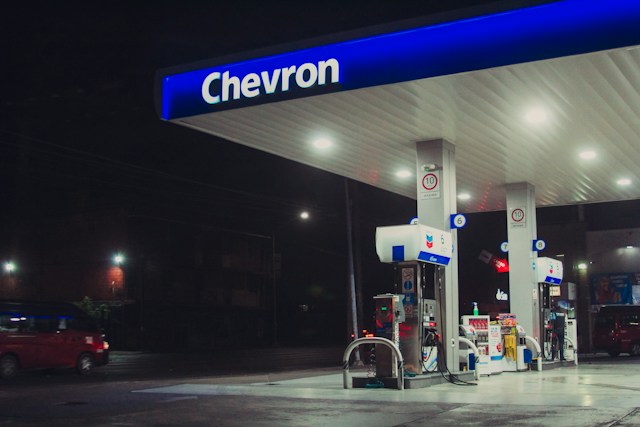
Chevron Corporation is an integrated energy company operating across crude oil and natural gas production, liquefied natural gas, refining, marketing, chemicals, transportation and emerging lower-carbon businesses. In 2025, Chevron completed the acquisition of Hess Corporation, materially expanding its upstream portfolio and resource base. The company’s stated objective is to safely deliver higher returns, lower carbon and superior shareholder value across business environments.

The model is capital intensive but economically broad. Chevron develops resources that can produce for decades, converts hydrocarbons into fuels and industrial products, moves energy through complex logistics networks and reaches customers through downstream channels. In 2025, worldwide net oil-equivalent production increased 12% to a record 3.7 million barrels per day, while proved reserves increased to approximately 10.6 billion barrels of oil equivalent.
1. Industry Problem Chevron Solves
Modern economies require enormous quantities of reliable energy. Transportation systems need liquid fuels, industries require natural gas and petrochemical feedstocks, and power systems increasingly need dependable generation alongside growing electricity demand. The challenge is not simply finding energy resources; it is developing them economically, transporting them safely, converting them into useful products and delivering them to customers at scale.

Energy supply is also technically difficult and capital intensive. Offshore fields, shale resources, LNG plants, refineries and pipelines can require billions of dollars of investment before generating cash. Projects may operate for decades, which means companies must make capital decisions despite uncertainty around commodity prices, regulation, technology and future demand.
Reliability is another problem. Customers and economies cannot easily tolerate interruptions in fuel, natural gas or power supply. Chevron therefore has to manage geology, engineering, project execution, asset reliability, shipping and logistics as one interconnected system.
At the same time, energy producers face pressure to reduce the carbon intensity of operations and develop lower-carbon solutions. Chevron’s challenge is therefore dual: supply growing energy demand while improving operational efficiency and selectively building new energy businesses.

For Chevron’s strategic response to these challenges, read our Chevron Business Strategy 2026.
2. Chevron’s Unique Solution
Chevron’s solution is an integrated energy portfolio supported by large-scale engineering, technology, partnerships and customer relationships. Upstream operations discover and produce crude oil and natural gas; LNG capabilities connect gas resources with international markets; downstream refineries convert crude into transportation and industrial products; and marketing and logistics move those products to customers.
The scale of the upstream portfolio increased substantially in 2025. Chevron’s worldwide production reached a record 3.7 million net oil-equivalent barrels per day, up 12%, while U.S. production increased 16%. The increase reflected the Hess acquisition, the Future Growth Project at Tengizchevroil, more than one million barrels per day in the Permian Basin and ramp-ups in the Gulf of America.
Chevron also replenished resources faster than it produced them. Proved reserves increased 8% to approximately 10.6 billion BOE and the one-year reserve replacement ratio was 158%. Its net unrisked resource base reached 74 billion BOE, including 24 billion BOE in the Permian Basin. These numbers matter because an upstream business consumes its reserve base every day; long-term value requires replacing production with economically developable resources.
Integration creates additional flexibility. Production assets can connect to transportation, refining and marketing capabilities, while downstream customer relationships can support renewable fuels and newer energy offerings. The company can therefore monetize energy at several points in the value chain rather than relying on one activity.
For a structured view of Chevron’s strengths and risks, see our Chevron SWOT Analysis 2026.
3. Chevron Business Model
Upstream oil and gas
Upstream is Chevron’s primary earnings engine. It includes exploration, development and production of crude oil and natural gas, LNG, gas marketing and related infrastructure. Economics are driven by production volumes, realized commodity prices, operating costs, royalties, taxes and capital efficiency.
Downstream refining and marketing
Downstream converts crude oil into gasoline, diesel, jet fuel and other products and markets fuels and lubricants. Refining economics depend on the spread between feedstock costs and product realizations, plant utilization and operating reliability. In 2025, Chevron achieved its highest U.S. refinery throughput in 20 years despite operating fewer refineries, reflecting expansion projects and efficiency improvements.
Chemicals and industrial products
Chevron participates in chemicals through affiliates that manufacture petrochemicals, plastics and additives. These businesses extend the hydrocarbon value chain into industrial and consumer applications and diversify customer exposure beyond transportation fuels.
Midstream, LNG and logistics
Pipelines, marine transportation, storage and LNG infrastructure connect resources to processing facilities and customers. These assets can improve market access and reduce bottlenecks, while LNG enables natural gas produced in one geography to serve demand in another.
New energies
Chevron is selectively investing in areas where existing capabilities can be applied, including renewable fuels, carbon capture, lithium and power. The Geismar renewable diesel plant expansion increased capacity from 7,000 to 22,000 barrels per day, while Chevron entered the U.S. lithium sector with approximately 135,000 net acres in the Smackover Formation.
For the political, economic, technological and environmental forces affecting these businesses, read our Chevron PESTEL Analysis 2026.
4. How Does Chevron Make Money?
Crude oil and natural gas sales
Chevron earns revenue by producing and selling crude oil, natural gas and natural-gas liquids. Commodity prices are largely outside management control, so profitability depends on the combination of realized prices, production volume and cost per barrel. Record 2025 production increases the number of barrels over which Chevron can generate margin.
LNG and international gas
Chevron participates across natural-gas production, liquefaction, transportation and marketing. Large LNG projects can create long-duration cash flows, often supported by commercial agreements, but require substantial upfront capital and reliable operation.
Refining margins
Refineries create value by purchasing or receiving crude feedstocks and selling higher-value refined products. Earnings fluctuate with regional product demand, crude differentials, refinery configuration and utilization. Operational reliability is critical because unplanned downtime can remove both revenue and margin.
Marketing, lubricants and renewable fuels
Chevron sells fuels and lubricants through branded and commercial channels. Customer relationships provide value beyond commodity production and can create routes to market for evolving products such as renewable fuels.
Chemicals
Chemical affiliates monetize hydrocarbon feedstocks through petrochemicals, plastics and additives. Results depend on feedstock costs, global capacity and industrial demand, producing an earnings pattern different from upstream production.
Portfolio and partnership economics
Many Chevron projects operate through joint ventures. Partnerships allow capital, technical capabilities and risks to be shared, while acquisitions and divestments reshape the portfolio. The Hess transaction demonstrates how Chevron can use corporate scale to add resources and future production opportunities.
5. Chevron Financial Analysis
Record production growth
Worldwide production increased 12% in 2025 to approximately 3.7 million net oil-equivalent barrels per day, while U.S. production rose 16%. The Permian Basin exceeded one million BOED. Volume growth is strategically important because Chevron cannot control oil prices; increasing efficient production from advantaged assets is one of the major variables management can influence.
Reserve replacement and resource depth
Proved reserves were approximately 10.6 billion BOE at year-end, 8% higher than 2024, and the reserve replacement ratio was 158%. A ratio above 100% means additions exceeded the volume produced during the year. Chevron also reported 74 billion BOE of net unrisked resources, giving it a large pipeline from which future projects can be selected.
Capital investment
Chevron invested $17.3 billion in consolidated capital expenditures in 2025, including $2.1 billion on legacy Hess assets after acquisition. Equity-affiliate capital spending declined more than 25% to $1.8 billion. Capital discipline matters because each project competes with dividends, repurchases and other investment opportunities for cash.
Shareholder distributions
Chevron paid $12.8 billion of dividends, or $6.84 per share, in 2025, marking the 38th consecutive year of higher annual dividend payouts per share. The size and persistence of the dividend impose an important financial discipline: the portfolio must generate enough cash through commodity cycles to fund investment and shareholder returns.
Structural cost reductions
Chevron reported $1.5 billion of cost reductions as part of a program targeting $3 billion to $4 billion of structural reductions by the end of 2026. If achieved without weakening operating reliability, these savings can lower the cash breakeven of the portfolio and make earnings more resilient at weaker commodity prices.
Hess and capital productivity
The Hess acquisition expanded reserves and production, but greater scale alone does not guarantee value creation. The financial test is whether acquired assets generate returns above their capital and integration costs. Chevron must combine Hess resources with disciplined project sequencing, operating performance and portfolio optimization.
6. Future of Chevron’s Business Model
Chevron enters 2026 with a materially larger upstream portfolio, record production and a deeper resource base. The Future Growth Project at TCO, Permian growth, Gulf of America developments and Guyana assets provide multiple sources of production, reducing reliance on any single basin.
Guyana is particularly important following the Hess acquisition. First oil from Yellowtail, the fourth Stabroek Block development, was achieved in 2025, while the Hammerhead project reached final investment decision as the seventh development. Long-lived, advantaged resources can support future production and cash flow if projects are executed efficiently.
Natural gas and power are another strategic direction. Chevron reached final investment decision on the Leviathan Gas Expansion Project in January 2026, which is expected to increase production capacity to 2.1 billion cubic feet per day. The company is also developing power solutions aimed at U.S. data-center demand, extending its natural-gas capabilities toward electricity customers.
New energies will likely remain selective and return-focused. Renewable diesel, lithium and carbon-management opportunities can leverage Chevron’s existing assets, subsurface knowledge and customer relationships, but they must compete economically with conventional investments for capital.
Cost reduction is central to the future model. The targeted $3 billion to $4 billion of structural savings by the end of 2026 can improve resilience if Chevron simultaneously maintains safety and reliability. A lower structural cost base makes each barrel and downstream asset more competitive through commodity cycles.
The long-term model is therefore not a wholesale replacement of oil and gas. Chevron’s stated strategy is to grow its core oil and gas business, lower the carbon intensity of operations and build new energy businesses where it has advantages. The economic objective is to combine resource depth, integration, technology and disciplined capital allocation to generate durable cash flow across changing energy markets.
Source: Chevron Corporation, FY2025 Annual Report / Form 10-K.