Thermo Fisher Scientific is one of the world’s largest companies serving science, with $44.56 billion in 2025 revenue. Its businesses span life-science tools, analytical instruments, diagnostics, laboratory distribution, clinical research and pharmaceutical development and manufacturing. Customers include pharmaceutical and biotechnology companies, hospitals, clinical laboratories, universities, governments and industrial organizations.
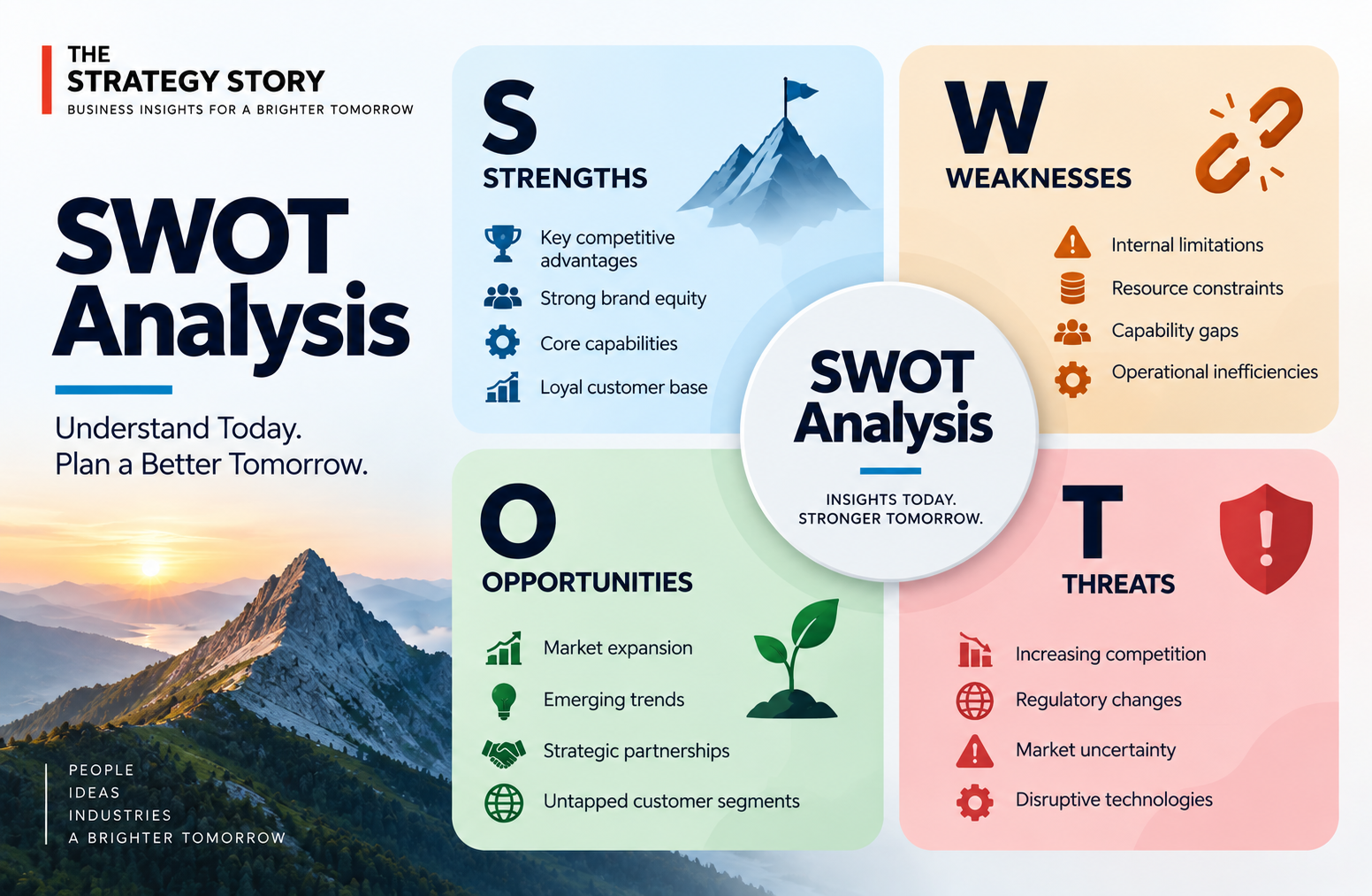
The breadth of this portfolio is central to Thermo Fisher’s competitive position in 2026. It creates diversification and cross-selling opportunities, but it also introduces complexity and exposes the company to multiple regulatory, funding and economic cycles. The following SWOT analysis evaluates these internal and external factors using Thermo Fisher’s latest full-year reporting.
Strengths of Thermo Fisher Scientific in 2026
1. Exceptional scale and portfolio breadth
Thermo Fisher generated $44.56 billion in 2025 revenue across four major segments. Few scientific suppliers participate across research reagents, instruments, diagnostics, laboratory distribution, clinical trials and pharmaceutical manufacturing at comparable scale. This breadth reduces dependence on one technology or customer workflow.
2. Diversified revenue model
The company generated approximately $18.66 billion from consumables, $7.30 billion from instruments and $18.59 billion from services in 2025. Consumables and services create recurring or repeat demand, while instruments provide differentiated technology and installed-base economics. The mix makes Thermo Fisher less dependent on a pure equipment cycle.
3. Powerful brands and commercial reach
Thermo Fisher operates brands such as Thermo Scientific, Applied Biosystems, Invitrogen, Fisher Scientific, Unity Lab Services, Patheon and PPD. Together, these brands cover multiple scientific workflows. Fisher Scientific also gives the company broad distribution reach and purchasing relationships that can support cross-selling.
4. Strong innovation capability
Thermo Fisher invested approximately $1.4 billion in R&D in 2025. High-impact innovation is one of its formal growth pillars. Continued product development in mass spectrometry, electron microscopy, genetic analysis, diagnostics and bioproduction helps the company remain relevant in markets where scientific performance changes rapidly.
5. Cash generation and acquisition capacity
Thermo Fisher generated about $6.34 billion of free cash flow in 2025. Strong cash generation supports organic investment, acquisitions and shareholder returns. The company can acquire specialized technologies and then apply its commercial network and PPI Business System to pursue synergies.
Related: Thermo Fisher Scientific’s Business Model in 2026
Weaknesses of Thermo Fisher Scientific in 2026
1. Exposure to research and capital-spending cycles
Not every part of Thermo Fisher is recurring. High-value analytical instruments can depend on customer capital budgets, while academic and government demand depends partly on research funding. In 2025, the academic and government market declined amid U.S. customer hesitancy and macroeconomic weakness in China.
2. Operational complexity
Thermo Fisher manages a portfolio ranging from reagent manufacturing to laboratory distribution, regulated diagnostics, clinical research and drug manufacturing. These businesses require different operating models, regulatory capabilities and talent. Complexity can make integration and execution more difficult as the portfolio expands.
3. Dependence on successful M&A integration
Acquisitions are a significant growth mechanism. Thermo Fisher pays for expected strategic benefits and synergies, but those benefits are not automatic. Integration can disrupt employees, systems or customers, and expected revenue or cost synergies may take longer to achieve than planned.
4. Service businesses increase execution intensity
Services generated $18.59 billion in 2025. Clinical trials and pharmaceutical manufacturing depend heavily on people, facilities, project execution and regulatory compliance. This gives Thermo Fisher deeper customer relationships but also exposes it to operational risks beyond conventional product manufacturing.
5. Large scale raises the growth hurdle
At more than $44 billion of annual revenue, even modest percentage growth requires substantial absolute incremental revenue. Thermo Fisher therefore needs multiple growth engines—innovation, market share, acquisitions and productivity—to sustain meaningful earnings expansion over time.
Related: Thermo Fisher Scientific’s Business Strategy in 2026
Opportunities for Thermo Fisher Scientific in 2026
1. Expansion in biologics and bioproduction
Biologic medicines require specialized cell-culture, purification, filtration and single-use technologies. Thermo Fisher’s acquisition of Solventum’s purification and filtration business broadens its bioproduction portfolio and allows it to serve more of the upstream and downstream manufacturing workflow.
2. Integrated drug development
Accelerator Drug Development connects Thermo Fisher’s clinical research and pharmaceutical development and manufacturing capabilities. If customers increasingly prefer fewer handoffs and more integrated partners, Thermo Fisher can capture a larger share of spending across each drug-development program.
3. Clinical-trial data and digital capabilities
The announced Clario acquisition would add endpoint-data solutions used in clinical trials. Combined with PPD, this could expand Thermo Fisher’s clinical-research offering into a more data-rich platform and deepen customer relationships, subject to completion and successful integration.
4. AI-enabled scientific and operating productivity
Thermo Fisher established a strategic collaboration with OpenAI in 2025 to expand artificial intelligence across operations, products and services. AI can potentially improve internal productivity while also creating tools that help customers analyze scientific information and accelerate development workflows.
5. Expansion of U.S. pharmaceutical manufacturing
The acquired sterile fill-finish facility in New Jersey increases domestic drug-product capacity. Pharmaceutical customers seeking resilient manufacturing networks and additional U.S. capacity may create opportunities for Thermo Fisher’s Pharma Services business.
Related: Thermo Fisher Scientific PESTEL Analysis in 2026
Threats to Thermo Fisher Scientific in 2026
1. Government research-funding uncertainty
Academic and government organizations are important customers. Changes in budgets, grants or policy can delay research spending and instrument purchases. Thermo Fisher’s 2025 experience demonstrates that uncertainty alone can create customer hesitancy before actual funding reductions fully flow through.
2. China and regional macroeconomic weakness
Thermo Fisher reported declining sales in China in 2025. Continued macroeconomic weakness, changing government priorities or reduced laboratory investment could pressure growth in an important scientific market.
3. Tariffs, trade restrictions and geopolitical disruption
The company operates a global manufacturing and supply network. Tariffs can raise input or distribution costs, while export controls and geopolitical tensions can limit access to customers or technologies. Thermo Fisher specifically highlighted active management of tariff and policy changes in 2025.
4. Rapid technological change and competition
Scientific tools evolve quickly. Competitors can introduce instruments or workflows with better sensitivity, speed, automation or cost economics. Thermo Fisher must sustain R&D investment across many product categories simultaneously to protect market positions.
5. Regulatory, quality and cybersecurity risk
Diagnostics, clinical research and pharmaceutical manufacturing operate under extensive regulation. Quality failures can lead to recalls, remediation costs or customer disruption. At the same time, increasing digitization and sensitive scientific data create cybersecurity and data-protection risks.
Thermo Fisher Scientific SWOT analysis in 2026: strategic takeaway
Thermo Fisher’s greatest strength is the system created by its scale. Innovation, brands, distribution, recurring consumables, services and acquisition capacity reinforce one another. That system gives the company multiple ways to deepen customer relationships and participate in attractive areas such as biologics, integrated drug development, clinical data and AI.
The same breadth creates the central weakness: complexity. Thermo Fisher must manage capital-spending cycles, government funding, regulated service operations and acquisition integration across a global portfolio. External threats from China, trade policy, technology and regulation therefore matter because they can affect several parts of the system at once.
In 2026, the strategic opportunity is to keep turning breadth into integration. If Thermo Fisher can make its businesses work together—rather than simply coexist—it can capture more customer spending across the scientific lifecycle while using PPI and cash generation to manage the complexity that comes with scale.