
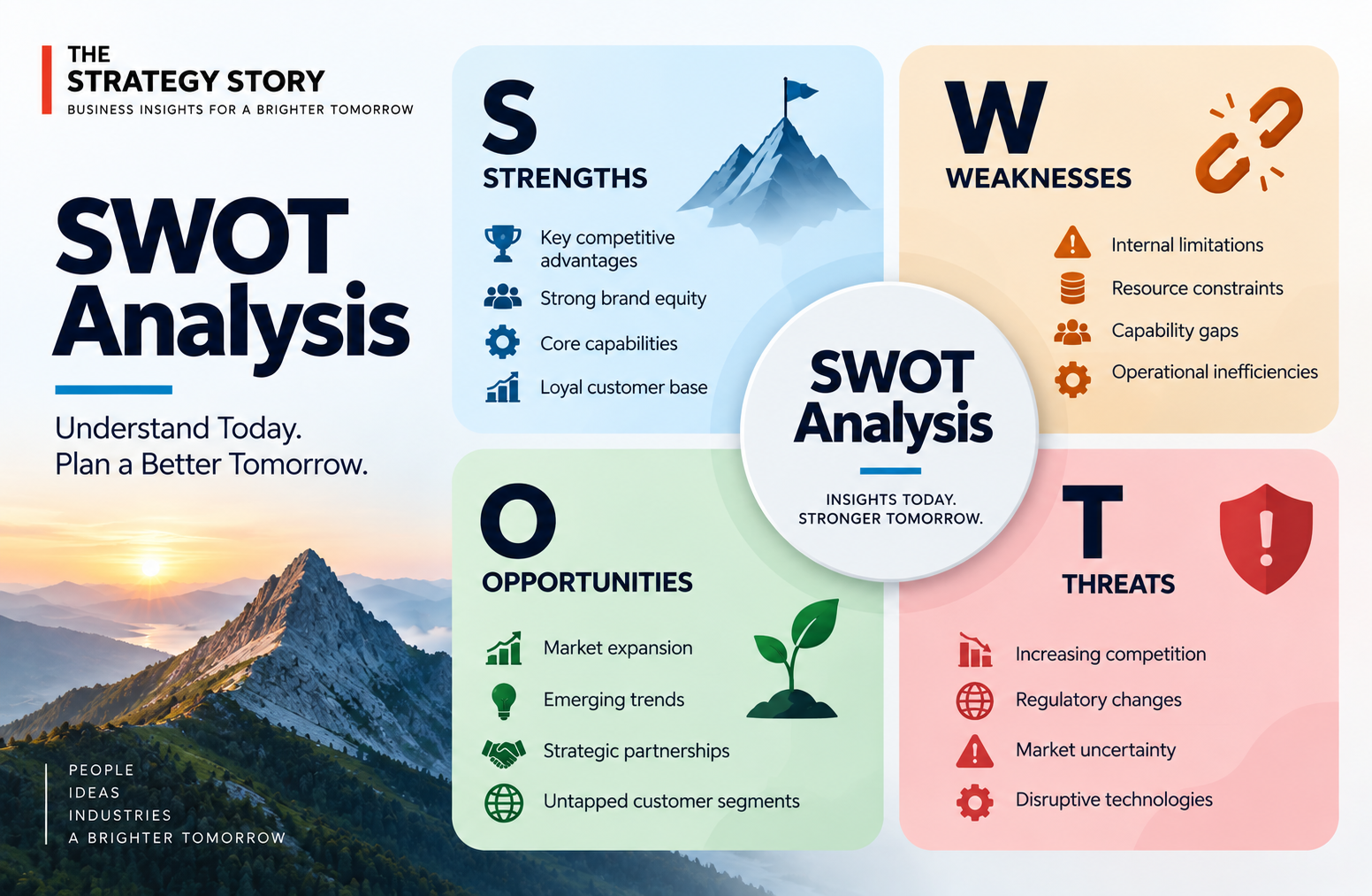
Texas Instruments enters 2026 with a broad analog and embedded portfolio, strong manufacturing ambitions and a clear free-cash-flow philosophy. Its strengths are structural, but the current capacity buildout increases exposure to semiconductor-cycle timing and utilization. This SWOT uses only TI’s 2025 Annual Report/Form 10-K.
Strengths
1. Broad analog product portfolio
TI sells tens of thousands of products across many applications, reducing dependence on individual chips and creating numerous customer design opportunities. See our Texas Instruments Business Strategy 2026.
2. Internal manufacturing advantage
TI’s 300-millimeter capacity can provide lower unit costs and greater supply control when efficiently utilized.
3. Long-lived product positions
Analog and embedded products can remain in customer systems for years, allowing R&D and manufacturing investments to generate revenue over long periods.
4. Diverse customer and end-market exposure
TI serves industrial, automotive, personal electronics, communications and enterprise markets, limiting reliance on a single application.
5. Disciplined capital-allocation framework
TI prioritizes long-term free cash flow per share, investing in competitive advantages before returning remaining cash through dividends and repurchases. See our Texas Instruments Business Model 2026.
Weaknesses
1. High near-term capital intensity
New fabrication facilities require substantial spending before reaching efficient utilization, reducing near-term free cash flow.
2. Fixed manufacturing costs
Owning factories provides strategic control but creates depreciation and fixed costs that pressure margins when semiconductor demand is weak.
3. Exposure to cyclical end markets
Industrial, automotive and electronics customers can reduce inventories and orders sharply during downturns.
4. Less exposure to leading-edge compute
TI’s focus on analog and embedded products means it does not directly capture all of the economics associated with leading-edge AI processors and memory.
5. Long payback periods
Manufacturing investments are designed for decades, increasing the consequences of incorrect assumptions about long-term demand or technology.
Opportunities
1. Industrial semiconductor growth
Factory automation, energy infrastructure and connected equipment can increase analog and embedded content over time.
2. Automotive electronics
Vehicles increasingly require power management, sensing, connectivity and embedded control, expanding TI’s semiconductor opportunity per vehicle.
3. 300-millimeter utilization
Higher utilization of new factories can improve unit economics and free cash flow as fixed costs are absorbed across larger volumes.
4. Direct customer channels
Digital and direct sales can deepen customer insight, improve product discovery and increase TI’s share of customer designs.
5. Supply-chain localization
Customers seeking dependable geographically resilient semiconductor supply can value TI’s internally controlled U.S. manufacturing footprint.
Threats
1. Semiconductor downturns
Prolonged weak demand can leave factories underutilized and pressure revenue, gross margin and cash generation.
2. Intense analog competition
TI competes with large global semiconductor suppliers and numerous specialized vendors on performance, price, availability and support.
3. Trade restrictions
Export controls, tariffs and geopolitical tensions can affect customer access and global supply chains. See our Texas Instruments PESTEL Analysis 2026.
4. Technology transitions
Changes in architectures, integration levels or customer design practices can reduce demand for existing products.
5. Manufacturing execution risk
Delays, yield issues or cost overruns in new fabrication facilities could weaken the expected economics of TI’s capacity strategy.
Source: Texas Instruments, 2025 Annual Report / Form 10-K.