
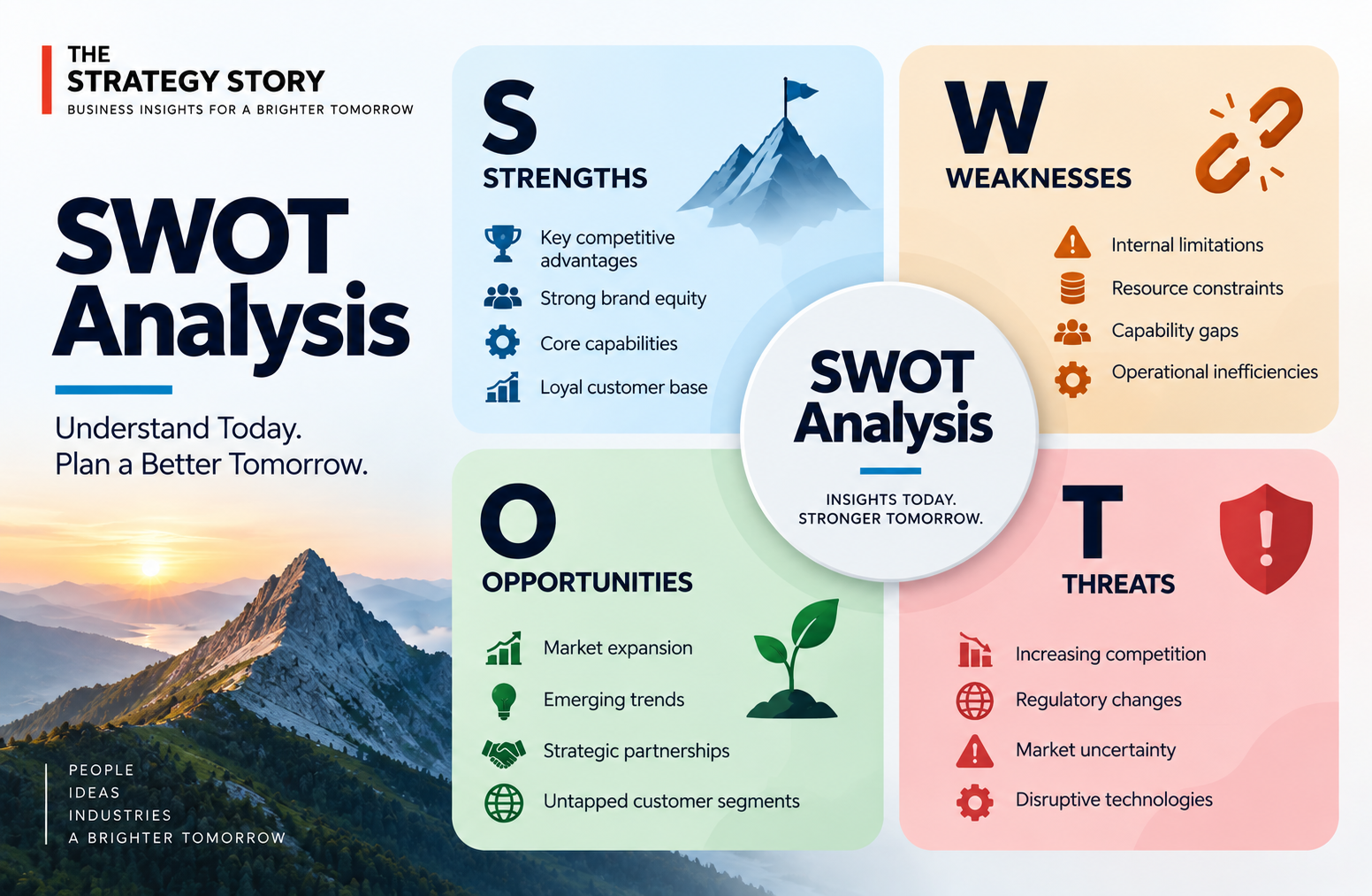
Goldman Sachs enters 2026 with stronger profitability, leading institutional franchises and a growing asset-management platform, balanced against market cyclicality, capital intensity and extensive regulation. In 2025, net revenues rose 9% to $58.3 billion and ROE improved to 15.0%. This SWOT uses only Goldman Sachs’ 2025 Form 10-K.
Strengths
1. Global institutional franchise
Goldman serves corporations, financial institutions, governments and individuals across major financial centers, giving it broad client access and deal flow. See our Goldman Sachs Business Strategy 2026.
2. Integrated banking and markets capabilities
Advisory, underwriting, FICC, Equities, financing and transaction banking allow Goldman to serve multiple needs within one institutional relationship.
3. Growing Asset & Wealth Management platform
Asset-based management fees and incentive fees diversify revenue beyond transaction activity and support a more recurring earnings mix.
4. Strong capital position
Year-end CET1 ratios were 14.3% under Standardized rules and 15.1% under Advanced rules, supporting resilience and capital deployment.
5. Improved profitability
2025 EPS rose 27% to $51.32 and ROE improved 230 basis points to 15.0%. The underlying revenue model is explained in our Goldman Sachs Business Model 2026.
Weaknesses
1. Cyclical transaction revenues
Investment banking and market activity fluctuate with economic confidence, financing conditions, volatility and client activity.
2. Capital-intensive activities
Trading, lending and investments require substantial balance-sheet and regulatory capital, limiting how rapidly some businesses can scale.
3. Complex operating structure
Goldman’s global, multi-product organization requires sophisticated risk, compliance and technology systems and can create coordination costs.
4. Funding sensitivity
Net interest income and financing economics depend on interest rates, funding composition and market conditions. 2025 net interest income rose sharply, demonstrating that sensitivity.
5. Reputation sensitivity
Financial institutions depend heavily on trust. Regulatory, conduct or operational failures can damage client relationships beyond the immediate financial cost.
Opportunities
1. Third-party asset-management growth
Goldman is transitioning from direct investments toward a scaled third-party funds-driven model, potentially increasing fee income while reducing capital intensity.
2. Cross-selling through One Goldman Sachs
Connecting advisory, markets, financing and asset-management capabilities can increase wallet share from existing relationships.
3. Wealth management expansion
Growing assets among high-net-worth and institutional clients can expand recurring management and advisory fees.
4. Strategic-location productivity
With 45% of employees in strategic locations at December 2025, Goldman can deepen centers of excellence and improve operating leverage.
5. Technology and AI
Technology can improve client service, risk management and internal productivity, although it also creates new cybersecurity risks.
Threats
1. Extensive regulation
As a globally systemically important financial institution, Goldman faces pervasive regulation, capital requirements and potential enforcement actions. See our Goldman Sachs PESTEL Analysis 2026.
2. Market and economic shocks
Wars, recessions, pandemics, extreme weather and other disruptions can reduce transactions, damage counterparties and create liquidity or market stress.
3. Cybersecurity attacks
Goldman warns that AI technologies may increase the frequency and severity of cyberattacks, while reliance on external cloud and service providers expands information risk.
4. Intense competition
The firm competes with banks, asset managers, private-capital firms and technology-enabled financial companies for clients, talent and capital.
5. Credit and counterparty risk
Lending, derivatives and financing expose Goldman to counterparties whose financial condition can deteriorate rapidly during market stress.
Source: Goldman Sachs, 2025 Form 10-K.