
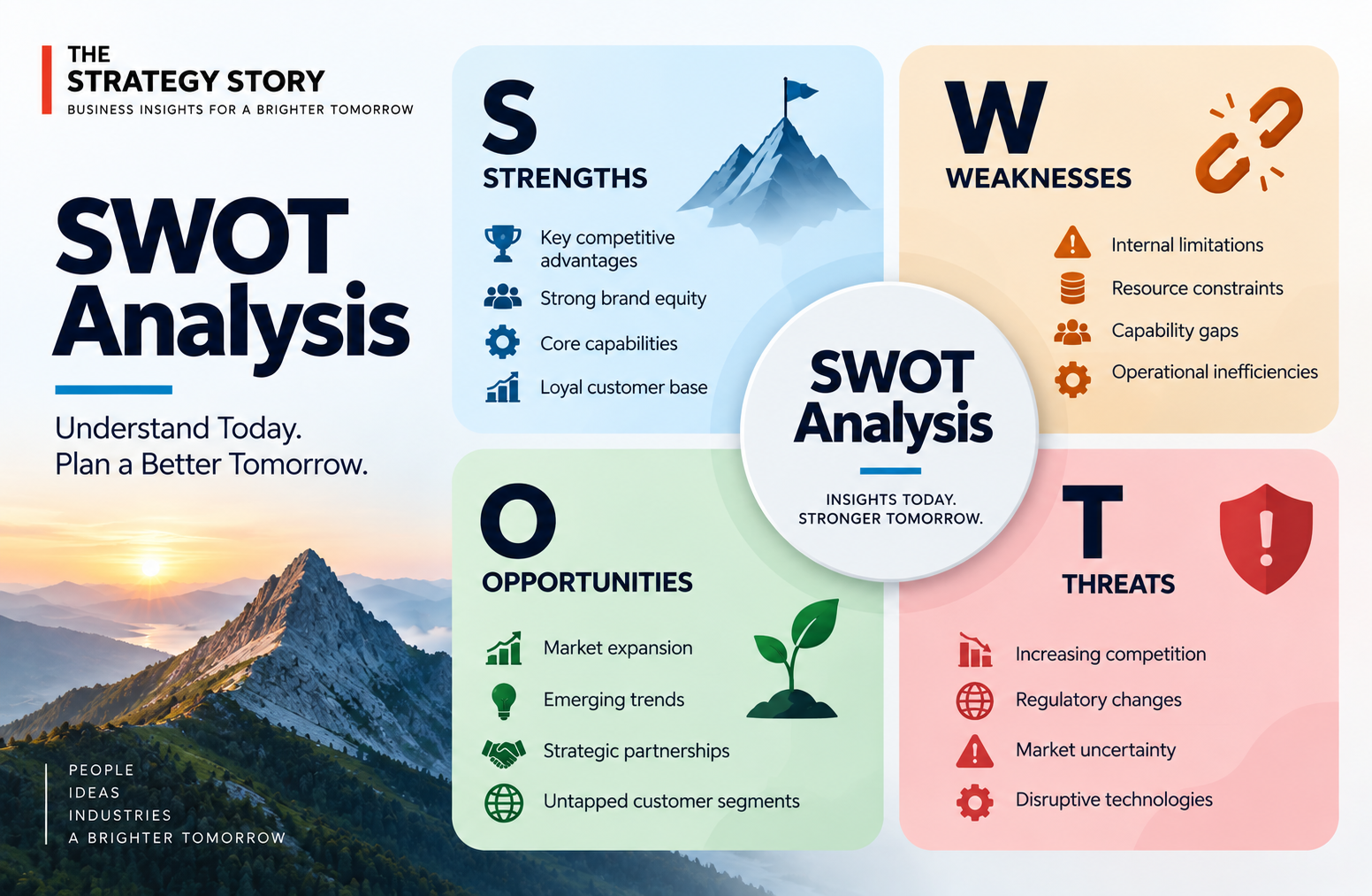
Philip Morris International enters 2026 with a rapidly growing smoke-free portfolio, global brand scale and strong cash generation, while remaining exposed to the health, regulatory and litigation risks inherent in nicotine products. In 2025, net revenues reached $40.6 billion and smoke-free products accounted for 41.5% of the total. This SWOT uses only PMI’s 2025 Form 10-K.
Strengths
1. Leadership in heat-not-burn
PMI estimates approximately 76% global heat-not-burn volume share, with IQOS holding the number-one volume position in 13 markets. This gives PMI scale, consumer recognition and accumulated product experience. See our Philip Morris International Business Strategy 2026.
2. Rapidly scaling smoke-free portfolio
Smoke-free shipments grew 12.8% in 2025 and represented 41.5% of net revenues. More than 43 million estimated adults used PMI smoke-free products across 106 markets.
3. Multi-category platform
IQOS, ZYN and VEEV give PMI exposure to heated tobacco, nicotine pouches and e-vapor rather than relying on one technology or consumer behavior.
4. Strong cash generation
Operating cash flow was $12.2 billion in 2025. This supports continued product investment, manufacturing, debt service and shareholder distributions during the transition.
5. Global brands and distribution
PMI’s cigarette brands and international commercial infrastructure provide broad distribution capabilities that can support smoke-free expansion. The underlying economics are explored in our Philip Morris International Business Model 2026.
Weaknesses
1. Continued dependence on cigarettes
Despite rapid smoke-free growth, cigarettes remain the majority of revenue. PMI therefore remains economically exposed to a category it ultimately intends to replace.
2. Product transition requires sustained investment
PMI has invested more than $16 billion in smoke-free development and commercialization since 2008. Maintaining innovation and consumer conversion requires ongoing spending.
3. Regulatory dependence
Smoke-free growth depends on market authorization and category-specific rules. A commercially attractive product cannot necessarily be launched or marketed freely in every geography.
4. Complex multi-category execution
Managing cigarettes, heated tobacco, oral nicotine and e-vapor across diverse markets increases manufacturing, regulatory and commercial complexity.
5. Reputation tied to nicotine and tobacco
Even as the portfolio shifts, PMI remains associated with tobacco and nicotine. That can constrain stakeholder acceptance, regulation, partnerships and communications.
Opportunities
1. Further smoke-free conversion
Smoke-free products were 41.5% of revenue in 2025, while 27 markets already exceeded 50%. That gap suggests substantial remaining migration potential across the broader portfolio.
2. Global expansion of ZYN
ZYN was available in 56 markets and nicotine-pouch volume grew 36%. PMI says the category remains nascent in most geographies, creating potential whitespace.
3. Continued IQOS innovation
ILUMA i was available in 55 of 79 IQOS markets. Device and consumable innovation can support retention, acquisition and category expansion.
4. E-vapor growth
PMI’s e-vapor volumes doubled in 2025 and VEEV profitability improved. This gives PMI another pathway to address adult nicotine preferences.
5. U.S. smoke-free market
Swedish Match expanded PMI’s U.S. presence, particularly through ZYN. The U.S. represents a significant growth opportunity if regulatory conditions permit continued category expansion.
Threats
1. Increasing regulation
Nicotine products face restrictions covering authorization, flavors, packaging, marketing, taxation and sales channels. These external constraints are examined in our Philip Morris International PESTEL Analysis 2026.
2. Health and litigation risk
Tobacco and nicotine products are subject to health-related litigation and public-policy scrutiny. Adverse judgments or new scientific findings can affect economics and reputation.
3. Illicit trade
High excise taxes and regulation can encourage illicit cigarette and nicotine-product markets, undermining legitimate volumes and government tax objectives.
4. Competitive innovation
PMI competes with global tobacco companies and emerging nicotine brands. Consumer preferences can shift quickly across product formats, requiring continued innovation.
5. Currency and geopolitical exposure
PMI operates across many countries, creating exposure to foreign exchange, economic instability, sanctions, conflict and changing trade rules.
Source: Philip Morris International, 2025 Form 10-K.