
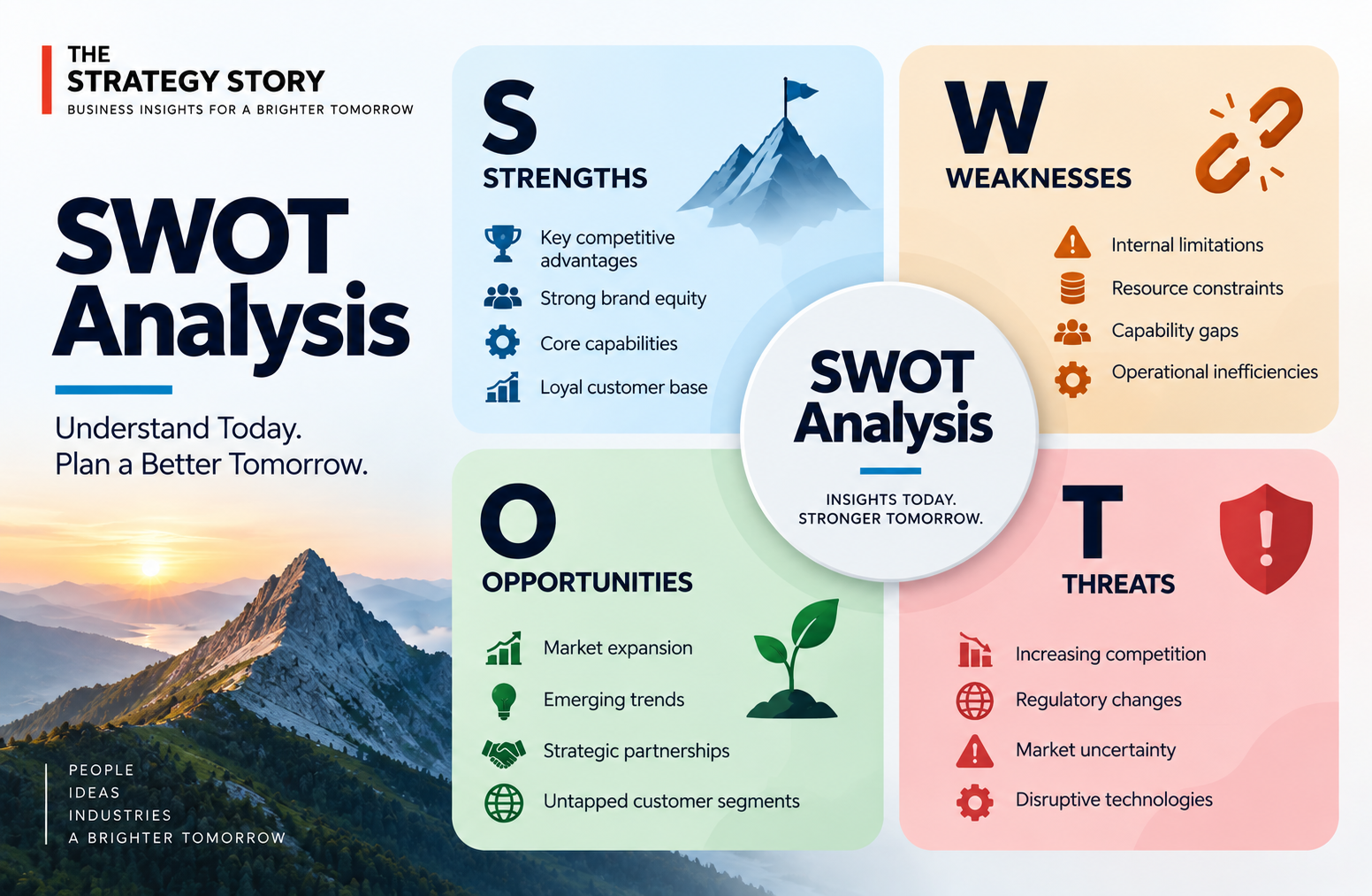
Pfizer’s 2026 SWOT reflects a company with exceptional commercial scale and cash-generating franchises, but also a substantial portfolio-renewal challenge. 2025 revenue was $62.6 billion, while non-COVID revenue grew 6% operationally. The analysis below is based only on Pfizer’s 2025 Form 10-K.
Strengths
1. Global biopharmaceutical scale
Pfizer combines discovery, clinical development, regulatory expertise, manufacturing and commercialization across global markets. This integrated scale allows successful assets to be developed and launched broadly. See our Pfizer Business Strategy 2026 for how Pfizer is redeploying that scale.
2. Large established franchises
Eliquis generated about $7.96 billion in 2025 and the Prevnar family about $6.49 billion. These franchises provide substantial revenue while newer products and pipeline assets develop.
3. Diversified medicines and vaccines portfolio
Pfizer operates across multiple therapeutic areas and product categories, reducing dependence on any single scientific platform even though individual blockbusters remain economically important.
4. Ability to acquire external innovation
Transactions involving Seagen, Metsera, 3SBio and YaoPharma demonstrate Pfizer’s ability to use its balance sheet and development infrastructure to source science externally.
5. Commercial and manufacturing infrastructure
Pfizer can move approved products through a global manufacturing and commercial system. This infrastructure increases the value it can potentially extract from internally discovered or acquired assets. The model is detailed in our Pfizer Business Model 2026.
Weaknesses
1. Revenue pressure from COVID normalization
Total revenue fell from $63.6 billion in 2024 to $62.6 billion in 2025 despite 6% operational growth excluding COVID products. Pandemic-product volatility continues to obscure underlying portfolio performance.
2. Blockbuster concentration
Eliquis represented about 13% of 2025 revenue and Prevnar about 10%. Large franchises create powerful economics but also significant exposure when competition or exclusivity changes.
3. Patent-expiry replacement burden
Pfizer’s scale means replacing lost exclusivity requires multiple successful launches. A single pipeline success may be material but insufficient to offset declines across several mature franchises.
4. High organizational complexity
A global R&D, manufacturing and commercial network creates substantial fixed costs and coordination demands. Pfizer’s ongoing simplification efforts implicitly acknowledge the productivity challenge of operating at this scale.
5. Dependence on successful capital allocation
Large acquisitions and licensing deals can accelerate growth, but value depends on clinical success, integration and commercial execution. Paying for external innovation transfers part of the scientific risk into capital-allocation risk.
Opportunities
1. Oncology expansion
The Seagen acquisition provides Pfizer with a larger oncology portfolio and antibody-drug conjugate capabilities. Successful pipeline execution could create multiple future franchises.
2. Obesity
The Metsera acquisition expanded Pfizer’s exposure to obesity, an area management views as a meaningful future opportunity. Success could diversify growth beyond existing therapeutic franchises.
3. Non-COVID portfolio momentum
Revenue excluding COVID products grew 6% operationally in 2025. Sustaining that momentum would progressively reduce dependence on pandemic-era products.
4. External licensing
Agreements with companies such as 3SBio and YaoPharma provide access to additional science without requiring all innovation to originate internally.
5. AI-enabled productivity
Pfizer plans to expand to more than 1,200 GPUs over two years. Better use of data and AI could potentially improve discovery, development and operating productivity, although realized returns remain to be demonstrated.
Threats
1. Pricing and reimbursement pressure
Government pricing initiatives and payer negotiations can reduce product economics. The policy environment is explored further in our Pfizer PESTEL Analysis 2026.
2. Generic and biosimilar competition
Loss of patent or regulatory exclusivity can cause rapid revenue erosion as lower-priced competitors enter. This is an inherent structural threat to the pharmaceutical model.
3. Clinical-development failure
Pipeline assets can fail for efficacy, safety or regulatory reasons after substantial investment. Pfizer’s future growth therefore depends on a portfolio of uncertain scientific outcomes.
4. Intense biopharma competition
Pfizer competes for scientific talent, licensing assets, clinical-trial participants, physician adoption and market access against large pharmaceutical companies and biotechnology firms.
5. Regulatory, legal and supply risks
Pharmaceutical companies operate under extensive product, manufacturing, safety and promotional regulation. Compliance failures, litigation, cybersecurity events or supply interruptions can create financial and reputational consequences.
Source: Pfizer, 2025 Form 10-K.