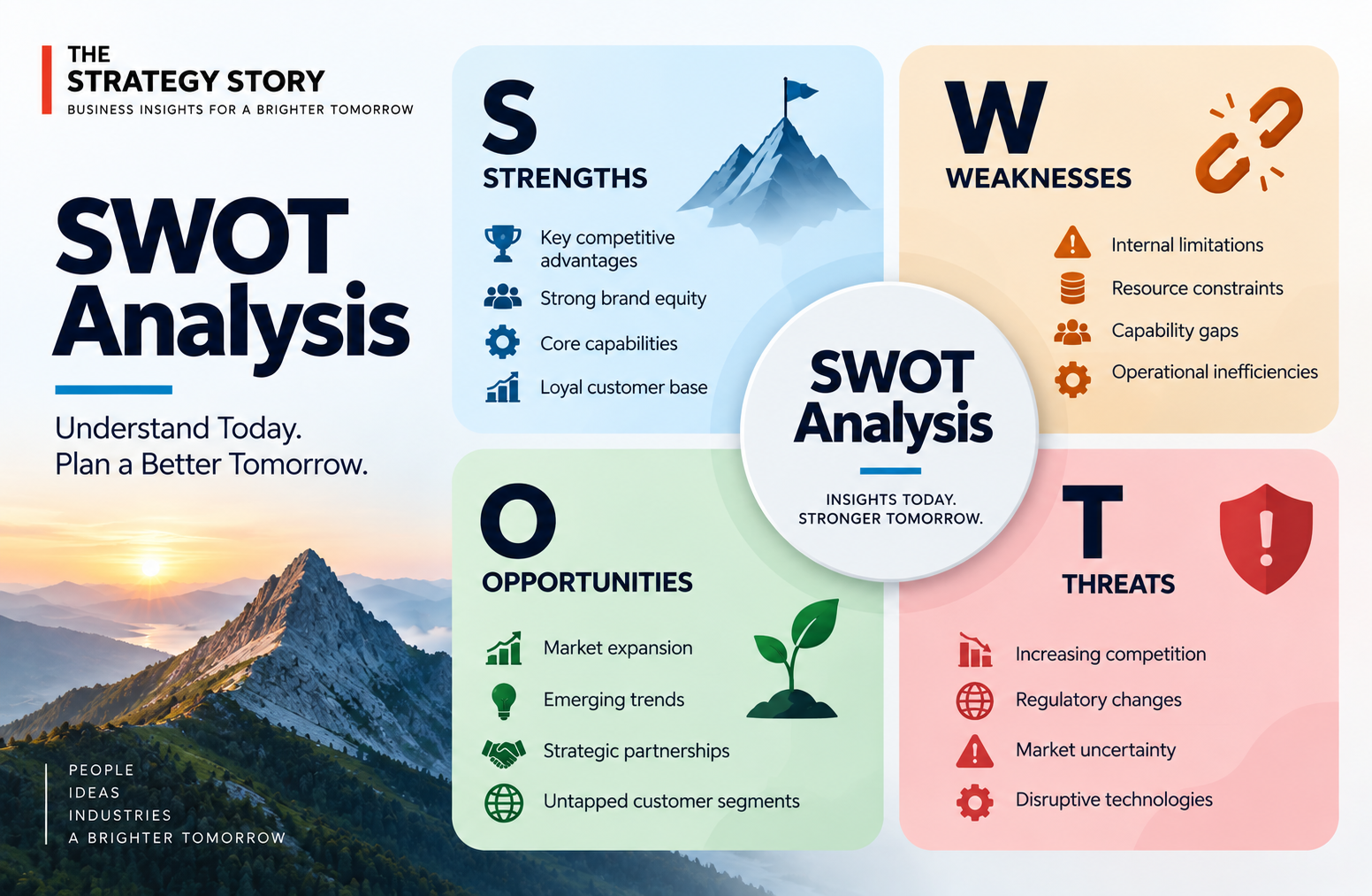
Intel is navigating one of the most consequential transformations in its history. The company combines a large computing-products franchise with an advanced semiconductor manufacturing network and is working to establish Intel Foundry as a commercially competitive manufacturing platform. Its FY2025 Annual Report highlights substantial technology, capital and customer assets, but also significant competitive and execution challenges. This SWOT analysis examines Intel’s strengths, weaknesses, opportunities and threats using the company’s FY2025 disclosures.
For Intel’s underlying revenue and manufacturing economics, read our Intel Business Model 2026.
Strengths
1. Integrated product design and manufacturing capabilities
Intel combines processor design, process technology, semiconductor fabrication and advanced packaging within one company. This integration can enable close coordination between product architecture and manufacturing and gives Intel strategic control over significant production capacity. Few major semiconductor companies operate with comparable breadth across both product development and leading-edge manufacturing.
2. Large x86 ecosystem and installed base
Intel’s processors operate within a broad x86 software and hardware ecosystem built over decades. PC manufacturers, enterprises, cloud providers and developers have substantial experience with Intel-compatible platforms. This installed base can reduce adoption friction for new generations and supports Intel’s ability to commercialize products across client and data-center markets.
3. Extensive semiconductor intellectual property and engineering expertise
Intel possesses deep expertise across processor architecture, manufacturing processes, packaging, software and platform engineering. Semiconductor leadership requires accumulated knowledge that is difficult to reproduce quickly. Intel’s engineering resources allow it to develop products and manufacturing technologies internally while also supporting customers through software tools, design capabilities and ecosystem relationships.
4. Strategic manufacturing footprint
Intel operates major semiconductor manufacturing facilities and continues to invest in advanced capacity. Its U.S. manufacturing position has strategic importance as governments seek greater domestic semiconductor capability. Intel’s 2025 agreement with the U.S. Department of Commerce illustrates the policy relevance of its manufacturing footprint and can support continued investment in U.S. semiconductor technology.
5. Broad customer relationships
Intel sells to a wide range of original equipment manufacturers, cloud and communications service providers, enterprises and other technology customers. These relationships provide market access across PCs, servers and infrastructure. They can also support Intel Foundry if the company demonstrates competitive process technology, packaging, design enablement and reliable customer execution.
For management’s strategic response, see our Intel Business Strategy 2026.
Weaknesses
1. Capital-intensive manufacturing model
Intel’s fabrication network requires very large investments in facilities and equipment before future demand is certain. High fixed costs and depreciation make profitability sensitive to factory utilization and process yields. When capacity exceeds demand or process transitions are delayed, the integrated model can create substantially greater financial pressure than a fabless semiconductor structure.
2. Foundry profitability and utilization challenge
Intel Foundry must support large internal manufacturing requirements while becoming competitive enough to win meaningful external business. Building an external customer base takes time, and underutilized capacity can weigh heavily on economics. The foundry therefore needs both strong process execution and sufficient wafer volume to spread its fixed manufacturing costs efficiently.
3. Need for consistent product execution
Intel’s economics depend on delivering competitive processors on predictable schedules. Product delays or weaker performance can affect market share, pricing and manufacturing utilization simultaneously. Because Intel Products and Intel Foundry are strategically linked, execution problems in one part of the company can reduce demand or worsen economics in the other.
4. Organizational complexity
Intel spans product design, software, process development, global manufacturing and foundry services. Managing these activities can create complexity in decision-making, resource allocation and accountability. Intel has been simplifying its organization and increasing separation between products and foundry operations, indicating the need for clearer ownership, faster decisions and stronger economic discipline.
5. Heavy dependence on core computing markets
Despite portfolio breadth, Intel remains highly exposed to client and data-center computing. Changes in PC demand, server architecture or customer spending can materially affect performance. AI is also shifting data-center investment toward accelerators, creating pressure on the traditional CPU-centric economics that historically supported a large portion of Intel’s business.
For the external forces shaping these opportunities and threats, read our Intel PESTEL Analysis 2026.
Opportunities
1. External foundry customer growth
Intel can potentially transform its manufacturing network into a broader revenue platform by serving third-party chip designers. External customers could increase fab utilization, diversify manufacturing volume and improve returns on process technology investments. Success requires competitive nodes, advanced packaging, customer-oriented service, design tools and reliable delivery.
2. AI-enabled PC refresh cycle
AI capabilities integrated into personal computers can create a new reason for consumers and enterprises to upgrade devices. Intel can benefit if its processors provide compelling local AI performance alongside power efficiency, security and software compatibility. Its existing relationships across the PC ecosystem give it a broad channel through which to commercialize AI-enabled client products.
3. Data-center platform renewal
Cloud and enterprise infrastructure continues to require substantial general-purpose computing even as accelerated AI expands. Intel has an opportunity to strengthen its server franchise through competitive processors that improve performance, efficiency and total cost of ownership. A strong product roadmap can also provide important internal wafer volume for Intel Foundry.
4. Advanced packaging and heterogeneous computing
Modern semiconductor systems increasingly combine multiple chiplets and process technologies. Intel’s advanced packaging capabilities can support its own products and potentially external foundry customers. Heterogeneous designs also allow Intel to combine internally manufactured components with externally sourced dies, creating flexibility in product architecture and manufacturing choices.
5. Greater capital and portfolio discipline
Intel can improve long-term economics by focusing investment on core product and manufacturing technologies, reducing organizational complexity and matching capacity more closely with demand. Portfolio simplification and selective external manufacturing can free resources for the areas most likely to restore competitiveness while limiting capital committed to lower-priority activities.
Threats
1. Intense semiconductor competition
Intel competes against companies with strong CPU, accelerator and semiconductor manufacturing capabilities. Rivals can gain share through superior performance, power efficiency, product timing or pricing. Because semiconductor customers plan platforms well in advance, a competitor’s technology advantage can influence multiple years of customer purchasing and ecosystem investment.
2. Rapid shift toward accelerated AI computing
AI is changing data-center spending patterns and increasing the importance of specialized accelerators. If general-purpose CPUs capture a smaller share of infrastructure value, Intel’s traditional data-center economics could face pressure. Intel must maintain CPU relevance while participating effectively in heterogeneous and accelerated computing environments.
3. Process technology execution risk
Intel Foundry depends on successful development and high-volume manufacturing of advanced process technologies. Delays, low yields or performance shortfalls can affect internal Intel products and reduce confidence among external foundry prospects. The long development cycle means process problems can have consequences across several product generations and capital-investment decisions.
4. Semiconductor demand volatility and customer concentration
Semiconductor demand can change rapidly because of macroeconomic conditions, inventory corrections and shifts in customer spending. Large PC manufacturers and cloud customers also have significant purchasing power. Demand weakness can reduce factory utilization, while customer concentration can increase pricing pressure and amplify the effect of major platform decisions.
5. Geopolitical, supply-chain and regulatory risk
Intel operates a global semiconductor supply chain subject to export controls, trade restrictions, geopolitical tensions and government policy. Advanced semiconductor technology is strategically sensitive, increasing regulatory scrutiny. Restrictions can affect customer access, equipment sourcing, manufacturing decisions and the ability to serve certain international markets.
Across these factors, Intel’s position is unusually interconnected. Product competitiveness affects internal manufacturing volume, manufacturing execution affects product cost and performance, and both determine whether external foundry customers view Intel as a credible long-term partner. This means strengths such as integration and manufacturing scale can become weaknesses when execution or utilization falls short.
Intel’s opportunity is therefore not simply to grow one product category. It is to make the integrated model work economically: competitive processors can provide foundry volume, better process technology can strengthen products, and external foundry customers can improve factory utilization. Achieving that cycle requires disciplined capital allocation and consistent delivery across several technology generations.
The same interdependence increases downside risk. Semiconductor development cycles are long, so weak decisions can affect results years later. Capital committed to facilities cannot be quickly reversed, while customers can shift future platforms toward competitors. Intel must therefore balance ambitious technology investment with realistic demand signals, customer commitments and measurable returns.
Its broad ecosystem remains an important buffer. Existing software compatibility, customer relationships and manufacturing assets provide a base from which Intel can rebuild competitiveness. Yet the FY2025 risk profile makes clear that historical scale alone is insufficient; the company must convert those assets into timely products, efficient manufacturing and external customer trust.
Source: Intel Corporation, FY2025 Annual Report / Form 10-K.