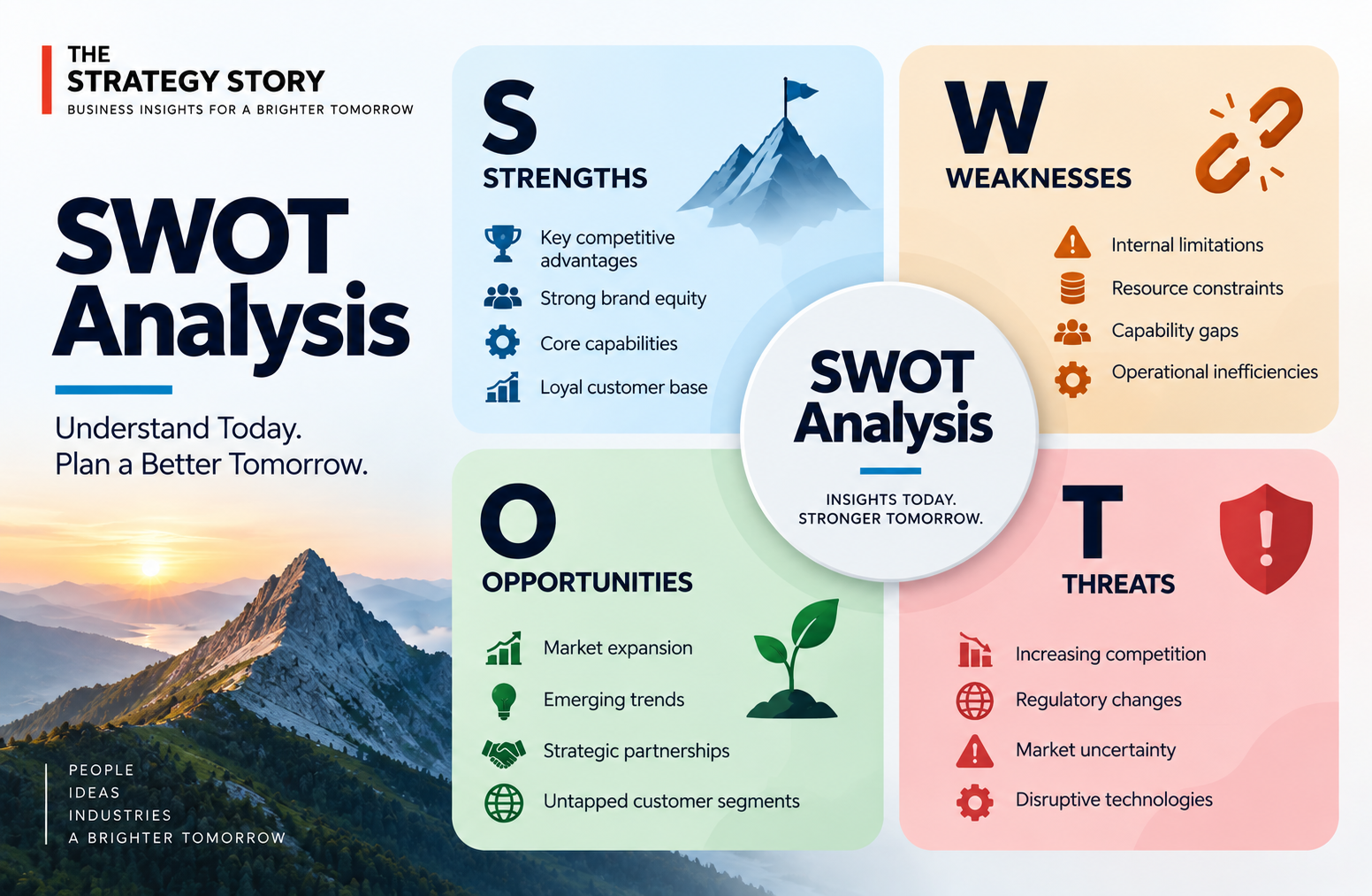

Morgan Stanley enters 2026 after a strong 2025, when net revenues reached $70.6 billion and net income applicable to Morgan Stanley reached $16.9 billion. The firm combines Institutional Securities with large Wealth Management and Investment Management businesses, creating both cyclical and recurring revenue streams. This SWOT analysis is based strictly on Morgan Stanley’s 2025 Form 10-K.
For how Morgan Stanley’s three major businesses generate revenue and reinforce one another, read our Morgan Stanley Business Model 2026.
Strengths
1. Diversified three-segment franchise
Morgan Stanley operates across Institutional Securities, Wealth Management and Investment Management. This diversification reduces reliance on a single revenue source. Wealth and investment-management fees can provide recurring revenue when investment banking slows, while stronger trading or deal activity can add upside during active markets. The combination creates a more balanced earnings model than a purely transaction-driven securities firm.
2. Approximately $9.3 trillion of client assets
Wealth Management and Investment Management together ended 2025 with approximately $9.3 trillion of client assets. This enormous base supports management and administration fees and creates opportunities for lending, banking and investment-product penetration. Asset growth can compound through market appreciation and net new assets, giving Morgan Stanley an organic growth engine without equivalent growth in physical infrastructure.
3. Strong Institutional Securities platform
Morgan Stanley has broad capabilities in investment banking, equities and fixed income. Corporate and institutional relationships allow the firm to participate in mergers, underwriting, trading, financing and risk management. The platform can benefit substantially when capital-markets activity increases because specialist teams, technology and distribution are already in place, creating operating leverage to stronger client volumes.
4. Broad Wealth Management distribution
Morgan Stanley combines financial advisors, self-directed capabilities and workplace channels. E*TRADE expanded digital reach while the traditional advisor network supports complex relationships. This creates multiple entry points for clients and allows the firm to serve people as their financial needs evolve, potentially improving asset retention and reducing dependence on any single acquisition channel.
5. Strong 2025 earnings momentum
Net revenues increased to $70.6 billion from $61.8 billion in 2024, while net income applicable to Morgan Stanley rose to $16.9 billion from $13.4 billion. Diluted EPS increased to $10.27 from $8.15. Strong earnings provide resources for technology, capital returns and strategic investment while reinforcing capacity to absorb market volatility.
For the strategic priorities Morgan Stanley is using to deepen client relationships and improve earnings durability, see our Morgan Stanley Business Strategy 2026.
Weaknesses
1. Significant exposure to market levels
Asset-based revenues depend partly on the value of client portfolios. A broad decline in equity or fixed-income markets can reduce fee-generating assets even without client withdrawals. Market weakness can simultaneously reduce investor activity, underwriting and transaction volumes, creating multiple revenue pressures across segments despite the firm’s diversified business mix.
2. Cyclicality of investment banking
Advisory and underwriting revenues depend on corporate confidence, valuations, financing conditions and regulatory approvals. Clients can postpone transactions when uncertainty rises, causing revenue to fall quickly while Morgan Stanley continues carrying highly skilled employees and global infrastructure. This makes parts of Institutional Securities inherently less predictable than recurring asset-management fees.
3. High operating and compensation cost base
Investment banking, trading and wealth management require expensive talent, technology, compliance and infrastructure. Many costs cannot be reduced immediately when revenue weakens. Compensation must remain competitive to retain bankers, traders, investment professionals and financial advisors, creating a structural tension between cost efficiency and protecting revenue-producing talent.
4. Complex regulatory burden
Morgan Stanley operates banking, broker-dealer, investment-management and other regulated entities across jurisdictions. Capital, liquidity, conduct, privacy and consumer requirements create significant compliance costs and can limit how resources are deployed. Regulatory changes may alter product economics or require technology and process changes even when underlying client demand remains strong.
5. Dependence on advisor and investment talent
Client relationships and investment performance often depend on individual professionals and teams. Departing financial advisors can take relationships or assets, while loss of investment professionals can affect performance and fundraising. Morgan Stanley must invest continuously in compensation, technology, culture and succession to retain key people across competitive talent markets.
For the broader external environment affecting these opportunities and risks, read our Morgan Stanley PESTEL Analysis 2026.
Opportunities
1. Continue organic client-asset growth
The approximately $9.3 trillion asset base provides a platform for compounding. Morgan Stanley can grow fee revenue by attracting net new assets, retaining existing relationships and benefiting from long-term market appreciation. Organic growth is particularly valuable after major acquisitions because it demonstrates that the expanded platform can generate additional value without repeated large transactions.
2. Convert workplace and digital users into advice relationships
Workplace and self-directed channels can introduce Morgan Stanley to customers before they require full-service wealth advice. As financial complexity and assets increase, some clients may migrate into advisory relationships, banking or managed products. Better cross-channel transitions can retain assets within Morgan Stanley and increase revenue per client over a long relationship.
3. Capture stronger capital-markets activity
A recovery in mergers, acquisitions, equity issuance or debt underwriting can increase Institutional Securities revenue. Morgan Stanley already maintains the advisory teams, distribution and trading infrastructure needed to serve higher volumes. Stronger activity can therefore create operating leverage, while the Wealth Management franchise provides diversification if recovery timing remains uncertain.
4. Expand private-market and alternative investments
Institutional and wealth clients seek differentiated sources of return. Investment Management can develop private-market and alternative strategies that generate management fees and potentially performance-based income. These products can deepen client relationships, although Morgan Stanley must manage illiquidity, valuation, fundraising cycles and investment risk carefully.
5. Use technology and AI to improve productivity
Technology can help advisors retrieve information, personalize service, automate administrative work and improve risk management. Morgan Stanley’s scale allows development costs to be spread across a large client and employee base. Carefully governed AI can augment professionals and improve operating leverage, provided accuracy, privacy, cybersecurity and regulatory obligations remain central.
Threats
1. Severe market or economic downturn
A recession or major market decline could affect several Morgan Stanley businesses simultaneously. Falling asset values reduce fee bases, clients may trade or invest differently, deal activity can slow and credit losses can increase. The firm’s diversification helps, but a broad financial shock can still create correlated pressure across Institutional Securities, Wealth Management and Investment Management.
2. Cybersecurity and technology disruption
Morgan Stanley relies on digital wealth platforms, trading systems, client data and global operational infrastructure. A significant cyberattack or outage could interrupt transactions, expose sensitive information and damage trust. The scale and interconnectedness of the franchise make technology resilience a continuing threat that requires substantial investment rather than a one-time solution.
3. Regulatory and capital-rule changes
New capital, liquidity, market-conduct or consumer rules can increase costs or reduce returns from particular activities. Morgan Stanley may need to hold more capital, change products or invest in additional compliance systems. Regulatory differences across jurisdictions can also complicate global client service and make some businesses less economically attractive.
4. Intense competition for clients and talent
Morgan Stanley competes with global banks, brokerages, asset managers, private-market firms and digital platforms. Competitors can recruit advisors and bankers, reduce fees or invest aggressively in technology. Client switching is particularly important in wealth and asset management because asset outflows can reduce recurring revenue immediately and weaken future cross-selling opportunities.
5. Credit, liquidity and counterparty stress
Trading, lending and financing expose Morgan Stanley to counterparties and borrowers. During stressed markets, collateral values can fall while funding becomes more expensive or less available. Strong capital and liquidity reduce this risk but cannot eliminate it. Poorly managed concentrations or rapid market moves can create losses and consume capacity when clients need it most.
The Wealth Management platform also creates strategic optionality. Clients can begin through workplace or self-directed channels and later require advice, lending or managed investments. Keeping these transitions inside Morgan Stanley can increase lifetime relationship value and reduce the cost of acquiring assets through entirely new relationships.
Investment Management adds product manufacturing and another recurring fee stream. Its long-term strength depends on investment performance and flows because distribution alone cannot prevent clients from reallocating capital when strategies fail to meet objectives.
The main structural weakness remains sensitivity to financial markets. Falling asset prices can reduce fee bases while weak corporate confidence can reduce investment-banking activity. These effects can occur at the same time, limiting the protection provided by revenue diversification during a broad shock.
Balance-sheet businesses add another layer of risk. Lending, derivatives and financing can deepen client relationships and generate revenue, but they expose the firm to credit and counterparty losses. Capital and liquidity therefore remain essential constraints on growth.
Technology creates a significant opportunity to improve operating leverage. Better digital experiences can serve self-directed clients efficiently, while advisor tools can reduce administrative work. The financial benefit can be substantial when productivity improvements are applied across a large client base.
Technology is simultaneously a major threat because wealth, trading and payment activities depend on secure and available systems. Cyber resilience must therefore grow alongside digital adoption, and third-party dependencies require the same attention as internally operated systems.
Regulation can also change competitive economics. Higher capital requirements may make balance-sheet-intensive activities less attractive, while conduct and privacy rules can increase operating costs. Morgan Stanley’s scale helps absorb compliance investment but does not remove the effect on returns.
Talent competition connects many SWOT factors. Experienced advisors help retain wealth assets, bankers protect institutional relationships and investment professionals influence product performance. Strong platforms and culture can support retention, but competitors can target productive teams directly.
Overall, sustainable performance depends on converting asset growth and client connectivity into revenue while maintaining capital, liquidity and operating discipline. The diversified franchise provides multiple paths to growth, but risk management determines whether those paths produce durable shareholder value.
Source: Morgan Stanley, 2025 Form 10-K.