
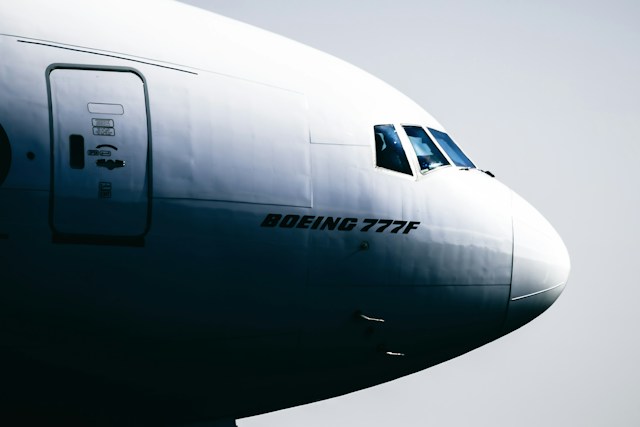
The Boeing Company is one of the world’s major aerospace firms, operating across commercial airplanes, defense and space systems, and global aviation services. Its strategic position in 2026 is defined by an unusual combination of enormous customer demand and significant execution requirements. Boeing ended 2025 with $682.21 billion of backlog, while annual revenue increased 35% to $89.46 billion from $66.52 billion in 2024.
The scale of demand does not eliminate Boeing’s operational challenges. Commercial Airplanes generated $41.49 billion of revenue but remained loss-making, while regulatory oversight, supply-chain constraints, certification programs and manufacturing stability remain critical. Boeing’s strategy is therefore centered not simply on winning more orders but on safely converting an already enormous backlog into deliveries, improving production quality, strengthening the supply chain and restoring sustainable financial performance.
The 2025 Annual Report points to several interconnected strategic priorities: safety and quality, commercial production stability, integration of Spirit AeroSystems, defense execution, services growth and disciplined management of long-cycle development programs.
Boeing Business Model 2026: How Does Boeing Make Money?
1. Restore Safety, Quality and Production Stability
The most fundamental element of Boeing’s strategy is improving safety and quality throughout its production system. In aerospace, production growth is valuable only when every aircraft conforms to exacting specifications and regulatory requirements. Boeing explicitly states that safety, quality and integrity are core to how it operates.
The January 2024 737-9 door-plug accident intensified regulatory scrutiny. The FAA investigated Boeing’s quality control system, including Spirit AeroSystems, and increased oversight of production and quality and safety management systems. Boeing subsequently slowed 737 production and delayed planned production-rate increases to reduce traveled work in factories and at suppliers.
This creates a strategic sequence: Boeing must establish stable production before pursuing maximum output. The company has invested in workforce training, simplified plans and processes, worked to eliminate defects and sought to strengthen its safety and quality culture. These measures may constrain short-term production but are intended to create a healthier long-term manufacturing system.
The importance of this strategy is financial as well as operational. Commercial Airplanes revenue increased to $41.49 billion in 2025, yet the segment still reported a $7.08 billion operating loss. Production disruption, program charges and other execution costs can overwhelm the economics of high-value aircraft deliveries. Sustainable profitability therefore requires predictable production rather than volume growth at any cost.
Regulatory concurrence is directly linked to production strategy. Boeing states that the 737 program may increase production rates and add new production lines only with FAA concurrence. Production health key performance indicators and Boeing’s rate-readiness process under its Safety Management System therefore influence the pace of growth.
2. Increase Commercial Aircraft Production Carefully to Convert Backlog Into Revenue
Boeing has exceptional commercial demand already embedded in its order book. Commercial Airplanes backlog reached $567.29 billion at the end of 2025, compared with $435.18 billion a year earlier. This makes production and delivery capability more strategically important than simply generating additional demand.
Boeing plans to increase 737 production to 47 aircraft per month in 2026 and is planning additional rate increases and another production line beyond that level. These plans are conditional on production health and regulatory concurrence. This cautious framework reflects the company’s attempt to avoid repeating a pattern in which schedule pressure undermines quality or factory stability.
The 787 program also demonstrates the production strategy. During 2024, Boeing slowed 787 production to below five aircraft per month while addressing performance challenges and supply-chain constraints. In 2025, it increased the rate from five to seven per month and began moving toward eight per month in the fourth quarter while monitoring supply-chain health and factory performance.
Higher stable production has several strategic benefits. It increases deliveries and revenue, helps Boeing work through inventory, improves fixed-cost absorption and can strengthen cash generation. It also allows the company to reduce the waiting time associated with its huge commercial backlog.
But production increases create risks if suppliers cannot keep pace or factory quality deteriorates. Boeing therefore needs synchronized improvement across its own factories and the broader supplier network. The strategic objective is not simply a higher monthly rate; it is a repeatable production system capable of sustaining that rate.
3. Integrate Spirit AeroSystems to Strengthen the Production System
Boeing’s acquisition of Spirit AeroSystems is a major strategic move intended to reshape its manufacturing architecture. Spirit has been a critical supplier of major aircraft structures. Bringing important Spirit operations into Boeing increases vertical integration and gives Boeing more direct responsibility for manufacturing activities that previously sat outside the company.
The strategic rationale is closely connected to safety, quality and production stability. Boeing’s annual report notes that the FAA investigation after the 737-9 accident included Spirit’s quality control system. Boeing had also increased inspections of fuselages and taken actions intended to improve quality before components entered its own factories.
Integration can improve coordination between engineering, quality, production and supply-chain activities. Instead of managing some critical manufacturing through a customer-supplier boundary, Boeing can align processes and accountability more directly across the combined organization.
However, integration itself is complex. Boeing notes that the Spirit acquisition significantly affected its financial position, results and cash flows. Spirit brings facilities, employees, supplier relationships and operational challenges that must be integrated without disrupting aircraft production.
Strategically, Boeing is accepting greater direct operational responsibility in exchange for the potential to improve control over a critical part of the aircraft production system. The value of the acquisition will therefore depend less on financial engineering and more on whether it contributes to stable, high-quality manufacturing.
4. Execute Defense and Space Programs With Greater Financial Discipline
Defense, Space & Security is an important strategic pillar because it diversifies Boeing beyond commercial aviation and connects the company with long-term government priorities. BDS generated $27.23 billion of revenue in 2025, up from $23.92 billion in 2024, and ended the year with $84.79 billion of backlog.
The segment’s major challenge has been profitability. BDS reported an operating loss of $128 million in 2025, a substantial improvement from the $5.41 billion loss recorded in 2024. The improvement shows the potential financial impact of better program execution, but the segment remains exposed to cost risk on complex contracts.
Many defense and space programs involve sophisticated engineering and long development timelines. Fixed-price contracts can transfer substantial cost risk to Boeing. When technical challenges, inflation, supplier problems or schedule delays increase program costs, Boeing may need to recognize losses rather than passing those costs to customers.
The strategic priority is therefore disciplined execution. Boeing needs to improve cost estimates, engineering maturity, supplier performance and production efficiency. Winning additional contracts is valuable only if those contracts generate acceptable economics.
Government funding creates another dimension. Boeing’s annual report notes uncertainty regarding future U.S. government budgets and spending priorities. BDS strategy must therefore combine execution on existing programs with positioning for future defense and space requirements.
5. Use Global Services to Monetize the Installed Base Throughout Its Life Cycle
Global Services provides Boeing with an important strategic counterbalance to long-cycle aircraft manufacturing. BGS generated $20.92 billion of revenue in 2025 and ended the year with $29.72 billion of backlog.
The services strategy is based on the long operational life of aerospace assets. Commercial airplanes, military aircraft and other systems can remain in service for decades. During that period, operators need spare parts, maintenance, modifications, engineering support, training, logistics and digital capabilities.
This means every delivered platform can create future service opportunities. Boeing can use its engineering knowledge, installed base and customer relationships to participate in aftermarket spending rather than earning revenue only at the original equipment sale.
BGS also helps diversify revenue timing. Commercial aircraft deliveries can fluctuate with production conditions and airline cycles, while service requirements continue as fleets operate. Government customers similarly need ongoing sustainment of defense systems.
Boeing’s 2025 BGS operating earnings were unusually high because they included the effect of a business disposition, so that year’s reported segment earnings should not be treated as a normal recurring margin benchmark. Nevertheless, the underlying strategic role of services remains important: deepen customer relationships and generate value throughout the life cycle of aerospace products.
6. Complete Certification and Development Programs Without Sacrificing Quality
Boeing’s future commercial portfolio depends on successfully completing several major certification and development programs. Development continues on the 777X and the 737-7 and 737-10 derivatives.
The company had approximately 35 737-7 and 737-10 aircraft in inventory at the end of 2025. Boeing has a final set of design changes addressing the engine anti-ice issue and continues working through certification. The company expected certification in 2026, while emphasizing that ultimate timing is determined by regulators.
Certification delays have strategic consequences. Boeing invests cash in aircraft before they can be delivered, customers wait longer for capacity and program costs can increase. Delays can also affect backlog if customers seek contractual remedies or cancel orders.
The 777X is similarly important because it expands Boeing’s wide-body portfolio. Long development programs must balance technical progress, customer commitments, regulatory requirements and financial discipline.
The strategic lesson from Boeing’s recent experience is that schedule cannot supersede certification and production health. Boeing’s future product strategy therefore depends on completing programs in a way that reinforces, rather than undermines, the broader objective of restoring trust in its engineering and manufacturing system.
7. Convert a $682 Billion Backlog Into Financial Recovery
Boeing’s backlog is both a competitive strength and an execution obligation. Total backlog increased to $682.21 billion at December 31, 2025 from $521.34 billion in 2024. Contractual backlog was $639.72 billion and unobligated backlog was $42.49 billion.
Commercial Airplanes represented $567.29 billion of backlog, BDS $84.79 billion and BGS $29.72 billion. This provides substantial future revenue opportunity across all three businesses.
However, backlog does not create cash until Boeing executes. Commercial aircraft need to be manufactured and delivered. Defense programs must meet contractual milestones. Services must be performed. Backlog can also be reduced by cancellations, accounting adjustments or changing customer circumstances.
Therefore, Boeing’s strategy in 2026 is unusually execution-oriented. The company does not lack demand. Its challenge is to transform that demand into predictable revenue, earnings and cash while managing quality, certification and supply-chain constraints.
8. Strengthen the Supply Chain and Workforce
Boeing’s production system depends on suppliers and skilled employees. The company acknowledges that it and its suppliers have experienced supply-chain disruptions, constraints, labor instability and inflationary pressures. These issues can reduce productivity and delay deliveries.
Supplier health is especially important when Boeing increases production. A monthly aircraft rate is only sustainable when engines, structures, electronics and thousands of other components arrive at the required quality and cadence.
Boeing is also investing in employee capabilities. In 2025, employees completed approximately 5.8 million hours of learning, and around 12,000 employees used tuition assistance for degrees, certificates and courses in strategic fields. Workforce development supports the broader safety, engineering and manufacturing strategy.
The company’s strategic challenge is to build a production ecosystem in which suppliers and internal teams can increase output without creating excessive traveled work, defects or instability. Supply-chain strategy is therefore inseparable from production and quality strategy.
9. Improve the Economics of Commercial Airplanes
Boeing’s revenue recovery in 2025 was substantial, but Commercial Airplanes remained loss-making. BCA revenue increased 82% to $41.49 billion from $22.86 billion, while its operating loss improved only modestly to $7.08 billion from $7.97 billion.
This highlights the need to move beyond revenue recovery toward economic recovery. Boeing states that it continues seeking opportunities to reduce aircraft production costs, including working with suppliers, implementing productivity improvements and optimizing inventory management.
Stable production is essential because abnormal disruption creates inefficiency. Rework, traveled work, excess inventory, delayed deliveries and supplier instability all consume resources. As Boeing improves production health and raises output, it has the opportunity to spread fixed costs across more deliveries and reduce abnormal costs.
The scale of backlog means even incremental improvement in aircraft economics can have significant long-term financial consequences. Conversely, persistent execution problems can destroy value despite strong customer demand.
10. Balance Growth With Financial and Risk Discipline
Boeing operates in businesses where strategic decisions can affect financial performance for decades. New aircraft development, defense contracts, acquisitions and production investments require substantial capital before returns are realized.
The company also faces meaningful interest and debt expense. In 2025, interest and debt expense was $2.77 billion. This increases the importance of restoring sustainable cash generation and avoiding additional program losses.
Risk discipline includes evaluating production-rate decisions, contract terms, development assumptions, supplier commitments and capital allocation. Boeing’s future success depends not only on engineering world-class products but on delivering them with financial discipline.
Conclusion
Boeing’s business strategy in 2026 is fundamentally about rebuilding execution capacity around an exceptionally strong demand position. The company generated $89.46 billion of revenue in 2025 and held $682.21 billion of backlog. The commercial market wants more aircraft, governments continue to require defense and space capabilities, and the installed fleet creates recurring services demand.
The strategic priorities are therefore interconnected: restore safety and quality, stabilize factories, integrate Spirit AeroSystems, carefully raise aircraft production, complete certification programs, improve defense execution, monetize the installed base through services and translate backlog into cash and profitability.
If Boeing can execute these priorities consistently, its huge backlog and diversified aerospace portfolio provide a powerful foundation for recovery. If production, certification or program-cost problems persist, the same scale and complexity can continue generating financial pressure. Boeing’s strategy is thus less about finding demand and more about proving that the company can deliver against the demand it already has.