Retailers and manufacturers have a deadline creeping up on them, with GS1 Sunrise 2027 planned to change how products get identified at the till. Yet, most scanning systems are not ready for it. Here’s what you need to know before the changes kick in.
What is GS1 Sunrise 2027 and why does it matter?
GS1 Sunrise 2027 is the global retail industry initiative aiming to get POS (Point of Sale) systems reading 2D barcodes (QR codes and GS1 DataMatrix symbols) alongside the traditional 1D barcodes most retailers still use. It isn’t necessarily a hard cut-off so much as a staged process: GS1 calls it a “crawl-walk-run”, meaning brands will add 2D codes to packaging first, retailers will upgrade their scanners next and the industry will gradually retire the old format, once enough infrastructure can cope.
The main problem, however, is that most industrial barcode scanning systems still cannot read a 2D code properly. So, until 90% of retail scanning kits can handle GS1 codes compliant 2D barcode readers, every product carrying one will also need a traditional linear barcode printed next to it. That will bring on additional costs for businesses that print their own labels or manage manufacturing, distributing, warehousing and logistics operations. Therefore, waiting for the deadline could be an expensive mistake and brands should aim to prepare for 2D barcode printing as early as possible.
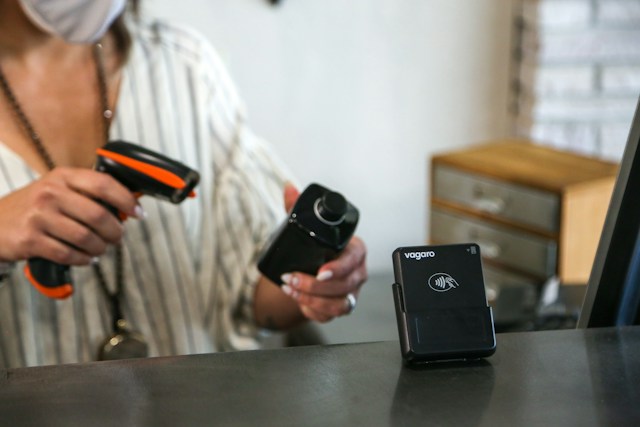
Preparation for retailers is a lot less rushed and should start with an internal audit to check every scanner and till against 2D compatibility, flagging anything still limited to 1D. This audit will show you which areas need simple upgrades and which may require complete replacement of systems. Luckily, GS1 partners have spent years building compatible print and scan technology for this transition, so there are plenty of options already available out there.
How do 2D codes differ from 1D codes?
A traditional 1D barcode holds a product number, but not much else. Meanwhile, a GS1 DataMatrix or QR code can carry that same identifier plus various other information, such as a batch number, expiry date, serial number, etc., all inside a symbol smaller than the barcode it’s replacing. So, not only is it storing more data about the product, but also saving valuable space on the packaging.
However, that’s not the only reason for this initiative – GS1 US research surveying 400 organisations found that switching to 2D barcode readers could cut operational costs by more than 60% in warehouse and distribution settings, worth upwards of $500,000 a year per site. This is largely because 1D barcodes fail on their first scan roughly 7% of the time, forcing manual re-entry or relabelling further down the line. If you multiply that failure rate across a distribution centre scanning tens of thousands of units a day, it really adds up fast. 2D codes, on the other hand, are much more resistant to smudging or tearing, thanks to the built-in error correction algorithms in the DataMatrix symbols.
The reason why the co-existence period (1D and 2D barcodes sitting side by side) is so important is due to the different data validation process. Because they carry variable information, the 2D barcode readers need to validate that data in real time, instead of simply recognising a static product number like 1D barcode scanners. That’s a much more complex technical ask than just swapping a scanner lens.
Where does the RFID technology fit in?
Many people tend to confuse RFID technology as a replacement for 2D barcodes, which is understandable, given that it promises richer data than a barcode ever could. But the two aren’t really competing for the same job: barcodes need a clean line of sight, whereas RFID tags can be read through packaging, at a distance, in bulk and without anyone even pointing a scanner at them directly.
For most supply chains, RFID ends up complementing barcode scanning at pallet or case level, while 2D barcodes handle the item-level work at the checkout till or on the factory floor. Essentially, RFID technology brings the biggest advantages in high-volume scenarios (e.g. a full pallet can be read in seconds, without unpacking it). It saves an incredible amount of time and resources, but it’s not the most cost-effective or sustainable solution at a single-item level. Layering these tools together is how businesses create a truly strong and efficient supply chain strategy.
When is the right time to start preparing?
Knowing that GS1 Sunrise 2027 will start slowly and we’ll likely have both, 1D and 2D barcodes, on our packaging for years to come, many retail businesses are wondering when is the right time to start preparing.
While yes, your scanners don’t need to be replaced overnight, it’s certainly something to add into the pipeline sooner rather than later. Start with an internal audit, which will help you understand the scope of upgrades needed down the line.
However, for businesses that print their own labels, the story is very different. You will be expected to start printing dual barcodes by the end of 2027, which means your deadline is fast approaching.