
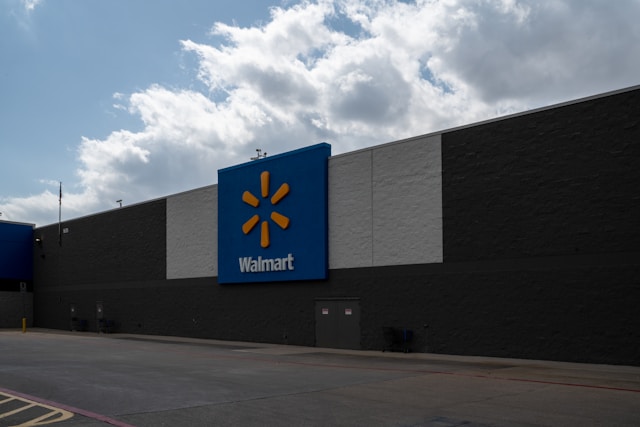
Walmart’s business strategy in 2026 is no longer centered only on selling more merchandise through more stores. The company is using its enormous physical retail base, digital platforms, supply chain and customer traffic to build a broader technology-powered omnichannel ecosystem.

Walmart defines its strategy around making life easier for busy families, operating with discipline, becoming more digital and making trust a competitive advantage. Price leadership remains foundational through Everyday Low Price and Everyday Low Cost, but the strategic model increasingly combines retail with eCommerce, membership, advertising, marketplace, fulfillment and financial services.
The company’s financial framework is explicitly organized around three priorities: Growth, Margin and Returns. Growth comes from omnichannel engagement; margin improvement comes from productivity and business mix; and returns come from disciplined capital deployment.

Five strategic pillars define Walmart’s business strategy in 2026.
Walmart Business Model 2026: How Does Walmart Make Money?
1. Build an Integrated Omnichannel Retail Ecosystem
The first pillar is to make physical stores and eCommerce function as one integrated retail system.

Walmart serves approximately 280 million customers every week through more than 10,900 stores in 19 countries, alongside its websites and mobile applications.
Rather than treating stores as a legacy asset, Walmart is turning them into a competitive advantage for digital retail.
Customers can access pickup or delivery from more than 8,400 locations globally. Walmart continues to invest in eCommerce, supply-chain capabilities and technologies such as AI, while combining stores, apps, websites and services into one ecosystem.
This is strategically important because physical stores can simultaneously function as:
- retail destinations,
- inventory locations,
- pickup points,
- local fulfillment hubs,
- last-mile delivery nodes.
The strategy is already affecting growth. Walmart U.S. comparable sales increased 4.3% in fiscal 2026, while eCommerce contributed approximately 4.3 percentage points to comparable sales growth. Store-fulfilled pickup and delivery were major drivers.
The objective is therefore not simply:
grow stores + grow eCommerce.
It is:
use stores to make eCommerce stronger and use digital engagement to make stores more productive.
2. Preserve Price Leadership Through EDLP and EDLC
Walmart’s second pillar remains its historic competitive advantage: price.
The company continues to anchor its retail model around Everyday Low Price (EDLP) and Everyday Low Cost (EDLC).
EDLP aims to give customers confidence that Walmart offers consistently low prices without depending heavily on temporary promotions. EDLC focuses on controlling costs so operational savings can be passed on to customers.
This creates a reinforcing economic cycle:
lower costs → lower prices → more customer traffic → higher purchasing volumes → stronger supplier economics → additional cost advantages.
Scale is particularly important. Walmart’s enormous merchandise volumes allow it to establish supplier relationships designed around volume, certainty and cost effectiveness.
But the 2026 strategy adds technology and automation to this traditional model.
Walmart is investing in technology and process improvements to improve productivity, manage inventory and reduce costs.
This means EDLC increasingly depends on:
automation + AI + inventory productivity + supply-chain efficiency, not only traditional purchasing power.
Price leadership therefore remains the foundation, while technology becomes one of the mechanisms that helps sustain it.
3. Shift the Business Mix Toward Higher-Margin Revenue
The third pillar is perhaps the most important economic evolution in Walmart’s strategy.
Walmart wants to grow operating income faster than sales by expanding businesses with better margins than traditional retail.
Management explicitly states that its margin strategy includes expanding the ecosystem into higher-margin businesses such as digital advertising. Its goal is operating-income leverage—growing operating income faster than net sales.
This is significant because Walmart’s traditional retail economics remain thin. Fiscal 2026 net sales were $706.4 billion, but operating income was $29.8 billion, representing an operating margin of about 4.2%.
The company is therefore building businesses around retail traffic that potentially require less merchandise ownership and generate stronger economics.
These include:
Advertising: Walmart’s global advertising business grew 46% in fiscal 2026. Advertising monetizes customer traffic and purchase intent without Walmart having to sell another physical unit.
Marketplace: Third-party sellers expand assortment while also creating demand for advertising and fulfillment services.
Fulfillment: Walmart can provide logistics and supply-chain capabilities to marketplace sellers.
Membership: Walmart+ and Sam’s Club produce recurring fee revenue while strengthening customer loyalty.
Data and insights: Walmart provides analytics and insights to suppliers and brands.
Walmart U.S. explicitly offers advertising, marketplace seller fulfillment and data analytics alongside traditional merchandise.
The strategic logic is:
low-margin retail creates traffic → traffic creates high-margin monetization opportunities.
4. Use AI, Automation and Technology to Improve Both Growth and Productivity
The fourth pillar is technology.
Walmart describes itself as a people-led, technology-powered omnichannel retailer, and its 2026 Annual Report repeatedly emphasizes AI as an important part of how the business is evolving.
Its strategy increasingly uses AI-powered tools across:
- customer-facing experiences,
- search and discovery,
- associate productivity,
- operations,
- supply-chain efficiency.
This is strategically broader than simply launching consumer AI features.
AI can potentially affect both sides of Walmart’s economics:
Revenue side: better search, recommendations, personalization and advertising.
Cost side: better inventory management, workforce productivity, automation and fulfillment efficiency.
Walmart has also formalized AI leadership. Daniel Danker became Executive Vice President of AI Acceleration, Product and Design in 2025, while Walmart U.S. CEO David Guggina previously led eCommerce, supply chain, innovation and automation roles.
This organizational structure signals that AI and automation are being incorporated directly into operating leadership rather than treated solely as an IT function.
Walmart is continuing to commit significant capital. For fiscal 2027, the company projects approximately $25 billion to $27 billion of capital expenditure, focused on technology, supply chain and customer-facing initiatives.
5. Build Membership and Customer Loyalty Into the Ecosystem
The fifth pillar is increasing the number and depth of recurring customer relationships.
Walmart’s formal growth priorities include increasing membership at both Sam’s Club U.S. and Walmart+.
Membership provides several strategic benefits.
It generates recurring fee revenue.
It encourages customers to shop more frequently.
It increases digital engagement.
It makes services such as delivery and shipping more attractive.
It creates opportunities to cross-sell other ecosystem products.
At Sam’s Club, membership is fundamental to the business. Club membership costs $50 annually and Plus membership $110, with higher-tier customers receiving additional delivery, shipping and shopping benefits.
Membership and other income at Sam’s Club increased 8.7% in fiscal 2026, primarily because of growth in the membership base and Plus penetration.
Walmart+ is following a similar strategic logic in Walmart U.S., combining delivery, shipping, fuel discounts and other benefits.
The objective is to move the relationship from:
transactional customer
toward:
recurring ecosystem member.
Expand Marketplace, Advertising and Fulfillment Together
One of the strongest aspects of Walmart’s strategy is that these newer businesses reinforce one another.
A third-party seller joins Walmart Marketplace.
That seller adds assortment without Walmart necessarily owning the inventory.
More assortment can attract customers.
The seller may then purchase Walmart advertising to gain visibility.
The seller may use Walmart fulfillment services.
Those transactions generate additional data and insights.
Walmart can then improve recommendations, advertising effectiveness and inventory positioning.
This creates another flywheel:
more sellers → broader assortment → more customer traffic → more advertising demand → more fulfillment demand → better economics → more sellers.
Walmart International explicitly describes advertising, marketplace, fulfillment, financial services and healthcare as mutually reinforcing businesses.
Use Supply Chain as a Competitive Weapon
Supply chain is another central part of Walmart’s strategy.
The company is investing significantly in automation and fulfillment because fast, reliable delivery is becoming as important to competition as price.
Walmart’s store network allows inventory to be positioned close to customers.
That physical proximity can support:
- pickup,
- same-day delivery,
- expedited delivery,
- lower last-mile distances.
Walmart’s planned fiscal 2027 capital spending of $25–$27 billion remains focused substantially on technology, supply chain and customer-facing initiatives.
The strategy is therefore to turn what was historically a supply chain built for stores into a broader omnichannel fulfillment network.
This is particularly important because eCommerce fulfillment can be expensive. Sam’s Club reported that higher eCommerce fulfillment costs partly offset improvements in gross margin in fiscal 2026.
Walmart must therefore grow digital convenience while continuously lowering the cost of delivering it.
Pursue Selective International Growth
Walmart International follows a more selective strategy rather than pursuing geographic expansion everywhere.
The company says it is deliberate about where and how it chooses to operate to create sustainable and profitable long-term growth.
International net sales reached $130.4 billion in fiscal 2026, up from $121.9 billion in fiscal 2025.
The international portfolio combines physical retail with digital platforms and businesses such as:
- Flipkart,
- PhonePe,
- international marketplaces,
- advertising,
- fulfillment,
- financial services.
Walmart has substantial stakes in its Indian digital ecosystem. Its ownership of Flipkart was approximately 85%, while its ownership of PhonePe was approximately 73% at January 31, 2026.
This gives Walmart different avenues for participating in international growth rather than relying only on conventional stores.
Improve Returns Through Disciplined Capital Allocation
Walmart’s strategy explicitly includes returns as one of its three financial priorities.
The company wants to improve return on investment through margin improvement and disciplined capital spending.
Capital expenditure reached $26.6 billion in fiscal 2026, compared with $23.8 billion in fiscal 2025 and $20.6 billion in fiscal 2024.
Most of the spending is concentrated in Walmart U.S., where $20.2 billion was invested in fiscal 2026.
But Walmart’s capital strategy is not simply “spend more.”
The objective is to deploy money toward capabilities that reinforce multiple businesses simultaneously.
For example, an automated fulfillment investment may support:
stores + eCommerce + marketplace + delivery + advertising growth.
This creates better potential returns than investments serving only a single channel.
Financial Evidence Behind the Strategy
Walmart’s fiscal 2026 results show continued top-line growth, although margin expansion remains a work in progress.
Revenue reached $713.2 billion, up 4.7%.
Net sales reached $706.4 billion, also up 4.7%.
Gross margin improved slightly to 24.2% from 24.1%.
Operating income reached $29.8 billion, compared with $29.3 billion.
However, operating margin decreased from 4.4% to 4.2%, partly because operating expenses increased faster than sales.
This is an important strategic tension.
Walmart is investing aggressively in technology, fulfillment, wages, stores and automation today while simultaneously trying to create operating leverage over time.
The strategy therefore depends not just on generating growth, but on eventually turning investments into better productivity and a more profitable revenue mix.
Walmart’s Core Strategic Flywheel
Walmart’s 2026 strategy can be summarized as:
EDLC lowers costs → EDLP strengthens price leadership → low prices attract more customers → greater traffic increases store and digital volume → omnichannel convenience deepens engagement → membership builds loyalty → marketplace expands assortment → advertising and fulfillment monetize traffic → AI and automation improve productivity → higher margins and cash generation fund further investment.
This is increasingly different from Walmart’s historic model.
The old model depended primarily on:
scale → purchasing power → low prices → volume.
The new model adds:
digital engagement → ecosystem monetization → AI → higher-margin services.
Strategic Risks and Trade-Offs
The strategy is attractive, but execution is demanding.
Walmart itself warns that its investments in eCommerce, technology, AI, supply-chain automation, advertising, acquisitions and omnichannel initiatives may not produce expected returns.
There are several inherent trade-offs.
Fast delivery improves convenience but increases fulfillment costs.
Large technology investments can reduce short-term profitability.
Marketplace expansion increases assortment but also increases platform complexity.
AI can increase productivity but requires investment and careful execution.
Membership benefits can deepen loyalty but also carry delivery and service costs.
Higher-margin businesses must grow fast enough to materially change Walmart’s overall economics given the enormous scale of its low-margin retail base.
This last point is particularly important. A rapidly growing advertising business can improve margins, but it remains small compared with over $700 billion in annual company revenue.
Conclusion
Walmart’s business strategy in 2026 can be understood through five core pillars:
- Build a seamless omnichannel ecosystem around stores and eCommerce.
- Maintain price leadership through EDLP and EDLC.
- Shift the revenue mix toward higher-margin advertising, marketplace, fulfillment and membership businesses.
- Use AI, automation and technology to improve customer experience and productivity.
- Deepen recurring customer relationships through Walmart+ and Sam’s Club while expanding selectively internationally.
The central strategic transformation is from a retailer that uses technology to a technology-powered retail ecosystem that monetizes customer traffic in multiple ways.
Walmart’s traditional merchandise business creates unparalleled scale. The strategic challenge is now to use that scale to build more profitable businesses around it.
In simple terms:
use retail to generate traffic → use omnichannel convenience to deepen engagement → use membership to increase loyalty → use marketplace to broaden assortment → use advertising and fulfillment to increase margins → use AI and automation to lower costs → reinvest the resulting economics into price and convenience.
That is the core of Walmart’s business strategy in 2026.
Source: Walmart annual report