Bajaj Finserv is one of India’s largest diversified financial services groups, offering products across lending, housing finance, insurance, investments, wealth management, healthcare, stockbroking, and digital financial platforms. Rather than operating as a standalone financial institution, the company has built an integrated ecosystem that aims to become the Financial Lifecycle Partner for individuals and businesses throughout their financial journey.
During FY2024-25, Bajaj Finserv served more than 308 million customers, offered over 750 financial products, operated across 4,200+ locations, and reported consolidated total income of Rs. 133,822 crore with profit after tax of Rs. 8,872 crore. The company’s diversified business model and strong digital capabilities continue to strengthen its position in India’s rapidly growing financial services market.
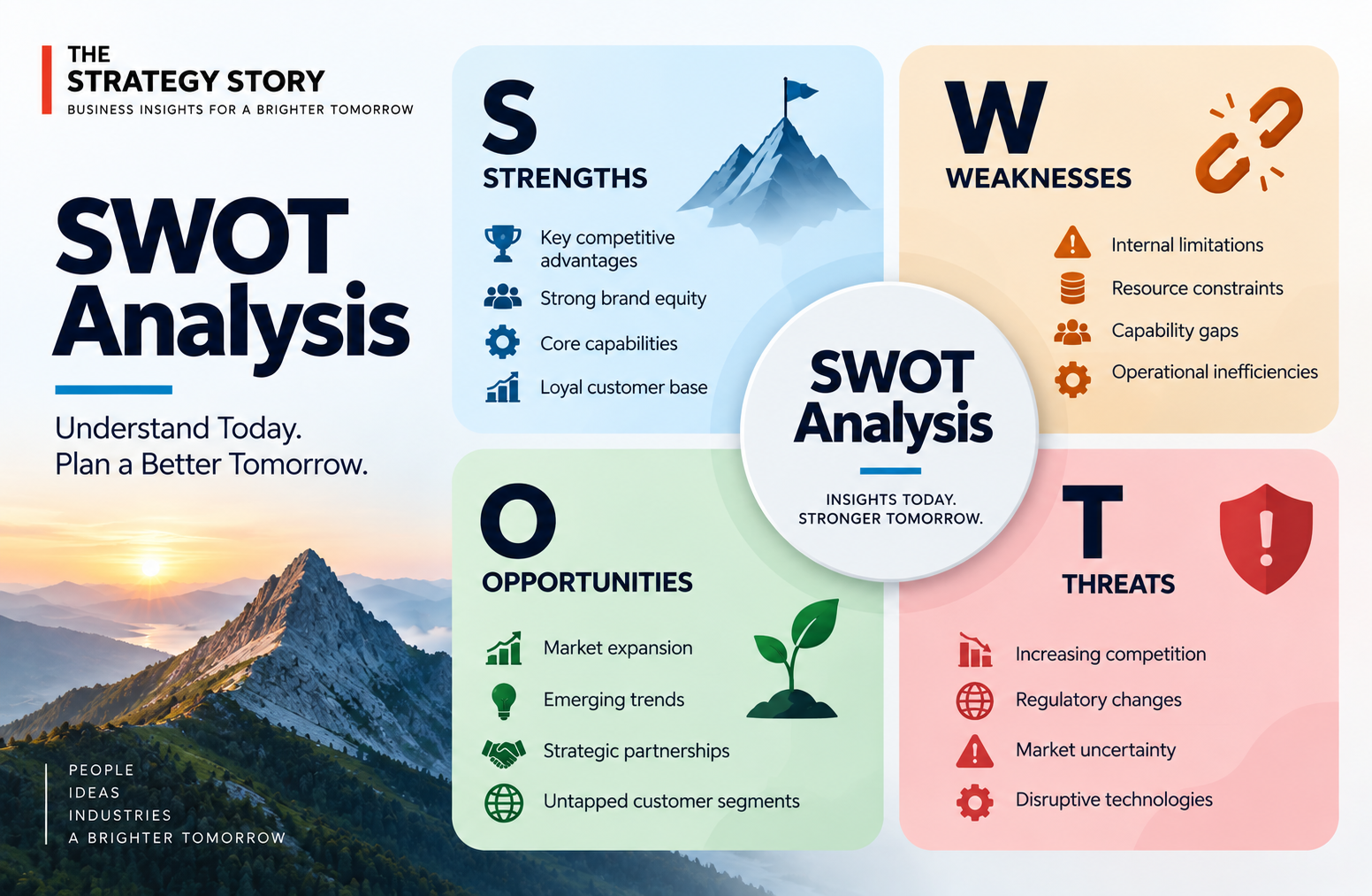
The following SWOT analysis is based on Bajaj Finserv’s FY2024-25 Annual Report.
Bajaj Finserv Business Model in 2026: How Does Bajaj Finserv Make Money?
Strengths
1. Diversified Financial Services Ecosystem
Bajaj Finserv operates across lending, housing finance, insurance, asset management, healthcare, stockbroking, and digital financial services. This diversified portfolio reduces dependence on a single business while enabling multiple sources of revenue growth.
2. Strong Customer Base
The company serves more than 308 million customers through an integrated ecosystem of financial products and services. This large customer base creates significant opportunities for cross-selling and long-term customer retention.
3. Market-Leading Lending Business
Through Bajaj Finance, the group has built one of India’s leading NBFCs with assets under management (AUM) of Rs. 416,661 crore and 43.42 million new loans booked during FY2024-25. This provides a strong foundation for earnings and future expansion.
4. Strong Digital and Technology Capabilities
The company continues investing in artificial intelligence, digital platforms, automation, analytics, and customer experience. These capabilities improve operational efficiency, underwriting, customer engagement, and ecosystem integration across businesses.
5. Well-Recognised Brand and Governance
Backed by the Bajaj Group, Bajaj Finserv benefits from strong brand recognition, disciplined capital allocation, robust corporate governance, and prudent risk management, strengthening customer trust and long-term financial stability.
Bajaj Finserv Business Strategy in 2026
Weaknesses
1. High Dependence on Lending Business
Although Bajaj Finserv has diversified operations, a significant portion of the group’s earnings continues to come from Bajaj Finance, making overall financial performance sensitive to credit demand and loan quality.
2. Exposure to Credit Risk
The lending business is exposed to borrower defaults, changing interest rates, and economic slowdowns, which may affect asset quality and profitability.
3. Highly Regulated Industry
The company operates across multiple regulated sectors including NBFCs, insurance, housing finance, mutual funds, and securities, increasing compliance requirements and operational complexity.
4. Continuous Technology Investment
Maintaining leadership in digital financial services requires continuous investment in technology infrastructure, cybersecurity, artificial intelligence, and digital platforms.
5. Complex Multi-Business Operations
Managing multiple subsidiaries across lending, insurance, healthcare, wealth management, and digital services requires effective coordination, governance, and execution across the entire ecosystem.
Bajaj Finserv PESTEL Analysis in 2026
Opportunities
1. Growing Financial Inclusion
India’s increasing financial inclusion, rising incomes, and expanding middle class create long-term opportunities across lending, insurance, investments, and wealth management.
2. Rising Insurance Penetration
Growing awareness of life and health insurance provides significant expansion opportunities for Bajaj Allianz General Insurance and Bajaj Allianz Life Insurance.
3. Expansion of Digital Financial Services
Rapid adoption of digital financial platforms creates opportunities to expand AI-enabled customer experiences, digital marketplaces, wealth management, and online financial services.
4. Growth in Asset and Wealth Management
Increasing household savings and investment participation create favourable conditions for expanding mutual funds, investment advisory, retirement solutions, and wealth management businesses.
5. Cross-Selling Within the Ecosystem
With over 308 million customers, Bajaj Finserv can deepen relationships by offering multiple financial products across lending, insurance, investments, healthcare, and wealth management, increasing customer lifetime value.
Threats
1. Intense Competition
Bajaj Finserv competes with banks, NBFCs, insurance companies, fintech firms, wealth management platforms, and digital-first financial service providers across nearly every business segment.
2. Regulatory Changes
Changes in RBI, IRDAI, SEBI, and other financial regulations could affect lending practices, capital requirements, product offerings, and overall business operations.
3. Economic Slowdowns
A weaker economic environment may reduce credit demand, increase loan defaults, lower investment activity, and affect insurance premium growth.
4. Cybersecurity Risks
As financial services become increasingly digital, cyberattacks, fraud, data breaches, and technology disruptions remain significant operational and reputational risks.
5. Rapid Technological Change
Advances in artificial intelligence, digital banking, embedded finance, and fintech innovation require continuous investment to maintain competitiveness and deliver evolving customer expectations.
Source: Bajaj Finserv Annual Report