
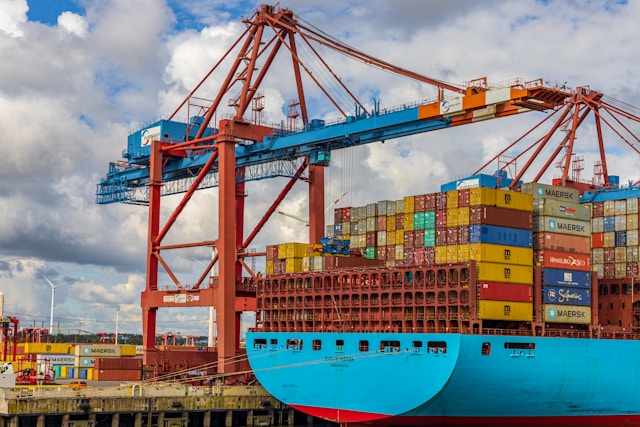
A product listed at a 30% margin often lands at 20% by the time it reaches the warehouse. Logistics eats the difference, the most underrated line in an e-commerce seller’s cost of goods. The scale is vast: logistics absorbs 8 to 10% of global GDP, and the freight forwarding market is on track to grow from $185 billion in 2025 to $260 billion by 2032, a CAGR near 5%, per Coherent Market Insights.
The leak starts with how sellers buy freight: one static quote from one forwarder on a market that reprices almost weekly. The auction model changes the price mechanics themselves. This piece breaks down where margin leaks, how a reverse auction works on marketplaces like Aideliv, and what it takes to win the auction.
Where Your Margins Actually Leak
Shipping’s hidden costs surface between order confirmation and customs clearance. Freight cost optimization starts with naming them:
- Forwarder markup. On the spot market it usually runs 15 to 30% and climbs higher when capacity tightens.
- Short quote windows. A static rate is good for only 3 to 7 days, expiring before the seller can finalize the shipment.
- DDU surprises. Under DDU terms, duties and customs fees hit the seller at clearance, not in the quote.
- Dimensional weight. Pricing by dimensional weight penalizes light, bulky freight, the typical e-commerce SKU.
- Peak-season surcharges. Carriers reset peak-season surcharges almost weekly in 2026.
2026 volatility amplifies every one of these. By June, spot rates from China to the US West Coast had jumped to roughly $4,500 per FEU, up 15% in a month, with the East Coast at $6,000, up 19%, and peak-season surcharges adding $500 to $2,000 per box. Tariff uncertainty piles on. The $800 de minimis threshold was removed, first for China-origin goods and then worldwide, while Section 301 adds up to 25% across most categories. A quote from last week is already wrong at booking.
How the Digital Freight Auction Works
A digital freight auction flips the procurement mechanics. The seller posts cargo details once, and vetted carriers participating in the marketplace submit bids inside a fixed window, each lower than the last, against one DDP scope. The price falls in real time, and the seller takes any bid before the window closes: price discovery in its purest form. In this reverse auction process, competition among carriers replaces a forwarder’s opaque number with a market rate.
Digital freight matching is already reshaping the market’s competitive landscape, trimming the empty miles that run 15 to 25% of trucking capacity. The platform stays a technology intermediary: it matches seller demand with carrier bids, but it does not move cargo, broker it, or act as a forwarder. The carrier that wins the auction is the one that performs the transportation. Carrier vetting and the auction engine are the platform’s proprietary mechanics, Patent Pending.
For a small seller, that means market-driven rates once reserved for large accounts. By AiDeliv’s internal data, auction bids come in 15 to 40% lower, and the average China to US DDP holds near $0.65 per kg. AiDeliv is one example of the SME-focused reverse-auction segment, not a special case.
Here is how the two procurement models look from a seller’s margin perspective:
| What the seller sees | Traditional forwarder procurement | Reverse auction marketplace |
| How price forms | One static quote, markup logic hidden | Live price discovery: bids visible, falling in the window |
| Rate shelf life | 3 to 7 days, stale before shipping | Auction window closes in hours |
| Markup in the price | 15 to 30% base plus hidden fees | Carrier competition drives margin down |
| Duties and landed cost | Often DDU, a surprise at clearance | One DDP figure: freight, duties, clearance, last mile |
| Access for small volume | Large volumes served first | Demand aggregation delivers a volume rate without the volume |
| Amazon FBA and documents | Manual coordination through middlemen | Direct-to-FBA routing and auto-generated documents |
Industry analysts increasingly call this volatility the new normal, not a run of exceptions:
“Since 2019, supply chains and logistics seem to have endured one black swan event after another. These disruptions may be less black swans and more the new normal,” Freightos Head of Research Judah Levine wrote in January 2025.
The market’s answer is transparent, real-time pricing: index linking is replacing static contracts with dynamic rates, and the auction rebuilds that price for every shipment.
DDP: Turning Freight Into a Predictable Landed Cost
DDP (Delivered Duty Paid) turns freight into a predictable landed cost. One figure locks in rate, duties, clearance, and last mile, so the seller knows true cost of goods before booking, not after clearance. This is landed cost optimization: when tariffs move, and in 2026 they do, a pre-locked all-in never becomes an unplanned bill.
Landed cost accuracy comes down to classification. The right HS code removes the risk of customs penalties, a painful line for US importers: a coding error costs about 20% on top of the duty, and up to 40% or more for negligence. Automated code checks in the auction interface clear that risk before shipping, and fees like MPF and HMF already sit inside the final DDP figure.
Built for E-commerce: Amazon FBA and DTC
For e-commerce, the bid price and what happens to the cargo at the finish line matter equally. Specialized Amazon FBA handling, from prep and labeling to direct-to-FBA or warehouse routing, removes the manual coordination between freight and fulfillment. Demand aggregation pools many small sellers into the volume of a large shipper, so a small DTC brand earns an enterprise rate without enterprise volume. Where margin is counted in cents per unit, freight spend management becomes as much of a lever as the product’s purchase price.
Reading the Auction: How to Pick a Winning Bid
A winning bid rarely equals the lowest price. The auction interface shows each carrier’s track record: route history, customs performance, damage rates. That is a built-in carrier management system, and its AI vetting screens out anyone likely to miss deadlines or stall at clearance.
From there, the seller weighs transit time against price. A $200 saving means nothing if it adds a week to an FBA restock before peak. Live bid visibility and auto-generated documents cut the manual quote-chasing and reduce freight costs systematically through a competitive process on every shipment.
Margin Is a Procurement Decision
Protecting margin is a procurement decision. In a volatile 2026, where spot rates swing tens of percent in a quarter and tariffs shift by court ruling, a single forwarder’s static quote bets the market will sit still. The smarter move is to run every shipment through the auction, benchmark it against live market-driven rates, and treat freight as a cost lever you control rather than a fixed tax on sales.