
Maruti Suzuki India Limited (MSIL) is India’s largest passenger vehicle manufacturer and the country’s leading exporter of passenger vehicles. Since its establishment in 1981, the company has transformed India’s automobile industry through affordable mobility, an extensive product portfolio, industry-leading manufacturing capabilities, and the country’s largest sales and service network. During FY2024-25, Maruti Suzuki became the first passenger vehicle manufacturer in India to produce over 2 million vehicles in a single financial year, while recording its highest-ever annual sales of 2.23 million vehicles.
The company’s long-term strategy revolves around expanding exports, increasing manufacturing capacity, embracing multiple green mobility technologies, strengthening engineering capabilities, and improving customer ownership experience. Backed by Suzuki Motor Corporation’s technology and global expertise, Maruti Suzuki continues to strengthen its leadership position while preparing for India’s transition towards cleaner and smarter mobility.
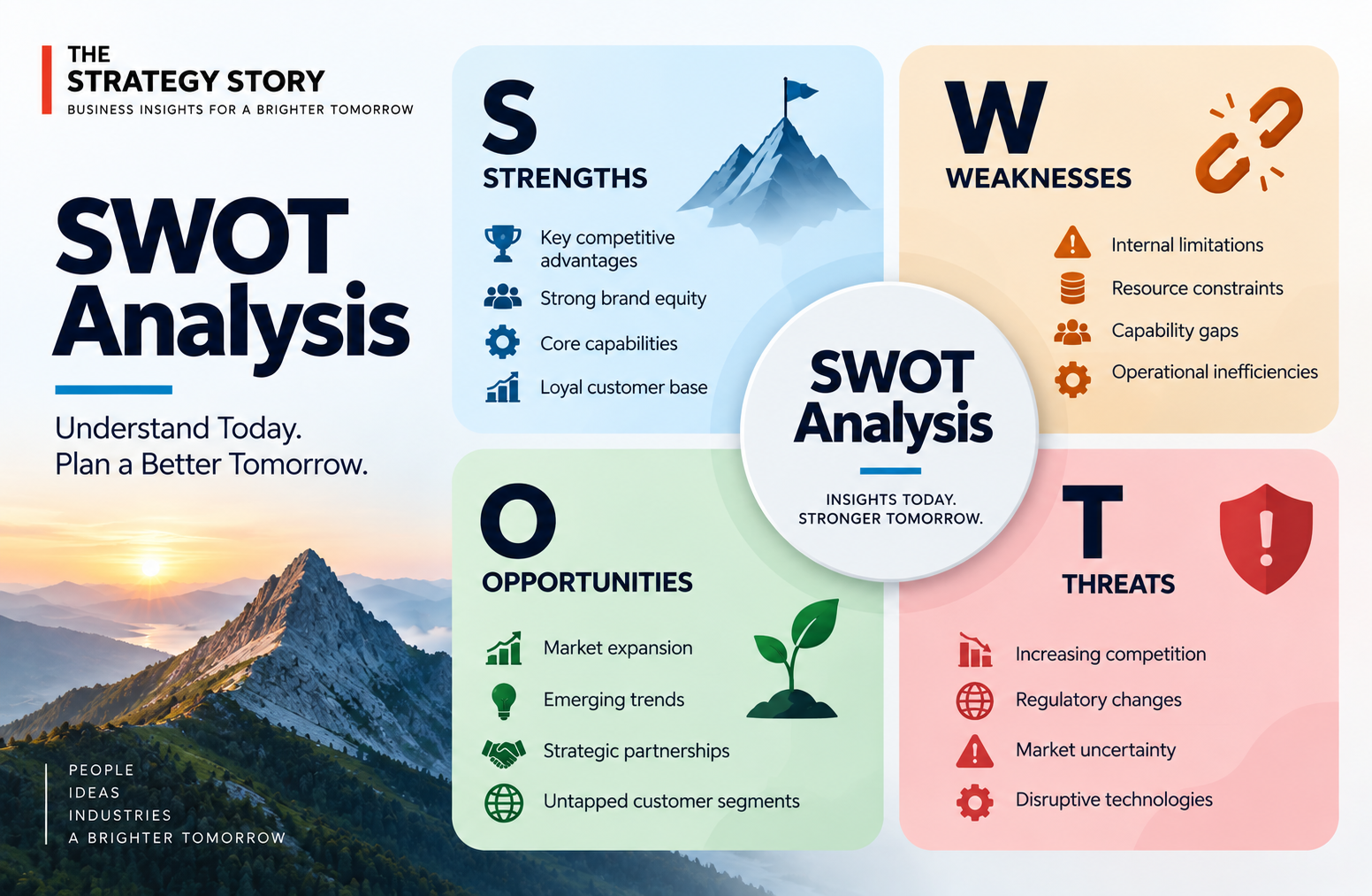
Despite these strengths, the company operates in an industry characterised by intense competition, changing regulations, evolving customer preferences, technological disruption, and macroeconomic uncertainties. A SWOT analysis helps evaluate Maruti Suzuki’s strategic position and future growth prospects.
Maruti Suzuki Business Model in 2026: How India’s Largest Carmaker Makes Money
Strengths
1. Market Leadership in India
Maruti Suzuki is India’s largest passenger vehicle manufacturer with the country’s highest production volumes, strongest brand recognition, and industry-leading market presence. During FY2024-25, it became the first passenger vehicle manufacturer in India to cross 2 million units of annual production.
2. Extensive Manufacturing and Distribution Network
The company operates four manufacturing facilities with annual production capacity of approximately 2.6 million vehicles, supported by over 4,235 sales outlets and 5,424 service touchpoints, providing unmatched nationwide reach.
3. Diversified Product Portfolio
Maruti Suzuki offers one of India’s broadest passenger vehicle portfolios, covering hatchbacks, sedans, SUVs, MPVs, vans, commercial vehicles, and premium vehicles through Arena and NEXA retail channels. It also provides multiple powertrain technologies including petrol, CNG, hybrid, and battery electric vehicles.
4. Strong Export Business
The company exports vehicles to nearly 100 countries and remained India’s largest exporter of passenger vehicles during FY2024-25, with exports growing to 332,585 vehicles, reducing dependence on domestic demand.
5. Strong Parent Support and Engineering Capabilities
Maruti Suzuki benefits from Suzuki Motor Corporation’s technology, product development expertise, and global manufacturing experience. Supported by 2,844 R&D engineers and an expanding patent portfolio, the company continues strengthening its innovation capabilities.
Maruti Suzuki Business Strategy in 2026
Weaknesses
1. Dependence on the Indian Market
Although exports are growing rapidly, the majority of Maruti Suzuki’s revenue continues to come from India, making performance sensitive to domestic consumer demand and economic conditions.
2. Pressure on the Small Car Segment
Management highlights that rising safety and emission regulations have increased vehicle prices, reducing affordability and slowing growth in India’s entry-level small car market, which has traditionally been Maruti Suzuki’s core strength.
3. Capital-Intensive Manufacturing
Continuous investments in production capacity, technology upgrades, green mobility, and manufacturing facilities require significant capital expenditure and long-term financial commitments.
4. Dependence on Supply Chain Stability
The company remains exposed to supply chain disruptions, including shortages of critical components and rare earth materials, which can affect production schedules and costs.
5. Transition Towards New Technologies
Managing multiple powertrain technologies simultaneously—including petrol, CNG, hybrid, ethanol, flex-fuel, and electric vehicles—increases operational complexity and requires continuous investment in product development and manufacturing capabilities.
Maruti Suzuki PESTEL Analysis in 2026
Opportunities
1. Low Car Penetration in India
India’s car ownership remains relatively low at approximately 34 cars per thousand people, providing significant long-term growth potential as incomes rise and personal mobility demand increases.
2. Growing Export Markets
The company plans to expand exports further by entering new international markets, including Europe, strengthening its position as India’s largest passenger vehicle exporter.
3. Green Mobility Transition
Increasing adoption of battery electric vehicles, strong hybrids, CNG, ethanol-compatible vehicles, and flex-fuel technologies provides long-term growth opportunities as India transitions towards cleaner transportation.
4. Manufacturing Capacity Expansion
The ongoing expansion towards 4 million units of annual production capacity by FY2030-31 provides significant scope for future volume growth across domestic and export markets.
5. Digitalisation and Connected Mobility
Investments in connected vehicles, Artificial Intelligence, engineering capabilities, manufacturing automation, and digital customer services create opportunities to improve operational efficiency and enhance customer experience.
Threats
1. Increasing Competition
Maruti Suzuki faces intense competition from domestic and international automobile manufacturers across hatchbacks, SUVs, electric vehicles, and premium passenger vehicle segments.
2. Regulatory Changes
Stricter emission standards, safety regulations, taxation policies, and environmental norms may increase manufacturing costs and vehicle prices, potentially affecting affordability and demand.
3. Supply Chain Risks
The company identifies uncertainties related to global supply chains, semiconductor availability, and rare earth material exports as potential risks that may impact production continuity.
4. Economic Slowdown
Weak consumer sentiment, slower economic growth, inflation, or higher financing costs could delay vehicle purchases and reduce demand in the passenger vehicle market.
5. Rapid Technological Change
The global automotive industry is undergoing rapid transformation through electrification, connected mobility, autonomous technologies, and software-defined vehicles. Failure to adapt quickly could affect long-term competitiveness, requiring continuous investment in innovation and technology development.