
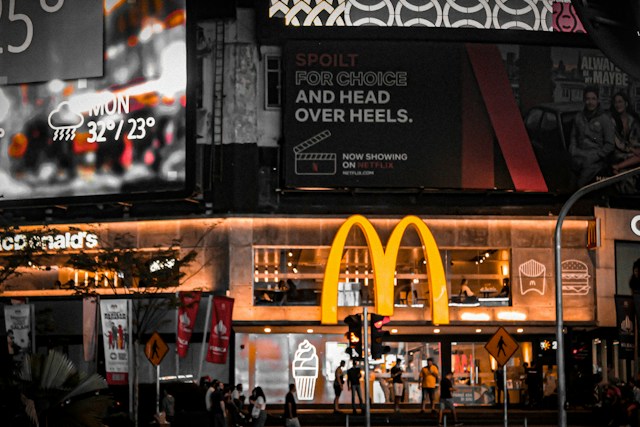
McDonald’s 2025 Annual Report shows a business combining enormous global scale with a predominantly franchised operating model. At year-end 2025, the company had 45,356 restaurants across more than 100 countries, approximately 95% of which were franchised. Systemwide sales exceeded $139 billion, while consolidated revenue reached $26.9 billion. The company is simultaneously expanding restaurants, strengthening digital loyalty, improving its core menu and modernizing its technology infrastructure.

The same scale creates significant execution requirements. McDonald’s operates through a system of the company, franchisees and suppliers and faces changing consumer preferences, intense competition, supply-chain risks, regulation, technology risks and macroeconomic uncertainty. The following SWOT analysis is based solely on the opportunities, capabilities and risks described in McDonald’s 2025 Annual Report.
McDonald’s Business Model (2026) | How McDonald’s Makes Money

Strengths
1. Global scale and a highly recognized brand
McDonald’s operates in more than 100 countries and generated more than $139 billion in Systemwide sales in 2025. Its global footprint allows the company to deploy marketing, menu and technology initiatives across a very large restaurant network. Management also highlights the strength and cultural relevance of the McDonald’s brand as a central competitive advantage.
2. Predominantly franchised business model
Approximately 95% of McDonald’s 45,356 restaurants were franchised at year-end 2025. The company considers franchising paramount to delivering locally relevant customer experiences and profitability. Franchisees provide entrepreneurial expertise and manage day-to-day operations, while benefiting from McDonald’s global brand, operating system and financial resources.
3. Strong financial performance and cash generation
McDonald’s reported 2025 consolidated revenue of $26.9 billion, operating income of $12.4 billion and a 46.1% operating margin. Cash provided by operations reached $10.6 billion and free cash flow was $7.2 billion. This financial capacity supports restaurant development, technology investment, menu initiatives and shareholder returns.

4. Large and growing digital loyalty ecosystem
McDonald’s ended 2025 with nearly 210 million 90-day active loyalty users across 70 markets. Systemwide sales to loyalty members reached nearly $37 billion, up 20%. Loyalty members visit more frequently, giving McDonald’s an expanding first-party customer relationship that can support personalization, value offers and more frequent engagement.
5. Proven core menu combined with global operating capabilities
McDonald’s strategy remains anchored in iconic products including World Famous Fries, Big Mac, Quarter Pounder and Chicken McNuggets. At the same time, dedicated beef, chicken and beverage teams combine menu, operations and supply-chain capabilities. This allows McDonald’s to improve established products and scale innovations through its global System.
McDonald’s Business Strategy (2026)
Weaknesses
1. Dependence on franchisee financial health and alignment
The heavily franchised model also creates dependence. McDonald’s states that its success relies significantly on franchisees’ financial success, cooperation and willingness to implement major initiatives. Franchisee access to financing, restaurant-level economics or disagreement around operating, promotional and capital-intensive programs can affect the company’s growth and results.
2. Complex execution across a very large global System
McDonald’s strategy requires coordination among corporate teams, franchisees, suppliers and restaurant crews across more than 100 countries. Technology deployments, menu changes, development and customer-experience initiatives must work at restaurant level. The company acknowledges that failure to execute significant investments successfully can prevent it from realizing intended benefits.
3. Exposure to customer affordability pressures
The Annual Report describes persistent inflationary pressure, tighter labor markets, trade dynamics and economic uncertainty that affected consumer sentiment, particularly among lower-income households. McDonald’s must preserve value perception while also supporting franchisee profitability, creating a continuing tension between affordability, pricing and restaurant economics.
4. Reliance on technology and digital infrastructure
Digital ordering, loyalty, delivery and technology-enabled restaurant operations are increasingly central to the strategy. This increases exposure to system failures, cybersecurity threats, data privacy requirements, technology implementation risks and dependence on third-party providers. Greater digitization therefore expands both capability and operational vulnerability.
5. Company performance depends on maintaining consistent brand standards
McDonald’s independent franchisees control many day-to-day employment, pricing, marketing and operational decisions. The business relationship depends on adherence to standards and policies, including Global Brand Standards. Operational, food-safety, people or reputational failures at individual restaurants can affect perceptions of the broader McDonald’s brand.
McDonald’s PESTEL Analysis (2026)
Opportunities
1. Accelerated restaurant development toward 50,000 locations
McDonald’s opened nearly 2,300 restaurants on a gross basis in 2025 and continues to target 50,000 restaurants globally by the end of 2027. Management describes this as potentially the fastest period of restaurant unit growth in company history. More locations can expand customer access and add Systemwide sales alongside comparable-sales growth.
2. Further expansion of digital loyalty
With nearly 210 million 90-day active loyalty users at year-end 2025, McDonald’s is progressing toward 250 million by the end of 2027. A common Global Mobile App, personalized offers and improved digital capabilities can deepen customer engagement and provide more data to improve marketing, value and revenue growth management.
3. Significant growth potential in chicken
McDonald’s describes chicken as one of its largest growth opportunities. The global chicken category is approximately twice the size of beef and growing faster. McCrispy has reached nearly all major markets, and the company is extending chicken platforms while targeting at least one percentage point of additional chicken share by the end of 2026 versus late 2023.
4. More than $100 billion global beverage opportunity
The company sees meaningful headroom in beverages, a global category opportunity exceeding $100 billion. A pilot in more than 500 US restaurants tested iced coffees, refreshers, crafted sodas and other drinks. The results are informing a new McCafé beverage lineup planned for the United States in 2026.
5. AI, cloud and restaurant modernization
McDonald’s is building Consumer, Restaurant and Company platforms. Edge, developed with Google, extends cloud capabilities into restaurants and can support AI and IoT applications designed to increase uptime, improve food quality and simplify crew work. The company is also standardizing data governance through an Enterprise Data, Analytics and AI initiative.
Threats
1. Intense competition across and beyond traditional restaurants
McDonald’s describes the informal eating out segment as highly competitive. Competition includes traditional quick-service and fast-casual restaurants as well as convenience stores, grocery stores, coffee shops and online retailers. Competitors can introduce new products, technologies, pricing or formats that affect traffic, market share and profitability.
2. Rapid changes in consumer preferences and eating behavior
Customer preferences can change quickly in response to health and wellness trends, digital behavior, environmental and social concerns and new consumption patterns. The Annual Report specifically notes evolving scientific and health trends, including weight-loss medications, as factors that could alter consumer behavior and perceptions of available food choices.
3. Supply-chain disruption and input-cost inflation
McDonald’s System depends on a complex global supply chain, and some items have limited suppliers. Shortages, inflation, tariffs, transportation problems, labor issues, technology disruptions, severe weather, natural disasters, geopolitical tensions or conflict can increase costs, affect ingredient quality and availability, and delay restaurant development.
4. Macroeconomic and geopolitical uncertainty
Inflation, interest rates, currency movements, labor-market conditions, trade dynamics and geopolitical tensions can influence customer demand and operating costs. Because McDonald’s operates globally, changes can affect different markets in different ways while also influencing franchisee financing and the company’s reported financial results.
5. Food safety, regulatory, reputational and operational risks
Food safety or quality incidents, regulatory changes, litigation and negative public commentary can damage customer trust. McDonald’s notes that adverse perceptions—whether accurate or not—can harm the brand and financial results. Its scale means incidents involving the company, suppliers or franchisees can receive widespread attention and require rapid response.
Overall, the Annual Report presents a company whose biggest advantages—scale, franchising, brand reach and digital adoption—also require disciplined coordination. McDonald’s opportunity is to use those strengths to expand restaurants, categories and customer relationships while protecting affordability and operational consistency. Its risk profile therefore centers heavily on execution: maintaining alignment across the System while adapting quickly enough to economic, technological and consumer change.
Source: McDonald’s 2025 Annual Report