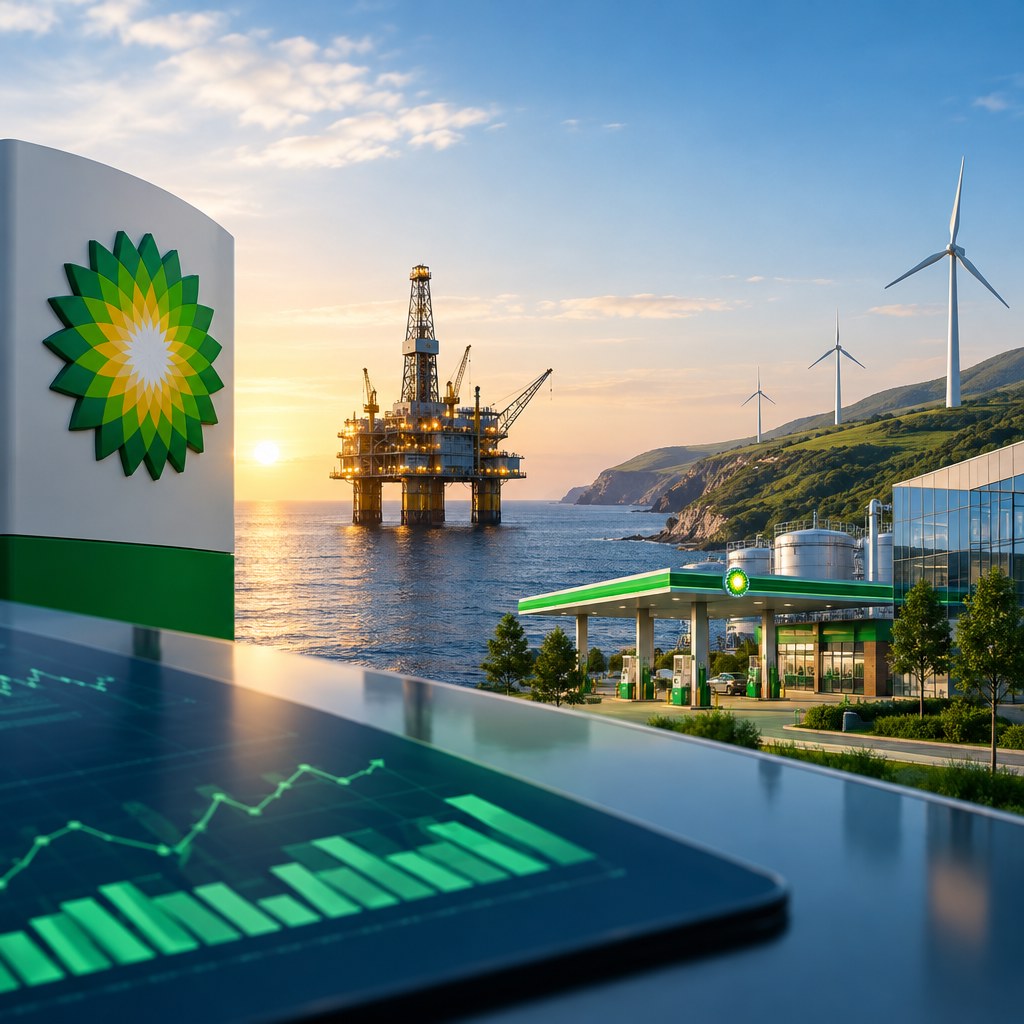
BP’s SWOT analysis in 2026 reflects a company changing its portfolio and management structure while remaining exposed to oil and gas prices. Strengths and weaknesses concern internal resources and execution; opportunities and threats arise from markets, regulation and technology. The analysis distinguishes current conditions from possible outcomes.

1. Business Context and 2026 Financial Position
BP operates across upstream oil and gas, refining, fuels, trading and customer businesses. In H1 2026 it reported underlying replacement cost profit of $8.930 billion, operating cash flow of $13.718 billion and net debt of $22.251 billion at 30 June. These figures illustrate significant cash-generating capacity but also sensitivity to commodity and refining conditions. In April 2026 the company outlined a plan to simplify into upstream and downstream units.
2. Strengths: Integrated Operations and Technical Expertise
Large, diversified physical system
BP can connect oil and gas production, transportation, refining, marketing and trading. This creates opportunities to optimise crude selection, supply logistics and product placement. Its worldwide commercial relationships and infrastructure are difficult for new entrants to replicate.

Upstream capabilities
Deepwater engineering, reservoir management, project execution and exploration experience provide options for future production. Technical skills can improve recovery and reduce unit costs, though they do not guarantee every discovery is commercial.
Customer channels and brands
Fuel retail, lubricants and aviation supply create customer access beyond upstream production. Different earnings streams can partly offset each other across the commodity cycle, although correlations rise during major shocks.
3. Weaknesses: Capital Intensity and Complexity
Upstream projects demand significant upfront investment, often years before cash returns. BP’s integrated operations also require coordination across jurisdictions and asset types. The planned organisational simplification itself carries transition costs and potential disruption. Debt limits flexibility when commodity prices weaken, and asset sales may sacrifice future cash generation. Operating reliability requires continuous maintenance investment; savings that undermine safety would be counterproductive.

4. Opportunities: Portfolio High-Grading
BP can prioritise resources with strong expected returns, reduce overheads and dispose of non-core businesses. A more focused upstream/downstream structure may sharpen accountability and reveal where capital is best deployed. New discoveries, brownfield improvements and operational technology offer routes to higher productivity. Trading, logistics and refinery optimisation can improve margins without necessarily requiring large new assets. Selective lower-carbon activities may remain attractive where customer demand, regulation and returns align.
5. Threats: Price Cycles, Policy and Competition
Oil and gas prices respond to global supply, demand, geopolitical disruptions and producer decisions. Refining margins can also reverse rapidly. Carbon pricing, emissions rules, litigation and environmental obligations increase costs or constrain projects. Competitors with stronger balance sheets may win access to scarce assets or fund projects through downturns. Cybersecurity incidents, spills, accidents and extreme weather can interrupt operations and damage trust.
6. SWOT Matrix and Strategic Implications
| Dimension | Key factors |
|---|---|
| Strengths | Integrated value chain, trading capability, technical expertise, customer access |
| Weaknesses | Capital intensity, organisational complexity, debt, exposure to asset reliability |
| Opportunities | High-grade portfolio, efficiency, attractive discoveries, selective transition investments |
| Threats | Commodity volatility, regulation, accidents, geopolitics, intense competition |
The most important interaction is between BP’s technical strengths and its capital constraints. Developing attractive projects can improve future earnings, but only if the balance sheet and cash flows support the spending. Simplification may help, provided it does not erode operational knowledge or trading synergies.
7. Conclusion
BP’s central challenge is converting a large and technically capable asset base into consistent returns. Strong commodity prices can temporarily obscure weaknesses, while downturns can understate long-term asset value. The strongest evidence of improvement will be sustained cash generation, lower financial risk and reliable operations across cycles.
Related reading: Business Model · Business Strategy · SWOT · PESTEL.
Sources: BP H1 2026 results; BP FY2025 results.